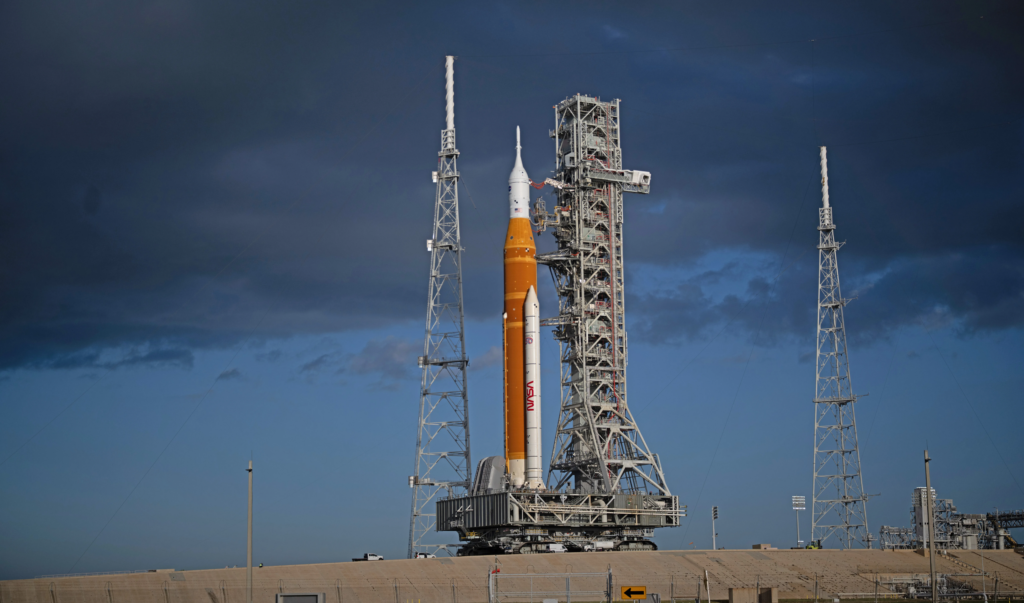
Artemis II Launches, Paving Way for Lunar Base
The Gist
Artemis II successfully launched, sending four astronauts on a 10-day lunar flyby mission to test Orion's capabilities and prepare for future lunar missions.
Explain Like I'm Five
"Imagine we're sending a car (Orion) around the block (the Moon) to make sure it works before driving across the country (landing on the Moon)."
Deep Intelligence Analysis
NASA's three-phase plan to establish a lunar base underscores the agency's commitment to sustained lunar presence, moving beyond the short-duration Apollo missions. The initial operating capability, targeted for 2029 at the lunar south pole, will rely heavily on robotic rovers and landers for autonomous construction and resource prospecting. This approach aims to minimize risk to human astronauts while maximizing the efficiency of base construction. The transition to commercial launch providers for subsequent crewed missions reflects a strategic shift towards leveraging private sector capabilities to reduce costs and increase mission frequency.
However, the Artemis program faces significant challenges, including technical hurdles, budgetary constraints, and reliance on unproven commercial technologies. Delays in the Artemis III and IV missions highlight the complexities of lunar landing operations and the potential for schedule slippages. The success of the Artemis program hinges on effective risk management, robust technology development, and sustained political support. The program's long-term impact will depend on its ability to unlock the Moon's scientific and economic potential, paving the way for future human exploration of Mars and beyond.
*Transparency Disclosure: This analysis was composed by an AI model. While efforts have been made to ensure accuracy, the information should be verified with trusted sources. The AI is trained on a diverse range of data, but its analysis may reflect inherent biases in that data.*
_Context: This intelligence report was compiled by the DailyOrbitalWire Strategy Engine. Verified for Art. 50 Compliance._
Impact Assessment
Artemis II is a crucial step toward establishing a sustained lunar presence. The mission validates key technologies and operational procedures necessary for future crewed lunar landings and the development of a lunar base.
Read Full Story on Payload SpaceKey Details
- ● Artemis II launched with astronauts Reid Wiseman, Christina Koch, Victor Glover, and Jeremy Hansen.
- ● The mission is a 10-day lunar flyby.
- ● Orion will test docking capabilities with the SLS upper stage.
- ● The mission includes testing of Orion's medical kit and radiation protection.
- ● Artemis IV, targeted for 2028, is the next planned lunar landing attempt.
Optimistic Outlook
Successful completion of Artemis II will accelerate the Artemis program, potentially enabling more frequent crewed lunar missions via commercial providers. The establishment of a lunar base by 2029 could unlock significant scientific discoveries and resource utilization opportunities.
Pessimistic Outlook
Delays in Artemis III and IV highlight the challenges of returning to the Moon. Reliance on commercial providers introduces potential risks related to cost overruns and schedule slippages, potentially delaying the lunar base development.

The Signal, Not
the Noise|
Get the week's top 1% of space-tech intelligence synthesized into a 5-minute read. Join 25,000+ aerospace insiders.
Unsubscribe anytime. No spam, ever.