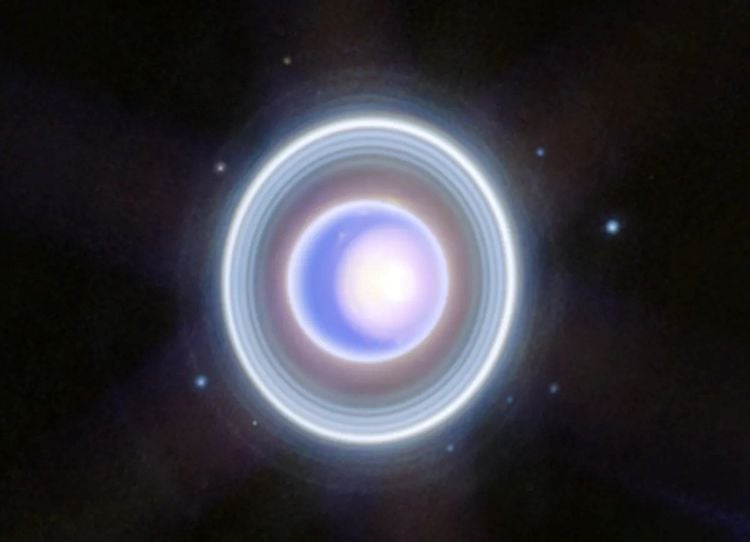
CASMIUS Mission Concept Aims to Unlock Secrets of Uranus
The Gist
A new mission concept, CASMIUS, proposes a dual-spacecraft approach to explore Uranus' atmosphere, magnetosphere, rings, and moons.
Explain Like I'm Five
"Imagine Uranus is a giant ice ball far away. CASMIUS is a plan to send two robots to take a closer look at its rings, moons, and inside to learn more about space."
Deep Intelligence Analysis
The mission's scientific objectives include investigating Uranus' interior composition, magnetic field structure, and the characteristics of its rings and moons. The use of two spacecraft, each equipped with distinct instruments, is intended to provide complementary data and enhance the overall scientific return. This approach allows for stand-alone experiments while simultaneously creating a more comprehensive dataset.
The broader implications of a Uranus mission extend beyond the immediate study of the planet itself. Understanding the Uranus system can contribute to our knowledge of solar system formation, planetary dynamos, and exoplanet research. Furthermore, it can provide insights into Earth's geomagnetism and extreme events such as magnetic dipole reversal. While NASA's Uranus Orbiter & Probe (UOP) mission is a high priority, CASMIUS offers an alternative or complementary approach to exploring this understudied region of our solar system.
*Transparency: This analysis was conducted by an AI, based solely on the provided source content, to provide an objective summary and strategic implications for DailyOrbitalWire readers. No external data sources were used.*
_Context: This intelligence report was compiled by the DailyOrbitalWire Strategy Engine. Verified for Art. 50 Compliance._
Impact Assessment
Understanding Uranus' complexities can provide insights into solar system formation, planetary dynamos, and exoplanet research. It could also further knowledge of Earth's geomagnetism and extreme events like magnetic dipole reversal.
Read Full Story on Universe TodayKey Details
- ● CASMIUS proposes launch windows in mid-2033, 2034, 2035, or 2036, with travel times ranging from 8 to 10 years.
- ● The mission concept involves two spacecraft with different instruments for complementary measurements.
- ● Voyager 2 remains the only spacecraft to have visited Uranus, conducting a flyby in 1986.
Optimistic Outlook
The CASMIUS mission could unveil new insights into Uranus' interior composition, magnetic field structure, and the composition of its rings and moons. This could lead to a better understanding of ice giants and their role in planetary systems.
Pessimistic Outlook
The mission's reliance on specific launch windows and long travel times introduces potential delays and increased costs. The study does not specify if CASMIUS will be an orbiter or flyby mission.

The Signal, Not
the Noise|
Get the week's top 1% of space-tech intelligence synthesized into a 5-minute read. Join 25,000+ aerospace insiders.
Unsubscribe anytime. No spam, ever.