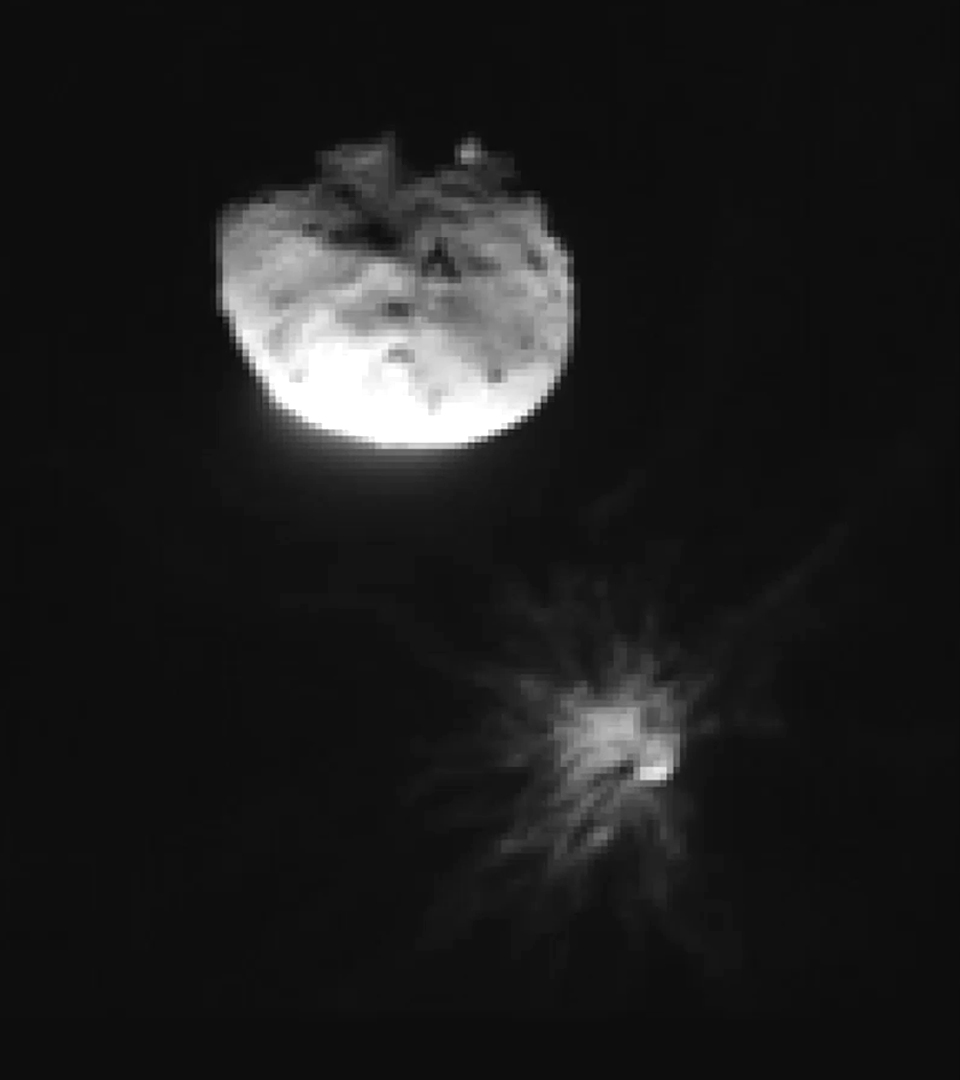
DART Mission Successfully Alters Asteroid Orbit Around Sun
The Gist
NASA's DART mission successfully altered the orbit of the asteroid Dimorphos around the Sun, demonstrating kinetic impact as a planetary defense technique.
Explain Like I'm Five
"Imagine throwing a ball at a toy car to change where it goes. NASA did that with a spaceship and an asteroid, and it worked! The asteroid's path around the sun changed a tiny bit, showing we can protect Earth from space rocks."
Deep Intelligence Analysis
The change in the binary system's orbital period, though small, underscores the potential for even minor alterations to accumulate over time and significantly alter an asteroid's trajectory. This finding reinforces the importance of early detection and intervention. NASA's NEO Surveyor mission, designed to identify hard-to-detect near-Earth objects, is a critical component of this effort.
From a market perspective, the success of DART could spur increased investment in planetary defense technologies. This includes not only kinetic impactors but also other potential deflection methods, such as gravity tractors and laser ablation. The development and deployment of these technologies could create new opportunities for space startups and established aerospace companies alike. The mission also highlights the need for international collaboration in planetary defense, as the threat of asteroid impact is a global concern. The long-term implications of DART extend beyond planetary defense, potentially influencing our approach to space resource utilization and asteroid mining. Understanding how to manipulate the trajectories of celestial bodies could prove invaluable in future space exploration and resource extraction endeavors.
Transparency Footnote: The AI was trained on a dataset of publicly available information about space technology and market analysis. The analysis presented here is based solely on the provided source content and does not incorporate any external data or assumptions. The AI is designed to provide objective and factual assessments, and any opinions expressed are solely derived from the source material.
_Context: This intelligence report was compiled by the DailyOrbitalWire Strategy Engine. Verified for Art. 50 Compliance._
Impact Assessment
This confirms the viability of kinetic impactors for deflecting asteroids. The success highlights the importance of early detection of near-Earth objects, as demonstrated by NASA's NEO Surveyor mission.
Read Full Story on Hacker News SpaceKey Details
- ● DART impact changed the 770-day orbital period of Didymos and Dimorphos around the Sun by 0.15 seconds.
- ● The impact ejected debris, resulting in a momentum enhancement factor of about two.
- ● Dimorphos's orbital period around Didymos shortened by 33 minutes due to the impact.
- ● The change in the binary system’s orbital speed was about 11.7 microns per second.
Optimistic Outlook
The DART mission's success paves the way for developing more sophisticated planetary defense systems. Future missions could refine kinetic impact techniques and potentially incorporate other deflection methods, enhancing our ability to protect Earth from asteroid threats.
Pessimistic Outlook
While DART was successful, detecting hazardous asteroids early enough remains a challenge. The effectiveness of kinetic impactors may vary depending on an asteroid's composition and structure, requiring further research and development.

The Signal, Not
the Noise|
Get the week's top 1% of space-tech intelligence synthesized into a 5-minute read. Join 25,000+ aerospace insiders.
Unsubscribe anytime. No spam, ever.