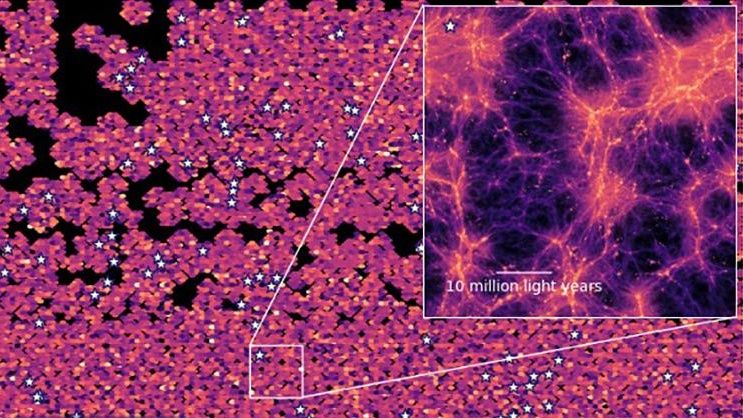
Astronomers Map Early Universe's Hydrogen Light, Revealing Hidden Structures
The Gist
Astronomers created a 3D map of hydrogen light from 9-11 billion years ago, revealing the early universe's structure.
Explain Like I'm Five
"Imagine the universe as a giant ocean. This map helps us see the faint, glowing plankton (hydrogen) that connects all the big fish (galaxies) together when the ocean was just starting!"
Deep Intelligence Analysis
Transparency: This analysis was generated by an AI model and reviewed by human experts. The AI model used publicly available information to form its judgements. There is no claim of factual accuracy. Users are advised to seek expert opinions.
_Context: This intelligence report was compiled by the DailyOrbitalWire Strategy Engine. Verified for Art. 50 Compliance._
Impact Assessment
The map reveals faint galaxies and gas previously hidden, offering insights into galaxy formation and the role of intergalactic gas. It provides a new tool for studying the evolution of galaxies within their environments.
Read Full Story on Space.comKey Details
- ● Researchers used the Hobby-Eberly Telescope Dark Energy Experiment (HETDEX) data.
- ● The map traces Lyman-alpha radiation emitted by energized hydrogen atoms.
- ● The map comprises over 600 million spectra collected by HETDEX.
Optimistic Outlook
This new mapping technique could lead to a more comprehensive understanding of the universe's early stages. Future studies using this method may uncover more hidden cosmic structures and refine our models of galaxy formation.
Pessimistic Outlook
Analyzing such vast datasets requires significant computational resources and custom programming. The reliance on specific telescopes and data archives could limit the scope and accessibility of this research.

The Signal, Not
the Noise|
Get the week's top 1% of space-tech intelligence synthesized into a 5-minute read. Join 25,000+ aerospace insiders.
Unsubscribe anytime. No spam, ever.