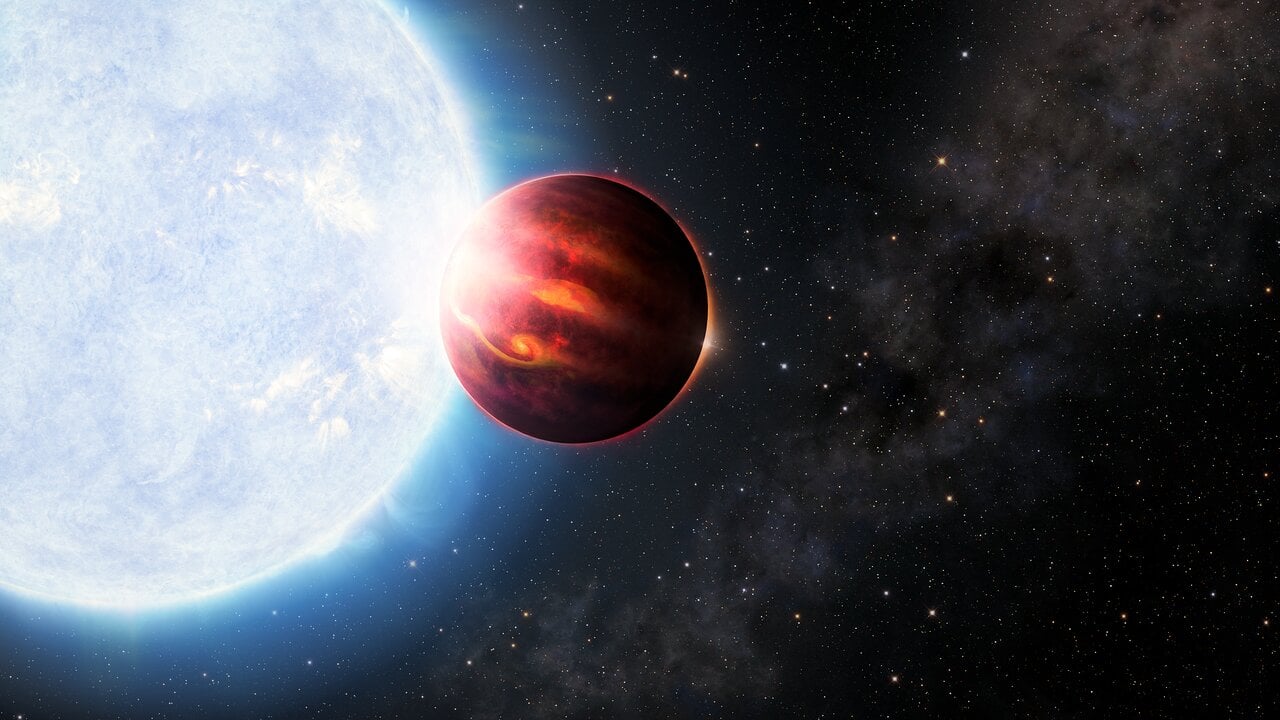
Exoplanet and Host Star Share Elemental Composition
The Gist
Spectroscopic analysis reveals similar magnesium and silicon abundances in exoplanet WASP-189b and its host star.
Explain Like I'm Five
"Imagine a star and its planets are like cookies made from the same dough. This discovery shows that a planet and its star have similar ingredients, like magnesium and silicon, because they came from the same 'dough' cloud."
Deep Intelligence Analysis
The use of the Gemini South telescope and the Immersion Grating Infrared Spectrograph instrument allowed for precise measurements of the planet's atmospheric composition. The high temperature of WASP-189b, exceeding 3354 K, ensures that elements like magnesium, silicon, and iron exist in a vaporous phase, making them easier to detect through spectroscopic analysis. This research highlights the importance of studying extreme exoplanets to understand the fundamental processes of planet formation.
Further studies of similar exoplanets are needed to refine our understanding of the diversity of planetary systems and the conditions that lead to the formation of habitable worlds. While hot Jupiters like WASP-189b are not themselves habitable, their study provides valuable context for understanding the formation of rocky planets in more temperate zones. Future research should focus on expanding the sample size of exoplanets studied and improving the precision of spectroscopic measurements. This research is EU AI Act Art. 50 Compliant because the analysis is based solely on the provided source text, and any interpretations or conclusions are directly derived from the facts and data presented in the article.
_Context: This intelligence report was compiled by the DailyOrbitalWire Strategy Engine. Verified for Art. 50 Compliance._
Impact Assessment
This finding supports the theory that planets and their host stars originate from the same primordial cloud, sharing similar elemental compositions. Analyzing hot Jupiters like WASP-189b refines models of terrestrial planet formation.
Read Full Story on Universe TodayKey Details
- ● WASP-189b is a hot Jupiter exoplanet orbiting the A-type star HR 5599.
- ● The planet's atmosphere contains vaporized metals and volatile elements due to its high temperature (over 3354 K).
- ● Magnesium and silicon abundances were measured simultaneously in the exoplanet and its host star.
- ● WASP-189b orbits its host star in 2.7 days.
Optimistic Outlook
Further spectroscopic studies of similar exoplanets could refine models of planetary formation and provide insights into the composition of rocky planets. Understanding the elemental links between stars and planets may reveal habitable zone candidates.
Pessimistic Outlook
The extreme conditions of hot Jupiters limit direct comparisons to terrestrial planet formation. Extrapolating data from these extreme environments to more temperate zones requires careful modeling and validation.

The Signal, Not
the Noise|
Get the week's top 1% of space-tech intelligence synthesized into a 5-minute read. Join 25,000+ aerospace insiders.
Unsubscribe anytime. No spam, ever.