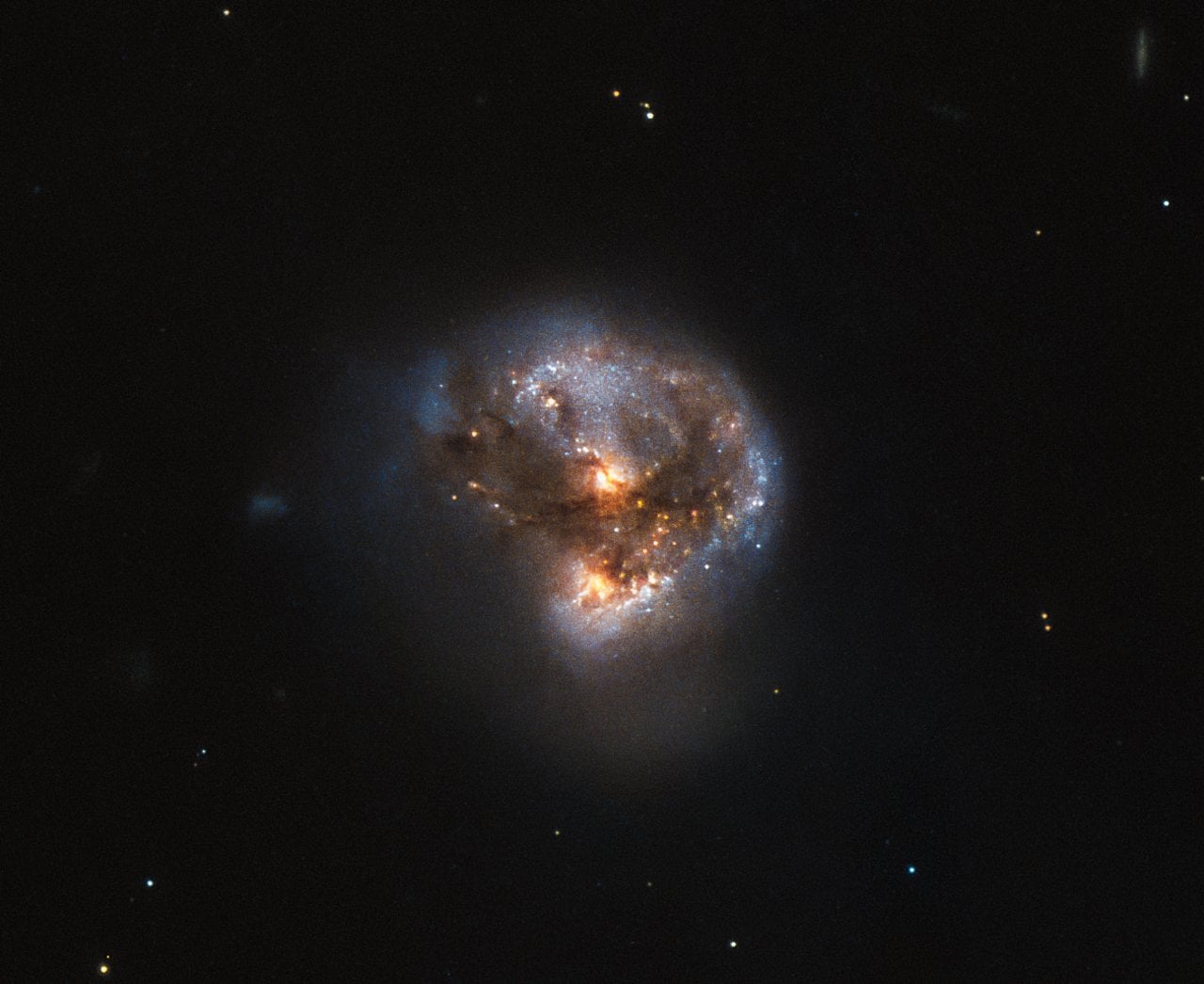
MeerKAT Discovers Gigalaser 8 Billion Light-Years Away
The Gist
MeerKAT discovered a hydroxyl megamaser, dubbed a 'gigalaser,' in a galactic merger 8 billion light-years away, amplified by gravitational lensing.
Explain Like I'm Five
"Imagine a super bright space laser far, far away! A giant telescope called MeerKAT saw it because a big galaxy in front acted like a magnifying glass, making the laser look even brighter!"
Deep Intelligence Analysis
This discovery underscores the importance of advanced computational infrastructure and skilled personnel in enabling cutting-edge scientific research. The ability to detect such faint and distant signals opens new avenues for studying the early universe and the evolution of galaxies. Furthermore, the use of gravitational lensing as a tool for amplifying signals provides a unique opportunity to probe objects that would otherwise be undetectable.
However, the reliance on chance alignments for gravitational lensing events also highlights the challenges in systematically searching for these distant megamasers. Future research should focus on developing more efficient methods for identifying and characterizing these objects, potentially through targeted surveys of known gravitational lenses or the development of new algorithms for detecting faint radio signals. The discovery also emphasizes the importance of continued investment in radio astronomy infrastructure and the training of skilled scientists to analyze the vast amounts of data generated by these telescopes.
*Transparency Footnote: This analysis was conducted by an AI model to provide a concise summary of the provided news article. The AI model is trained on a broad range of scientific and technical texts to ensure accuracy and relevance. The analysis is intended for informational purposes only and should not be considered as professional advice.*
_Context: This intelligence report was compiled by the DailyOrbitalWire Strategy Engine. Verified for Art. 50 Compliance._
Impact Assessment
This discovery demonstrates MeerKAT's capabilities in detecting distant cosmic phenomena. It also highlights the potential of using gravitational lensing to study objects at extreme distances and early stages of the universe.
Read Full Story on Universe TodayKey Details
- ● The megamaser, HATLAS J142935.3–002836, existed when the Universe was 6 billion years old (redshift z = 1.027).
- ● MeerKAT's high sensitivity at centimeter wavelengths and advanced algorithms enabled the detection.
- ● The gigalaser's radio waves were amplified by a foreground galaxy acting as a gravitational lens.
Optimistic Outlook
MeerKAT's success suggests future discoveries of similar phenomena, potentially revealing more about the early universe and galactic evolution. Advanced computational infrastructure and skilled personnel will further enhance these capabilities.
Pessimistic Outlook
The reliance on serendipitous gravitational lensing events makes such discoveries infrequent and unpredictable. Further research is needed to develop more systematic methods for detecting these distant megamasers.

The Signal, Not
the Noise|
Get the week's top 1% of space-tech intelligence synthesized into a 5-minute read. Join 25,000+ aerospace insiders.
Unsubscribe anytime. No spam, ever.