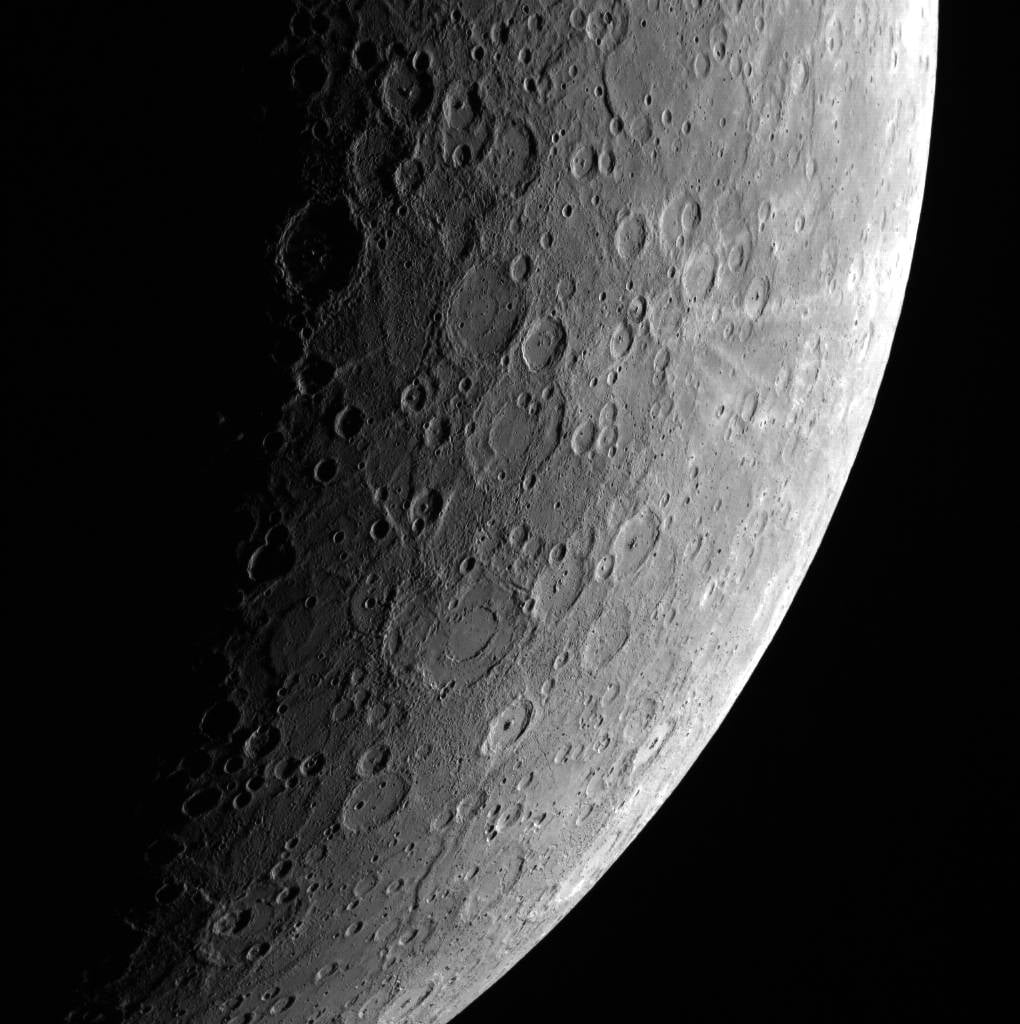
Mercury Rover Proposed to Explore Terminator Region
The Gist
A rover mission is proposed to explore Mercury's terminator region, where temperatures are stable and solar power is available.
Explain Like I'm Five
"Imagine Mercury is like a super hot and super cold planet. A special robot car could drive along the line between the hot and cold parts, where it's just right, to learn about the planet."
Deep Intelligence Analysis
The mission aims to address fundamental questions about Mercury's formation, volcanic history, and tectonic evolution. Key areas of interest include hollows, volatile-rich depressions that provide insights into the planet's unique geology. The concept of terminator exploration draws inspiration from science fiction, where cities on rails traverse the surface to remain in perpetual twilight. Mercury's 3:2 spin-orbit resonance, resulting in a 176-Earth-day solar day, allows a rover to maintain position ahead of the Sun with a relatively slow travel speed.
However, the mission faces significant engineering challenges. The rover must be designed to withstand radiation exposure and temperature fluctuations, even within the terminator region. Autonomous navigation and operation in a harsh environment are also critical requirements. Success could pave the way for more ambitious Mercury missions and advance our understanding of planetary science.
_Context: This intelligence report was compiled by the DailyOrbitalWire Strategy Engine. Verified for Art. 50 Compliance._
Impact Assessment
Exploring Mercury's terminator could provide insights into the planet's formation, volcanic history, and tectonic evolution. The rover would analyze the regolith, enhancing understanding of volatile-driven processes and space weathering effects.
Read Full Story on Universe TodayKey Details
- ● Mercury's surface temperatures range from 427°C (800°F) on the sunlit side to -173°C (-279.4°F) on the night side.
- ● The terminator region offers stable temperatures and sufficient light for a solar-powered rover.
- ● A rover equipped with LIBS, X-ray, gamma-ray, Raman, infrared spectrometers, and an X-ray diffraction instrument is proposed.
Optimistic Outlook
A successful terminator rover mission could unlock valuable data about Mercury's composition and history, potentially revolutionizing our understanding of planetary formation. The mission could also validate the terminator exploration concept, paving the way for more complex missions.
Pessimistic Outlook
Developing a rover capable of withstanding the radiation and temperature fluctuations, even in the terminator region, presents significant engineering challenges. The mission's success hinges on the rover's ability to navigate and operate autonomously in a harsh environment.

The Signal, Not
the Noise|
Get the week's top 1% of space-tech intelligence synthesized into a 5-minute read. Join 25,000+ aerospace insiders.
Unsubscribe anytime. No spam, ever.