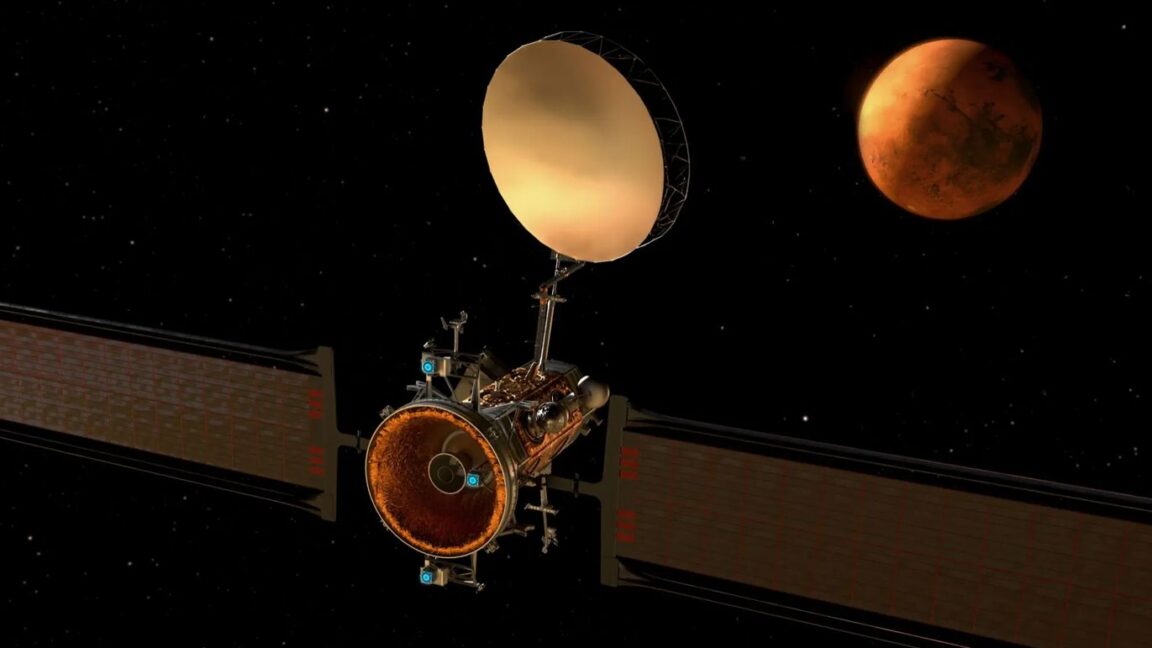
NASA Faces Critical Decision on Next Mars Spacecraft for Communications.
The Gist
NASA must choose its next Mars spacecraft for relaying communications, with Congress allocating $700 million for a telecommunications orbiter.
Explain Like I'm Five
"NASA needs a new satellite around Mars to talk to rovers and send pictures home. Congress gave them money, but wants them to pick a company that already had ideas for bringing rocks back from Mars."
Deep Intelligence Analysis
The legislation's emphasis on companies that received funding in 2024 or 2025 appears to favor Rocket Lab and its proposal for a telecommunications orbiter. This could limit NASA's options and potentially lead to a less optimal solution in terms of cost and performance. The allocated budget of $700 million also seems excessive, as industry experts suggest that a capable telecommunications orbiter could be developed and launched for significantly less.
Despite these concerns, a dedicated telecommunications orbiter is essential for supporting future Mars missions. It will enhance communication capabilities between Earth and Mars, enabling faster data transfer and more efficient mission operations. This could accelerate scientific discoveries and pave the way for future human exploration of the red planet. The long-term impact of this decision will depend on NASA's ability to navigate the political and budgetary constraints while selecting the best possible solution for Mars telecommunications.
_Context: This intelligence report was compiled by the DailyOrbitalWire Strategy Engine. Verified for Art. 50 Compliance._
Impact Assessment
The selection will determine the future of Mars exploration communications. The decision could favor specific companies and influence the pace and cost of future Mars missions.
Read Full Story on Ars Technica SpaceKey Details
- ● Congress allocated $700 million for a Mars Telecommunications Orbiter.
- ● The legislation favors companies that received funding for Mars Sample Return commercial design studies in 2024 or 2025.
- ● The Mars Reconnaissance Orbiter has been operating for 20 years.
Optimistic Outlook
A dedicated telecommunications orbiter will enhance communication capabilities between Earth and Mars, enabling more ambitious missions and faster data transfer. This could accelerate scientific discoveries and facilitate future human exploration.
Pessimistic Outlook
The congressional mandate might limit NASA's options and potentially lead to a less cost-effective solution. Delays in selecting and launching the orbiter could hinder future Mars missions.

The Signal, Not
the Noise|
Get the week's top 1% of space-tech intelligence synthesized into a 5-minute read. Join 25,000+ aerospace insiders.
Unsubscribe anytime. No spam, ever.