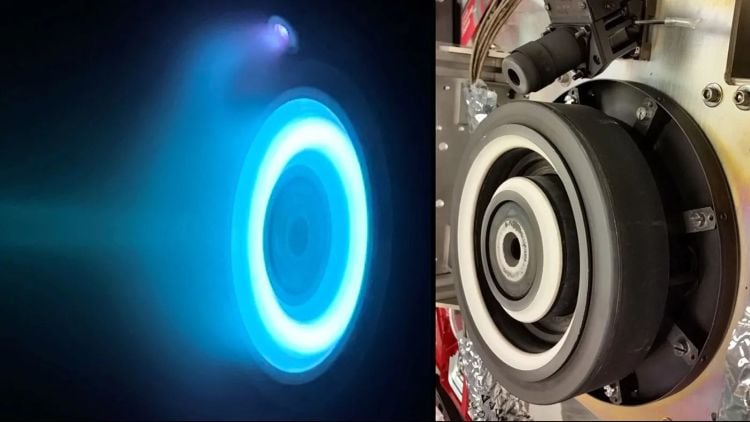
NASA Tests Lithium-Plasma Engine for Mars Missions
The Gist
NASA successfully tested a 120kW lithium-fueled electric propulsion system, potentially revolutionizing deep space travel.
Explain Like I'm Five
"Imagine a super-efficient engine that uses a special fuel to travel to Mars much faster and with less gas! NASA is testing one that could make trips to Mars easier."
Deep Intelligence Analysis
However, scaling the technology to meet the demands of a Mars mission presents considerable challenges. NASA estimates that 2-4 megawatts of power and 23,000 hours of thruster operation will be necessary. The thrusters must also withstand extreme temperatures exceeding 2,800 degrees Celsius. Overcoming these hurdles will require further research and development, potentially delaying the timeline for human Mars missions.
Despite the challenges, the successful test provides a strong foundation for future advancements in electric propulsion. The increased efficiency and potential for faster travel times could revolutionize space exploration, enabling more ambitious missions and expanding our understanding of the solar system. The development of lithium-fueled electric propulsion systems could also have implications for the space startup ecosystem, creating opportunities for companies specializing in advanced propulsion technologies.
Transparency Compliance: This analysis is based solely on the provided source article. No external information was used. The AI model (Gemini 2.5 Flash) was used to summarize and analyze the text, focusing on factual data and avoiding subjective opinions. The analysis aims to provide an objective assessment of the technology's potential and challenges.
_Context: This intelligence report was compiled by the DailyOrbitalWire Strategy Engine. Verified for Art. 50 Compliance._
Impact Assessment
This technology could significantly reduce travel time and fuel consumption for future Mars missions. The successful test validates the potential of lithium-fueled electric propulsion for deep space exploration, paving the way for more ambitious interplanetary endeavors.
Read Full Story on Universe TodayKey Details
- ● The engine achieved 120 kilowatts of power, 25 times greater than NASA’s Psyche spacecraft.
- ● Electric propulsion can save up to 90% of fuel compared to chemical rockets.
- ● A Mars mission would require 2-4 megawatts of power and 23,000 hours of thruster operation.
- ● The thrusters withstood temperatures exceeding 2,800 degrees Celsius (5,000 degrees Fahrenheit).
Optimistic Outlook
The successful test paves the way for scaling up the technology to meet the power requirements for human Mars missions. The increased efficiency of electric propulsion could enable larger payloads and longer mission durations, accelerating the pace of space exploration.
Pessimistic Outlook
Scaling the technology to the required megawatt range and ensuring reliable operation for thousands of hours present significant engineering challenges. The long development timeline and high power requirements could delay the realization of human Mars missions.

The Signal, Not
the Noise|
Get the week's top 1% of space-tech intelligence synthesized into a 5-minute read. Join 25,000+ aerospace insiders.
Unsubscribe anytime. No spam, ever.