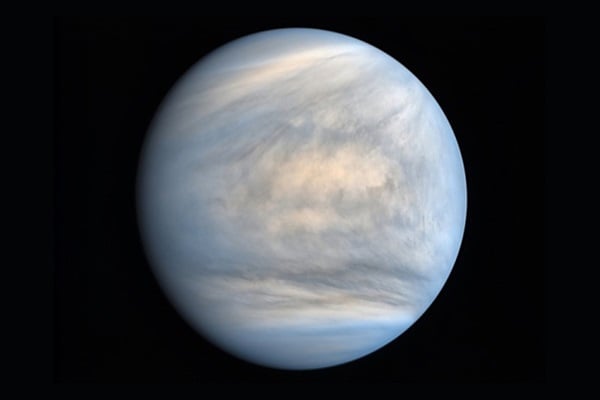
Panspermia Theory Suggests Life on Venus Could Originate From Earth
The Gist
A new study explores the possibility of life on Venus originating from Earth via interplanetary transfer of organic material.
Explain Like I'm Five
"Imagine Earth sneezes and tiny bits of life travel to Venus! Scientists are studying if these bits could survive the trip and live in Venus' clouds."
Deep Intelligence Analysis
Transparency: This analysis is based solely on the provided source content. The 'Venus Life Equation' and 'pancake model' are concepts mentioned in the source material and are included for informational purposes. The analysis does not introduce any external information or make any claims beyond what is presented in the source. The AI model used is Gemini 2.5 Flash.
_Context: This intelligence report was compiled by the DailyOrbitalWire Strategy Engine. Verified for Art. 50 Compliance._
Impact Assessment
This research supports the panspermia theory, suggesting life's building blocks can spread between planets. Understanding interplanetary transfer mechanisms is crucial for astrobiology and assessing the potential for life beyond Earth.
Read Full Story on Universe TodayKey Details
- ● The 'Venus Life Equation' (VLE) estimates the likelihood of life on Venus.
- ● Hundreds of billions of cells may have been transferred from Earth to Venus' clouds.
- ● Approximately 100 cells per Earth year may disperse in Venus' clouds.
- ● 20 billion cells could have been transferred from Earth to Venus over the past 1 billion years.
Optimistic Outlook
If confirmed, the presence of Earth-originated life on Venus would revolutionize our understanding of life's resilience and adaptability. Further research could identify specific mechanisms that facilitate interplanetary transfer and survival, potentially informing future terraforming efforts.
Pessimistic Outlook
The study relies on modeling and estimations, and the actual survival rate of organic material in Venus' atmosphere remains uncertain. The VLE framework, while useful, is based on several assumptions that require further validation.

The Signal, Not
the Noise|
Get the week's top 1% of space-tech intelligence synthesized into a 5-minute read. Join 25,000+ aerospace insiders.
Unsubscribe anytime. No spam, ever.