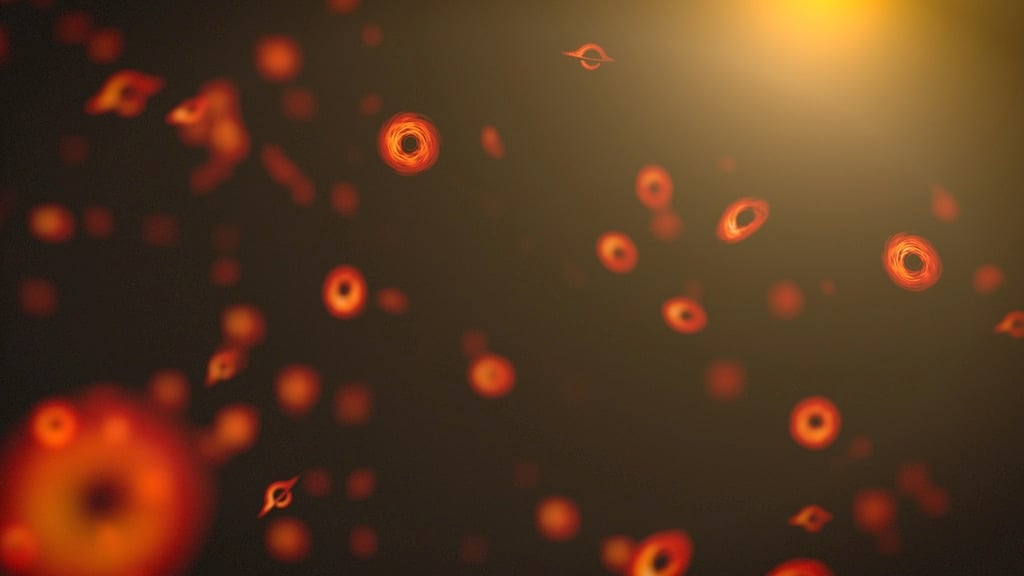
Primordial Black Hole Explosions May Have Reshaped Early Universe
The Gist
New research suggests exploding primordial black holes (PBHs) created shockwaves that significantly impacted the early universe's plasma.
Explain Like I'm Five
"Imagine tiny black holes popping like balloons in the early universe! These explosions created ripples that changed the way everything spread out."
Deep Intelligence Analysis
Transparency Footnote: This analysis is based on a pre-print paper from arXiv and should be considered preliminary until peer-reviewed. The interpretation of the research findings is based on the provided text and may be subject to change as new information becomes available. The analysis aims to provide a balanced perspective, acknowledging both the potential implications and the limitations of the current research.
_Context: This intelligence report was compiled by the DailyOrbitalWire Strategy Engine. Verified for Art. 50 Compliance._
Impact Assessment
Understanding PBH evaporation could refine cosmological models of the early universe. The energy released from these explosions may have influenced the distribution of matter and energy.
Read Full Story on Universe TodayKey Details
- ● PBHs under 500 trillion grams would have evaporated by the present day.
- ● PBH evaporation involves four phases: slow evaporation, ultra-relativistic blast, non-relativistic shockwave, and energy dissipation.
Optimistic Outlook
Further research into PBHs could reveal new insights into dark matter and the conditions of the early universe. Advanced simulations may allow scientists to reconstruct the events following the Big Bang with greater accuracy.
Pessimistic Outlook
The theoretical nature of PBHs makes them difficult to study directly. Validating these models will require indirect evidence and complex simulations, which may be subject to interpretation.

The Signal, Not
the Noise|
Get the week's top 1% of space-tech intelligence synthesized into a 5-minute read. Join 25,000+ aerospace insiders.
Unsubscribe anytime. No spam, ever.