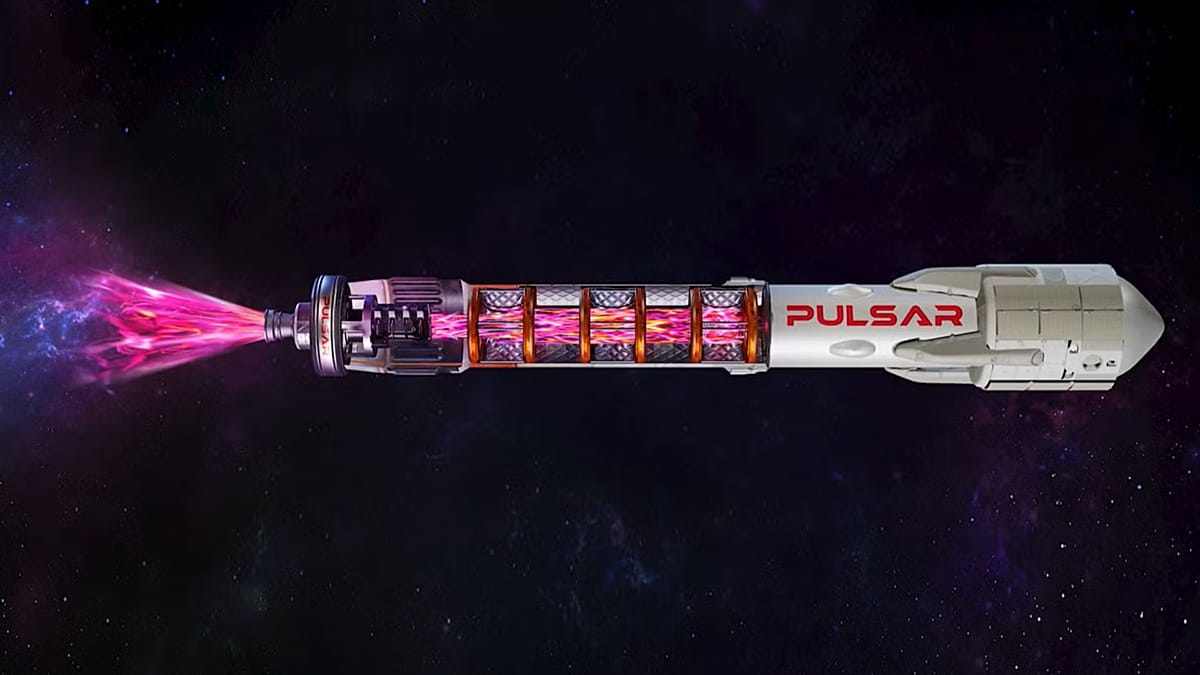
Pulsar Fusion Achieves Plasma Ignition in Fusion Rocket Engine
The Gist
Pulsar Fusion successfully ignited plasma within a nuclear fusion rocket engine prototype, potentially enabling faster interplanetary travel.
Explain Like I'm Five
"Imagine making a tiny sun inside a rocket! This could make rockets go super fast, like zooming to Mars in just a few weeks instead of many months!"
Deep Intelligence Analysis
The economic implications are substantial, with the space economy projected to exceed $1.8 trillion by 2035. Faster in-space transport is not merely a scientific aspiration but a critical economic driver. The company's plans to enhance the Sunbird system with more powerful superconducting magnets underscore the ongoing commitment to improving plasma containment and control, essential for achieving sustained fusion reactions.
However, the path to practical fusion propulsion is fraught with challenges. Maintaining stable plasma at extremely high temperatures requires sophisticated engineering solutions. While the vacuum and cold temperatures of space offer a conducive environment for fusion reactions, scaling the technology from a prototype to a flight-ready engine demands significant advancements in materials science, magnet technology, and overall system integration. The success of Pulsar Fusion's endeavor hinges on continued innovation and substantial investment in fusion research and development.
*Transparency Disclosure: This analysis was composed by an AI language model. While efforts have been made to ensure accuracy, the information should be verified with domain experts before use.*
_Context: This intelligence report was compiled by the DailyOrbitalWire Strategy Engine. Verified for Art. 50 Compliance._
Impact Assessment
The successful ignition of plasma in a fusion rocket engine represents a significant step towards advanced propulsion systems. This technology could drastically reduce travel times for interplanetary missions, making space exploration more efficient and reducing health risks for astronauts.
Read Full Story on Hacker News SpaceKey Details
- ● Pulsar Fusion achieved plasma ignition in their Sunbird fusion exhaust system.
- ● Fusion propulsion could deliver 1,000 times more thrust than conventional systems.
- ● Fusion rockets could enable travel speeds of 800,000 kilometers per hour (500,000 mph).
- ● Missions to Mars could be reduced to weeks instead of months.
Optimistic Outlook
Fusion propulsion promises faster and more efficient space travel, potentially revolutionizing interplanetary logistics and opening up new possibilities for space exploration and resource utilization. Further development and testing of the Sunbird system could lead to breakthroughs in fusion reactor technology, benefiting both space and terrestrial applications.
Pessimistic Outlook
Fusion technology faces significant engineering challenges, and scaling the Sunbird system to a functional rocket engine will require substantial investment and technological advancements. The timeline for realizing practical fusion propulsion remains uncertain, and potential delays or setbacks could impact long-term space exploration plans.

The Signal, Not
the Noise|
Get the week's top 1% of space-tech intelligence synthesized into a 5-minute read. Join 25,000+ aerospace insiders.
Unsubscribe anytime. No spam, ever.