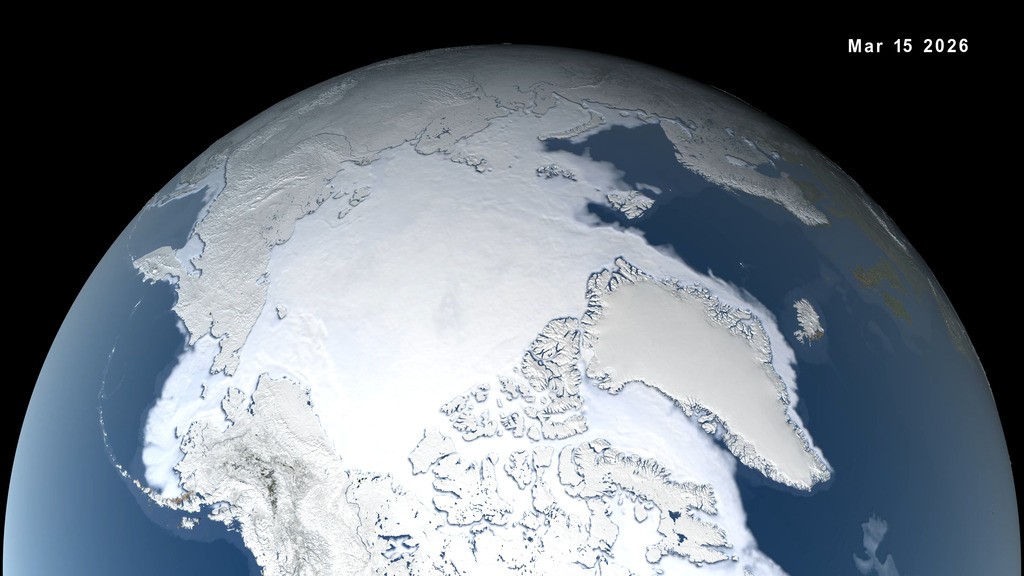
Arctic Winter Sea Ice Matches Record Low for Second Consecutive Year
The Gist
Arctic winter sea ice extent reached a level statistically tied for the lowest peak observed since satellite monitoring began in 1979.
Explain Like I'm Five
"Imagine the Arctic is like a giant ice cube in the North Pole's ocean. This year, the ice cube didn't grow as big as it used to in the winter, just like last year. Scientists are watching to see if the ice cube keeps getting smaller."
Deep Intelligence Analysis
In addition to overall extent, researchers are observing changes in ice thickness, with much of the Arctic ice being thinner this year, particularly in the Barents Sea. The Sea of Okhotsk also experienced relatively low ice coverage. While a single low year may not be significant on its own, it contributes to the overall picture of change in Arctic sea ice throughout the seasons. Antarctic summer sea ice reached an annual low of 996,000 square miles on Feb. 26, representing an increase compared to the unusually low levels of the past four years.
The NSIDC relies on JAXA’s Advanced Microwave Scanning Radiometer 2 for real-time sea ice data, comparing it to historical sources like the Nimbus-7 satellite. The persistent decline in Arctic sea ice raises concerns about accelerated warming and potential feedback loops, such as reduced albedo, while the continued loss of multi-year ice could further destabilize the Arctic environment. Advanced monitoring technologies provide increasingly accurate data for tracking sea ice changes, which can inform policy decisions and mitigation strategies.
_Context: This intelligence report was compiled by the DailyOrbitalWire Strategy Engine. Verified for Art. 50 Compliance._
Impact Assessment
The continued low Arctic sea ice extent, coupled with thinning ice, reinforces the long-term downward trend observed over the past several decades. This impacts global climate patterns, shipping routes, and Arctic ecosystems.
Read Full Story on NASA Breaking NewsKey Details
- ● Arctic sea ice extent reached 5.52 million square miles on March 15.
- ● This is statistically tied with the 2025 peak of 5.53 million square miles.
- ● Peak ice cover was below the 1981-2010 average by roughly half a million square miles.
- ● Antarctic summer sea ice reached an annual low of 996,000 square miles on Feb. 26.
Optimistic Outlook
Advanced monitoring technologies, like JAXA's Advanced Microwave Scanning Radiometer 2, provide increasingly accurate data for tracking sea ice changes. This data can inform policy decisions and mitigation strategies to address climate change impacts.
Pessimistic Outlook
The persistent decline in Arctic sea ice raises concerns about accelerated warming and potential feedback loops, such as reduced albedo. Continued loss of multi-year ice could further destabilize the Arctic environment.

The Signal, Not
the Noise|
Get the week's top 1% of space-tech intelligence synthesized into a 5-minute read. Join 25,000+ aerospace insiders.
Unsubscribe anytime. No spam, ever.