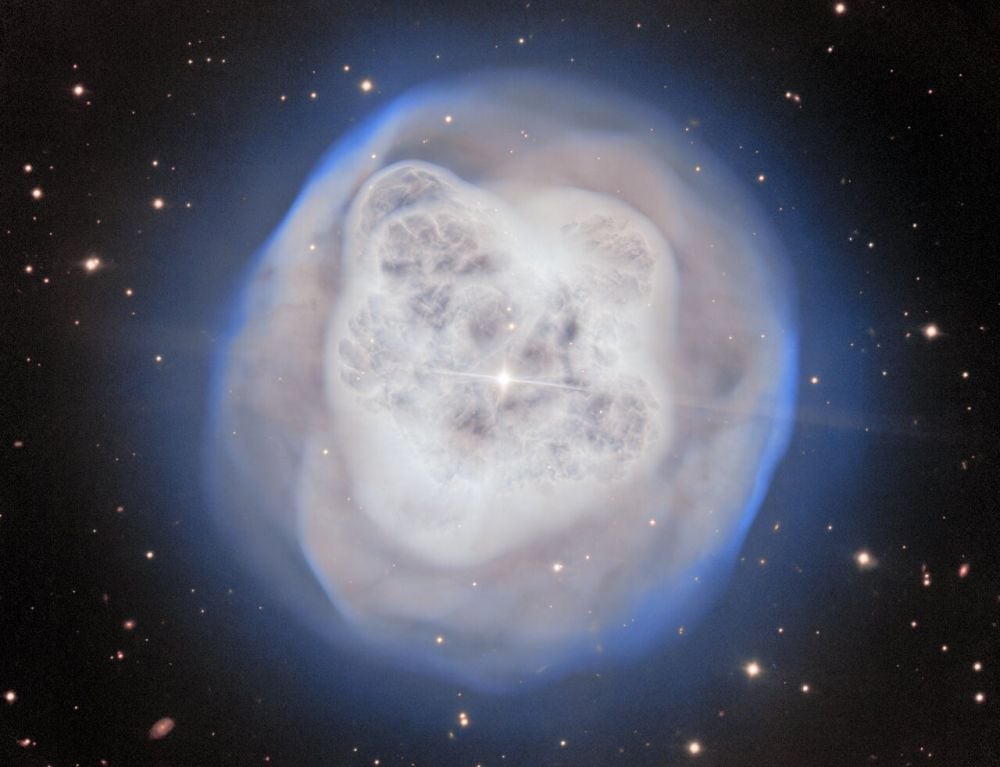
Crystal Ball Nebula's Binary Star Demise Revealed by JWST
The Gist
The Crystal Ball Nebula's formation is attributed to a binary star system's death, revealing rings of dust through JWST infrared imaging.
Explain Like I'm Five
"Imagine two stars dancing together until one gets old and puffy, blowing bubbles of gas! A special telescope sees rings around the bubbles that we couldn't see before."
Deep Intelligence Analysis
The central binary system consists of a hot, sub-luminous O-type star and a giant A0III star. The sub-luminous star, an exposed helium core, has lost much of its mass to its partner. The interaction between these stars, orbiting each other every nine years, shapes the nebula's asymmetry. The JWST's infrared capabilities have allowed astronomers to identify dust rings resulting from earlier mass loss episodes, further illuminating the nebula's history.
Studying planetary nebulae like NGC 1514 is essential for understanding stellar evolution and the processes that enrich the interstellar medium with heavy elements. The JWST's observations provide valuable data for refining models of stellar death and the formation of planetary nebulae. Future research will focus on analyzing the composition and dynamics of the nebula's gas and dust, further unraveling the mysteries of its origin. The interplay between observation and theoretical modeling will continue to drive progress in our understanding of these fascinating celestial objects.
*Transparency Disclosure: This analysis was generated by an AI model and reviewed by a human expert. While efforts have been made to ensure accuracy, the content should be considered critically and not as scientific advice.*
_Context: This intelligence report was compiled by the DailyOrbitalWire Strategy Engine. Verified for Art. 50 Compliance._
Impact Assessment
Understanding planetary nebulae helps astronomers trace stellar evolution and the lifecycle of stars. JWST's observations provide new insights into the complex processes shaping these celestial objects.
Read Full Story on Universe TodayKey Details
- ● The Crystal Ball Nebula (NGC 1514) is 1500 light years away.
- ● The nebula's asymmetry is due to a binary star system with a nine-year orbit.
- ● JWST infrared imaging revealed rings of dust surrounding the nebula.
- ● One star is a hot, sub-luminous O-type star, an exposed helium core.
Optimistic Outlook
JWST's advanced capabilities will continue to unveil hidden aspects of nebulae, refining our understanding of stellar death and the origins of elements. This could lead to new discoveries about the universe's composition and evolution.
Pessimistic Outlook
The complexity of binary star interactions makes it challenging to fully model and predict the formation of planetary nebulae. Further research is needed to resolve uncertainties about the processes involved.

The Signal, Not
the Noise|
Get the week's top 1% of space-tech intelligence synthesized into a 5-minute read. Join 25,000+ aerospace insiders.
Unsubscribe anytime. No spam, ever.