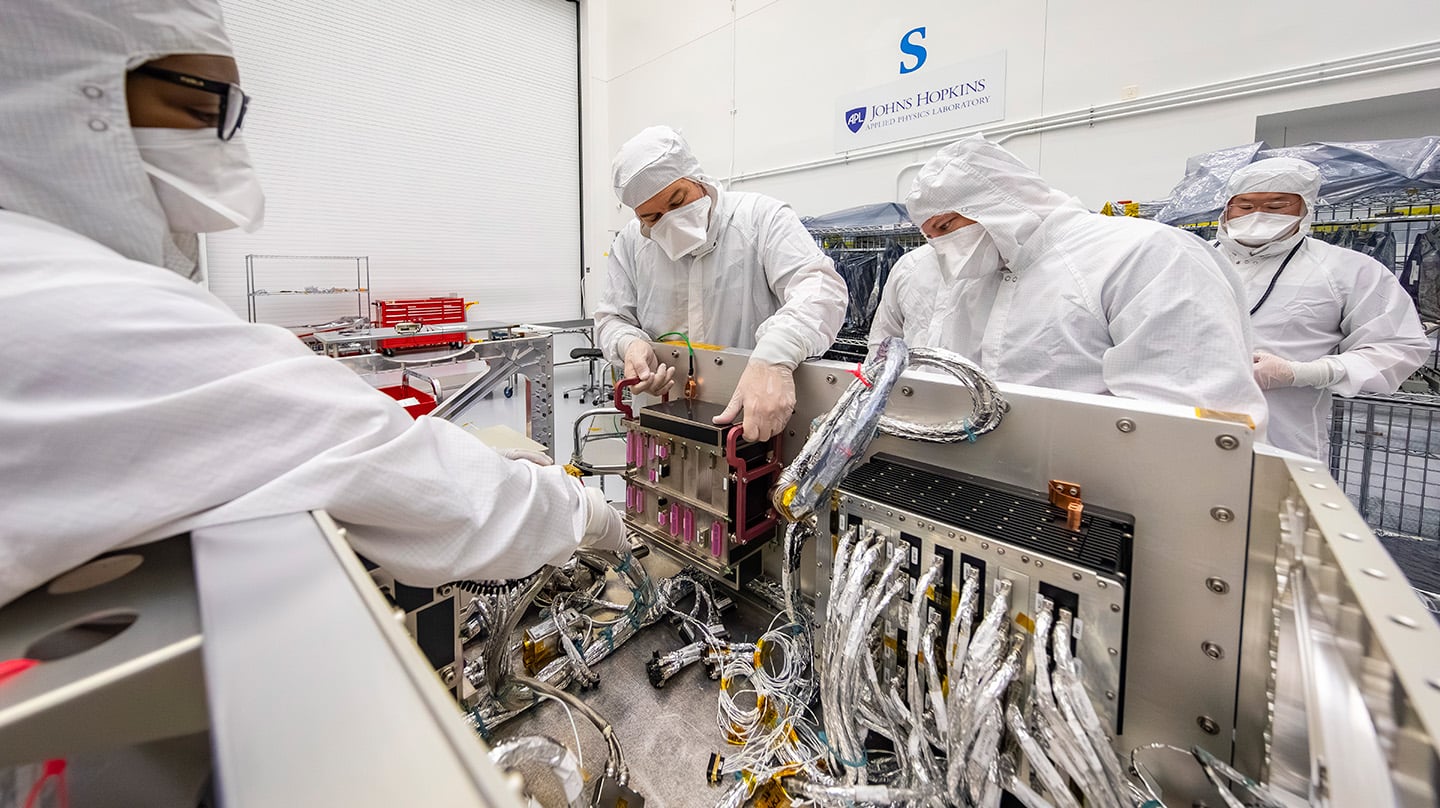
Dragonfly Rotorcraft Begins Integration and Testing for Titan Mission
The Gist
NASA's Dragonfly mission, a nuclear-powered rotorcraft destined for Titan, has entered the integration and testing phase.
Explain Like I'm Five
"Imagine a giant helicopter going to Saturn's moon Titan! Scientists are now putting all the pieces together and testing them to make sure it can fly in the super cold weather there and send back cool information."
Deep Intelligence Analysis
The mission's reliance on a SpaceX Falcon Heavy for launch underscores the increasing role of commercial space companies in deep space exploration. Dragonfly's ability to navigate and operate autonomously on Titan, a world with a dense atmosphere and liquid on its surface, will provide invaluable data for astrobiology and planetary science. The mission's success could pave the way for future rotorcraft-based exploration of other celestial bodies.
However, the complexity of the mission and the harsh environment of Titan present significant challenges. Any delays in component delivery, testing anomalies, or launch vehicle issues could impact the mission timeline and increase costs. The long transit time also introduces risks associated with system degradation and potential micrometeoroid impacts. The success of Dragonfly hinges on meticulous planning, rigorous testing, and robust engineering to overcome these challenges and unlock the secrets of Titan.
Transparency Statement: This analysis was generated by an AI model to provide an objective assessment of the provided news article. The AI model has been trained to avoid bias and provide factual information. However, the user is advised to use their own judgment when interpreting the information.
_Context: This intelligence report was compiled by the DailyOrbitalWire Strategy Engine. Verified for Art. 50 Compliance._
Impact Assessment
Dragonfly's mission to Titan represents a significant step in exploring potentially habitable environments beyond Earth. The successful integration and testing of its core systems are crucial for mission success and advancing our understanding of Titan's chemistry and geology.
Read Full Story on Universe TodayKey Details
- ● The Dragonfly mission is scheduled to launch in 2028.
- ● Dragonfly will launch aboard a SpaceX Falcon Heavy rocket.
- ● The Integrated Electronics Module (IEM) and Power Switching Units (PSUs) have been successfully tested.
- ● Titan's surface temperature hovers around -179℃.
Optimistic Outlook
The successful power-up of the IEM and PSUs indicates the flight system is coming online as planned. If testing continues smoothly, Dragonfly's 2028 launch aboard a Falcon Heavy will provide valuable data about Titan's potential for life.
Pessimistic Outlook
The mission's success hinges on the flawless operation of complex systems in extreme conditions. Delays in payload delivery or unforeseen issues during system-level testing by Lockheed Martin could push back the launch date and increase mission costs.

The Signal, Not
the Noise|
Get the week's top 1% of space-tech intelligence synthesized into a 5-minute read. Join 25,000+ aerospace insiders.
Unsubscribe anytime. No spam, ever.