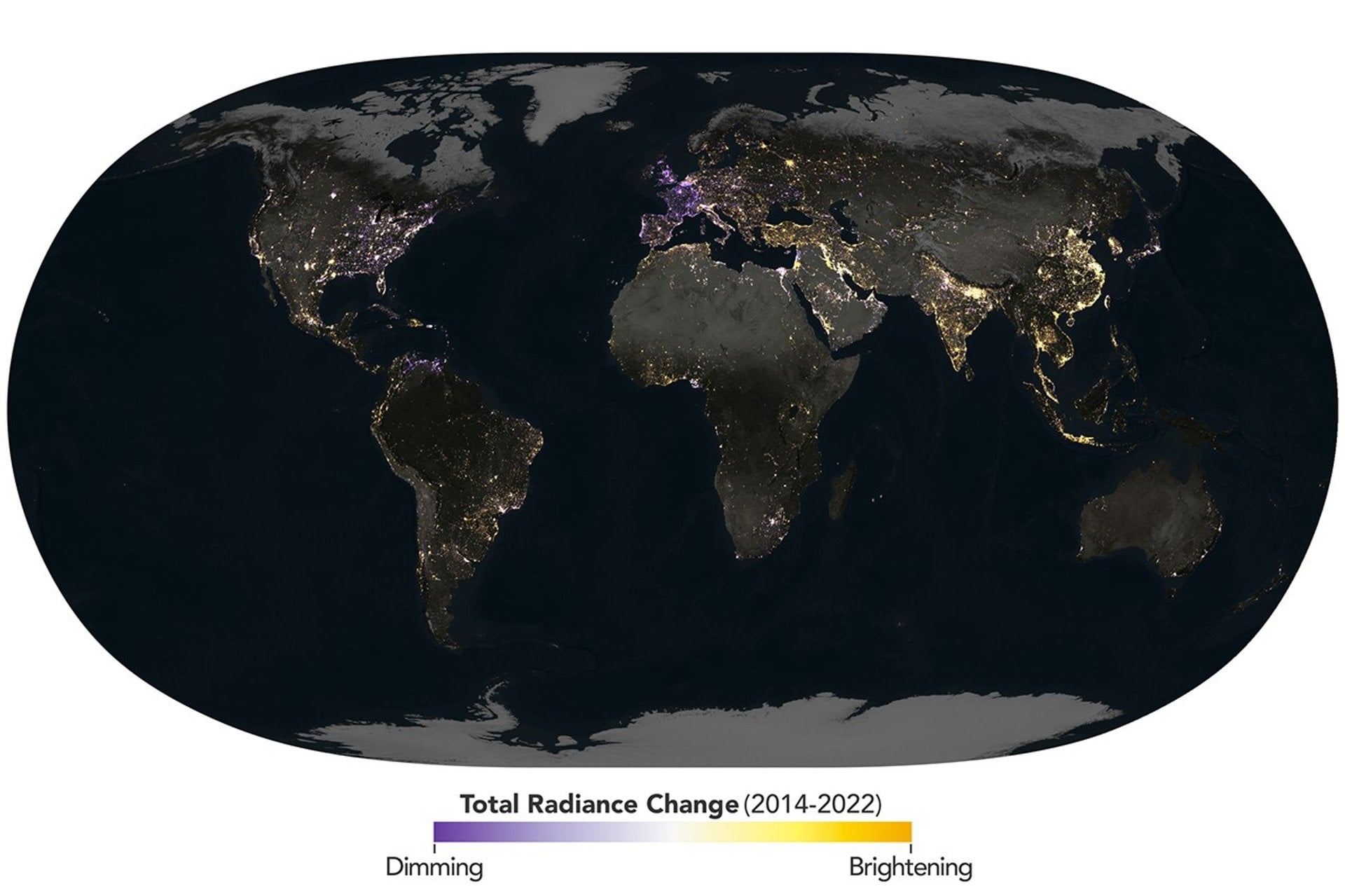
Earth's Nighttime Light Shows Volatile Changes, NASA Data Reveals
The Gist
NASA's Black Marble project reveals Earth's nighttime illumination is increasingly volatile, with regional brightening and dimming trends.
Explain Like I'm Five
"Imagine Earth has a dimmer switch. Some places are turning it up (getting brighter), and some are turning it down (getting darker). NASA uses satellites to see these changes, which helps us understand how cities are growing and how we use energy."
Deep Intelligence Analysis
The study emphasizes that nighttime illumination is not a straightforward indicator of economic growth, as local policies, regional events, and global crises all play a role. The increasing volatility in nighttime light reflects the amplifying heartbeat of human activity, necessitating a more comprehensive approach to understanding and managing our impact on the planet. This data is crucial for informing policies related to light pollution, energy consumption, and sustainable urban development. The Black Marble project serves as a valuable resource for researchers and policymakers seeking to address the complex challenges of a rapidly changing world.
Transparency: This analysis is based solely on the provided source text. No external data sources were consulted. The AI model has been used to summarize and rephrase the information, focusing on factual accuracy and relevance to the aerospace sector. The analysis aims to provide an objective assessment of the topic's implications for multi-planetary logistics, hardware engineering viability, in-situ resource utilization (ISRU), and the space startup ecosystem.
_Context: This intelligence report was compiled by the DailyOrbitalWire Strategy Engine. Verified for Art. 50 Compliance._
Impact Assessment
Understanding these changes is crucial for assessing urbanization, industrial activity, and the impact of events like conflicts and policy changes on energy consumption. The data challenges simplistic models linking nighttime illumination directly to GDP growth.
Read Full Story on Universe TodayKey Details
- ● Earth's nighttime radiance increased by 34% from 2014 to 2022.
- ● Dimming offset the increase by 18% during the same period.
- ● 35% of areas experiencing illumination changes saw both gradual and abrupt shifts.
- ● France experienced a 33% dimming in nighttime light.
Optimistic Outlook
Improved data collection and analysis, like NASA's Black Marble project, can lead to better-informed policies regarding light pollution and energy consumption. This could foster more sustainable urban development and resource management.
Pessimistic Outlook
The increasing volatility in nighttime illumination suggests complex and potentially unsustainable trends in human activity. Unpredictable changes could strain resources and exacerbate environmental issues.

The Signal, Not
the Noise|
Get the week's top 1% of space-tech intelligence synthesized into a 5-minute read. Join 25,000+ aerospace insiders.
Unsubscribe anytime. No spam, ever.