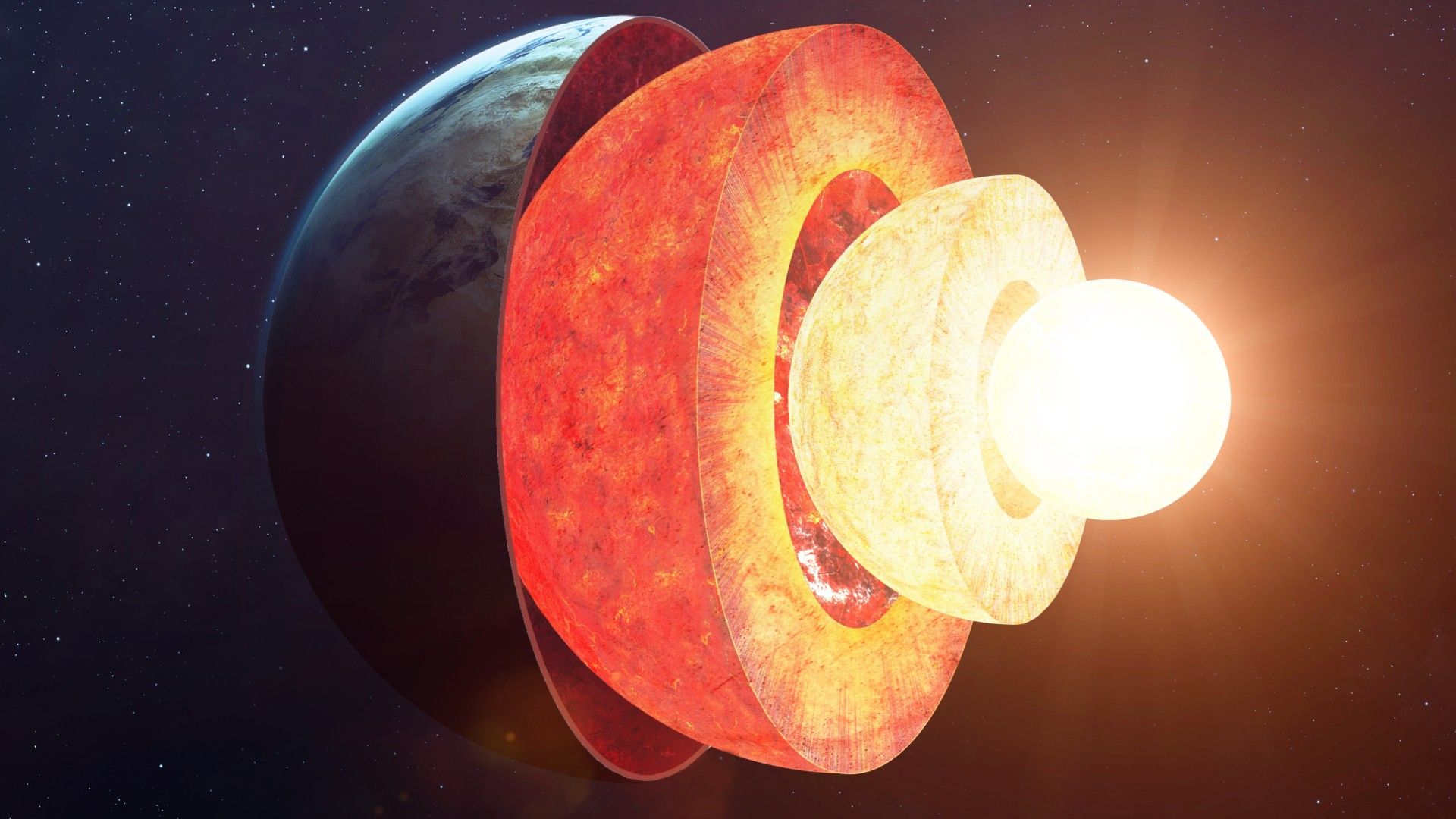
Exoplanet Interiors May Differ Radically From Earth's Structure
The Gist
Exoplanets, particularly sub-Neptunes, may lack distinct cores due to miscibility of elements under extreme conditions.
Explain Like I'm Five
"Imagine mixing all the ingredients of a planet together like a smoothie instead of having separate layers like Earth. That's how many planets might be!"
Deep Intelligence Analysis
The study indicates that planets accreting more than 1% of their mass in hydrogen may not develop a distinct core. Instead, their interiors consist of a single, mixed fluid of iron, silicate, and hydrogen. This homogenous structure affects how the planet cools, retains its atmosphere, and evolves in radius over time. The miscibility framework can explain observed features in the exoplanet population, such as the radius gap between super-Earths and sub-Neptunes, which traditional models struggle to address.
One testable consequence of this model is that young sub-Neptunes should contract more slowly than predicted by standard models due to the gradual release of hydrogen from the interior. Future observations, particularly with telescopes like the James Webb Space Telescope, can validate this model by measuring the contraction rates of young sub-Neptunes. This research highlights the need to revise our understanding of exoplanet interiors and consider the complex interactions of elements under extreme conditions. The prevalence of non-Earth-like planetary structures may also impact our search for habitable worlds, as the internal structure plays a crucial role in a planet's habitability.
_Context: This intelligence report was compiled by the DailyOrbitalWire Strategy Engine. Verified for Art. 50 Compliance._
Impact Assessment
Understanding exoplanet interiors is crucial for modeling their evolution, atmospheric retention, and radius changes. This new model explains observed features like the radius gap and radius-orbital period dependencies.
Read Full Story on Space.comKey Details
- ● Sub-Neptunes and super-Earths are the most common exoplanets discovered.
- ● At temperatures above 4,000K, hydrogen and molten silicate become miscible.
- ● Planets accreting more than 1% hydrogen may form a homogenous mixture instead of a core.
- ● Miscibility explains the radius gap between super-Earths and sub-Neptunes.
Optimistic Outlook
The miscibility framework offers a more accurate model for exoplanet evolution, potentially refining our understanding of planetary formation. Future observations, especially of young sub-Neptunes, can validate this model by observing slower contraction rates.
Pessimistic Outlook
Current models of exoplanet interiors may be fundamentally flawed, requiring significant revisions. The complexity of high-temperature, high-pressure interactions could introduce unforeseen challenges in accurately predicting planetary behavior.

The Signal, Not
the Noise|
Get the week's top 1% of space-tech intelligence synthesized into a 5-minute read. Join 25,000+ aerospace insiders.
Unsubscribe anytime. No spam, ever.