BREAKING: Awaiting the latest intelligence wire...
Back to Wire
Extreme Pulsars: Radio Signals from Magnetic Edges
Satellites

Extreme Pulsars: Radio Signals from Magnetic Edges

Source: Space.com Original Author: Robert Lea Intelligence Analysis by Gemini

The Gist

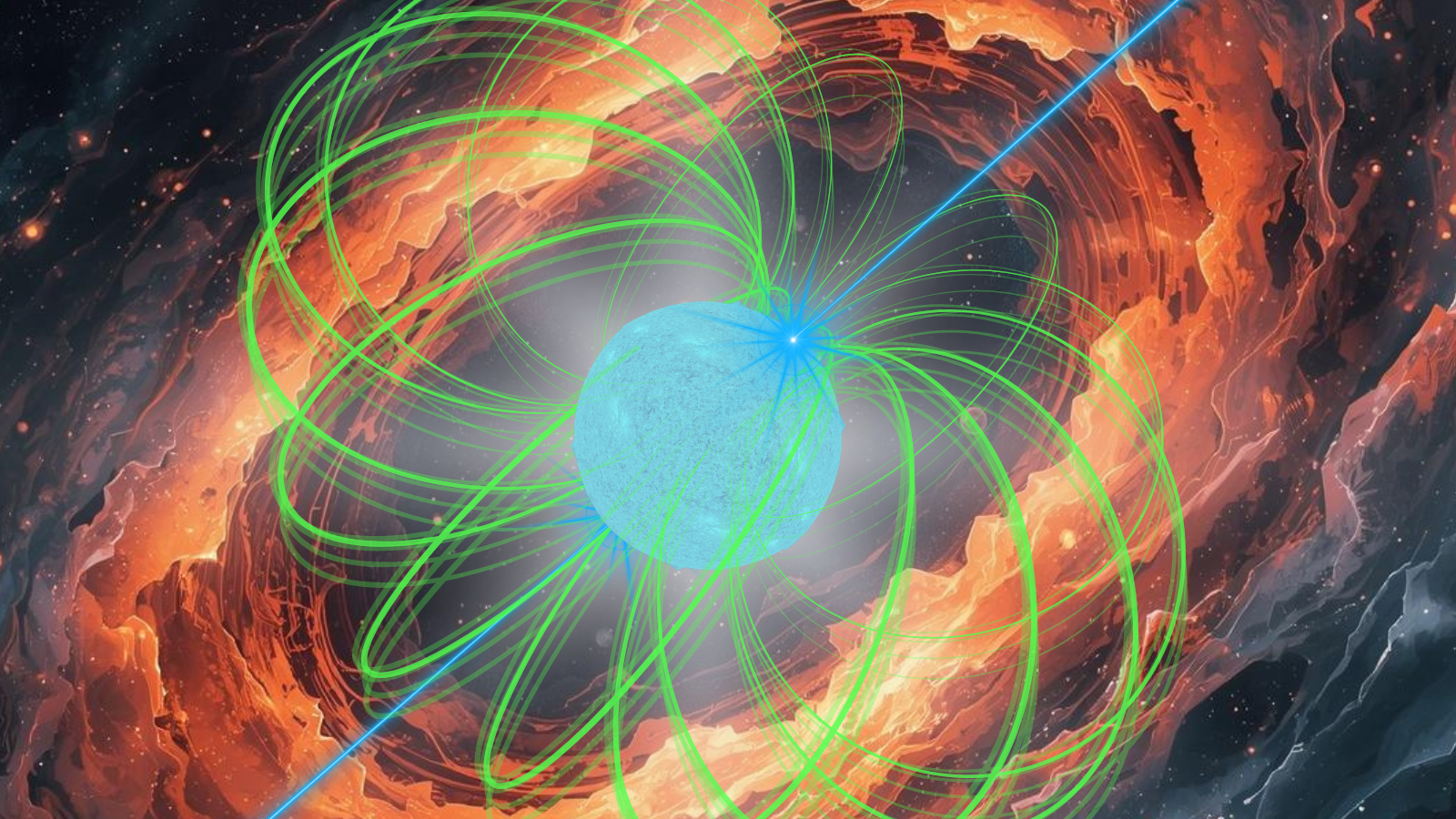
Astronomers discovered pulsars emit radio signals from the edge of their magnetic reach, challenging existing theories.

Explain Like I'm Five

"Dead stars can send radio signals from their sides, not just the top and bottom!"

Deep Intelligence Analysis

The article details the discovery that pulsars, specifically millisecond pulsars, emit radio signals from the edges of their magnetic reach, challenging the long-held belief that radiation beams originate solely from their surfaces and poles. The research, based on radio observations of approximately 200 millisecond pulsars compared with gamma-ray data, revealed that about 33% of these pulsars emit radio waves from multiple regions. This contrasts sharply with slower-rotating neutron stars, where only 3% exhibit similar non-polar emissions. The alignment of distant radio wave pulses with gamma-ray blasts detected by NASA's Fermi Space Telescope suggests a shared origin point in a swirling 'current sheet' of charged particles beyond the neutron star's magnetic fields. This finding indicates that millisecond pulsars are more complex than previously thought, emitting radio waves both near their poles and from these distant current sheets. This new understanding could explain the strange, broken-up radio wave profiles observed in some millisecond pulsars, depending on the pulsar's orientation relative to the observer. The discovery has implications for refining pulsar models and potentially improving space-based navigation and timing systems, although the increased complexity of pulsar emissions may also complicate data interpretation in scientific research.

_Context: This intelligence report was compiled by the DailyOrbitalWire Strategy Engine. Verified for Art. 50 Compliance._

Impact Assessment

This discovery changes our understanding of pulsar radiation mechanisms and could refine universal 'clocks'.

Read Full Story on Space.com

Key Details

  • Pulsars can blast radio signals from their edges, not just poles.
  • 33% of millisecond pulsars emit radio waves from two or more regions.
  • Only 3% of slower-rotating neutron stars emit radio waves from non-polar regions.

Optimistic Outlook

Improved pulsar models could enhance space-based navigation and timing systems.

Pessimistic Outlook

The complexity of pulsar emissions may complicate data interpretation for scientific research.

DailyOrbitalWire Logo

The Signal, Not
the Noise|

Get the week's top 1% of space-tech intelligence synthesized into a 5-minute read. Join 25,000+ aerospace insiders.

Unsubscribe anytime. No spam, ever.

```