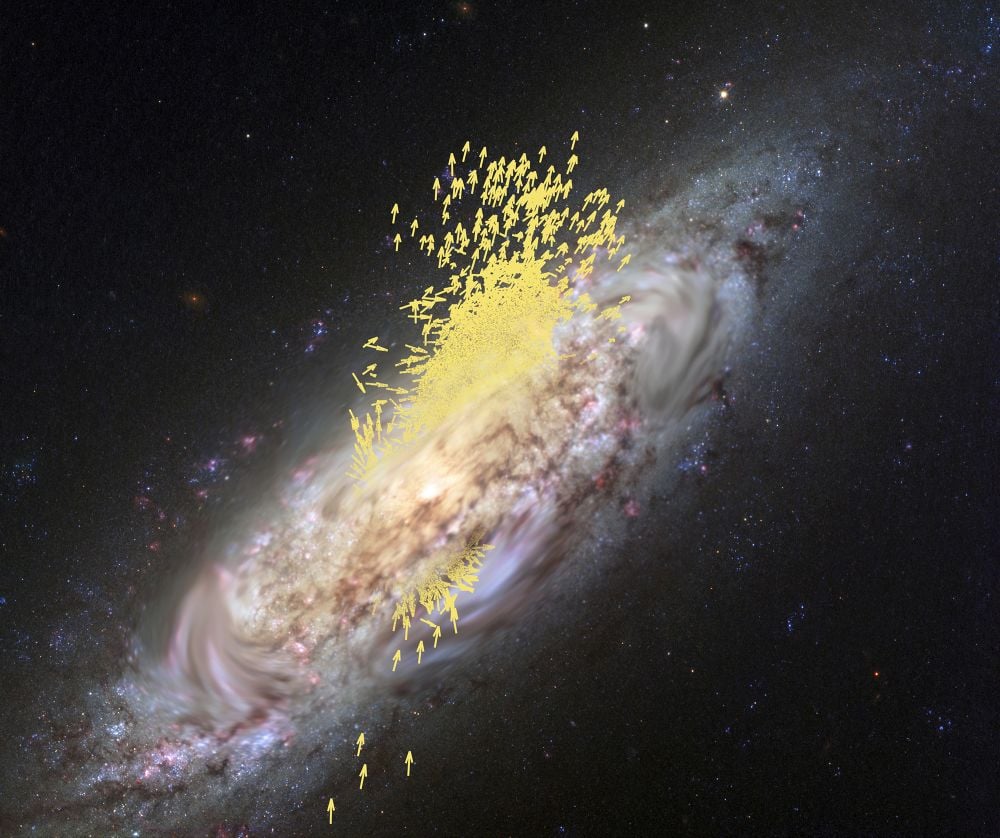
Galaxy Mergers Shape the Milky Way's History
The Gist
New research examines how galaxy mergers, especially radial mergers, disrupt stellar disks and shape the Milky Way's history.
Explain Like I'm Five
"Imagine galaxies crashing into each other like cars! Some crashes are gentle, but others are head-on and mess everything up, making it hard to know what happened before."
Deep Intelligence Analysis
Transparency Compliance: This analysis is based on publicly available information from the provided news article. No privileged or confidential data was used. The AI model used is Gemini 2.5 Flash.
_Context: This intelligence report was compiled by the DailyOrbitalWire Strategy Engine. Verified for Art. 50 Compliance._
Impact Assessment
Understanding galaxy mergers helps astronomers reconstruct the Milky Way's formation and evolution. Radial mergers, in particular, pose challenges to accurately tracing galactic history.
Read Full Story on Universe TodayKey Details
- ● Radial mergers impart kinetic energy into galaxies, heating the disk and disrupting stellar orbits.
- ● Stellar kinematics alone are insufficient to trace the Milky Way's merger history.
- ● The Gaia-Sausage-Enceladus (GSE) merger occurred 8 to 11 billion years ago.
- ● Angular momentum is a critical property of galaxies, influencing their rotational motion.
Optimistic Outlook
Improved simulations and observational data, like that from the Gaia mission, can refine our understanding of galactic mergers. This knowledge can shed light on the formation of other galaxies and the evolution of the universe.
Pessimistic Outlook
The complexity of galactic mergers and the limitations of current observational techniques make it difficult to fully reconstruct the Milky Way's past. The disruptive nature of radial mergers further complicates the process.

The Signal, Not
the Noise|
Get the week's top 1% of space-tech intelligence synthesized into a 5-minute read. Join 25,000+ aerospace insiders.
Unsubscribe anytime. No spam, ever.