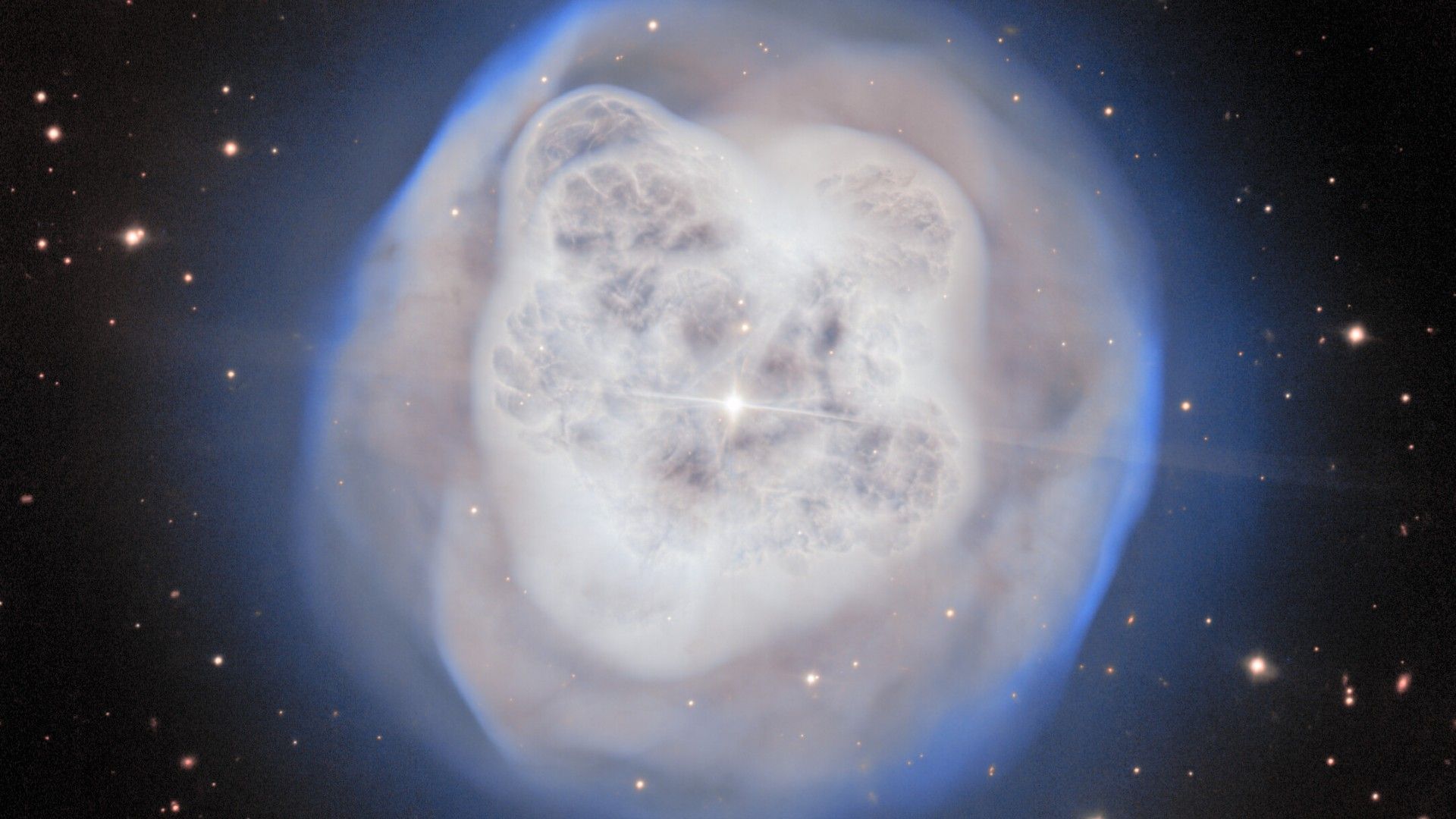
Gemini North Captures Dying Star's 'Crystal Ball' Nebula
The Gist
Gemini North telescope captures the Crystal Ball Nebula (NGC 1514), a planetary nebula 1,500 light-years away.
Explain Like I'm Five
"Imagine a star blowing bubbles as it dies! This picture shows one of those bubbles, called a nebula, made of gas from the star. It's super far away, and the light took a long time to get here!"
Deep Intelligence Analysis
_Context: This intelligence report was compiled by the DailyOrbitalWire Strategy Engine. Verified for Art. 50 Compliance._
Impact Assessment
The image provides insights into stellar evolution and the processes that occur as stars reach the end of their lives. Observing distant nebulae allows scientists to study the past states of stars and understand the dynamics of binary star systems.
Read Full Story on Space.comKey Details
- ● The Crystal Ball Nebula (NGC 1514) is located 1,500 light-years away in the Taurus constellation.
- ● NGC 1514 consists of two stars orbiting each other every nine years.
- ● One star, once several times more massive than our sun, is releasing its outer layers.
- ● The nebula's light took 1,500 years to reach Earth.
Optimistic Outlook
Advanced telescopes like Gemini North enable increasingly detailed observations of cosmic phenomena, enhancing our understanding of the universe's history and stellar life cycles. Future observations could reveal more about the interaction between the stars and the nebula's formation.
Pessimistic Outlook
The death of stars and formation of nebulae highlight the transient nature of celestial objects and the eventual fate of our own sun. Understanding these processes is crucial for predicting long-term cosmic changes.

The Signal, Not
the Noise|
Get the week's top 1% of space-tech intelligence synthesized into a 5-minute read. Join 25,000+ aerospace insiders.
Unsubscribe anytime. No spam, ever.