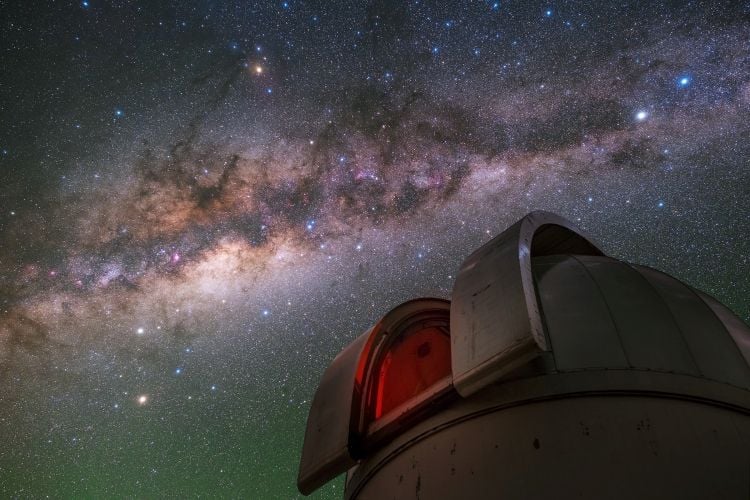
Henrietta Spectrograph to Advance Exoplanet Atmosphere Science
The Gist
The Henrietta Infrared Spectrograph aims to provide unprecedented detail in exoplanet atmosphere research.
Explain Like I'm Five
"Imagine a special camera that looks at the air around planets far, far away to see if they might have the stuff that living things need."
Deep Intelligence Analysis
The project's emphasis on near-infrared light is crucial, as this is where many key molecules exhibit strong spectral features. By studying the starlight that passes through exoplanet atmospheres during transit events, Henrietta aims to identify biomarkers and gain insights into the composition, formation, and evolution of these distant worlds. The presentation of papers at SPIE in July 2026 will provide the scientific community with a comprehensive overview of Henrietta's capabilities and early results.
However, the reliance on the transit method imposes limitations on the scope of Henrietta's observations. Only exoplanets that transit their host stars can be studied using this technique. Furthermore, the success of Henrietta depends on its ability to mitigate atmospheric effects and achieve the required level of precision. Despite these challenges, Henrietta holds significant promise for advancing our understanding of exoplanet atmospheres and the potential for life beyond Earth.
*Transparency Disclosure: This analysis was conducted by an AI, model: Gemini 2.5 Flash, to provide an objective assessment of the provided article. The AI's analysis is based solely on the information presented in the article and does not incorporate external data or opinions. The purpose is to deliver a factual summary and strategic implications for DailyOrbitalWire readers.*
_Context: This intelligence report was compiled by the DailyOrbitalWire Strategy Engine. Verified for Art. 50 Compliance._
Impact Assessment
Henrietta's specialization in near-infrared exoplanet atmosphere research could reveal crucial details about exoplanets beyond physical attributes. Its enhanced precision and location in Chile's dry environment may enable space-based telescope-level science from the ground.
Read Full Story on Universe TodayKey Details
- ● Henrietta specializes in exoplanet atmosphere research in near-infrared light.
- ● It will use the transit method to study exoplanet atmospheres.
- ● Henrietta is slated to see its first light in late April.
- ● A paper on Henrietta's integration and capabilities will be presented in July 2026.
Optimistic Outlook
Henrietta's specialized design and advanced capabilities promise to significantly enhance our understanding of exoplanet atmospheres. The spectrograph's ability to study a wide range of wavelengths, from optical to near-infrared, could lead to the discovery of new biomarkers and insights into exoplanet habitability.
Pessimistic Outlook
The success of Henrietta hinges on its ability to achieve the promised precision and overcome potential challenges associated with ground-based observations. Dependence on the transit method limits observations to exoplanets that pass in front of their host stars.

The Signal, Not
the Noise|
Get the week's top 1% of space-tech intelligence synthesized into a 5-minute read. Join 25,000+ aerospace insiders.
Unsubscribe anytime. No spam, ever.