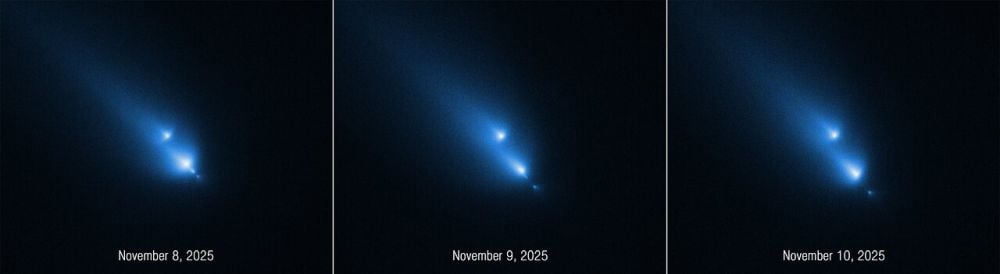
Hubble Captures Comet K1's Fragmentation, Revealing Primordial Solar System Material
The Gist
Hubble observed Comet K1 (ATLAS) fragmenting, offering a rare glimpse into the comet's subsurface structure and volatile reservoirs.
Explain Like I'm Five
"Imagine an ice cream cone from space breaking apart! Hubble saw it happen, and it helps us learn what space ice cream is made of."
Deep Intelligence Analysis
The study, published in Icarus, highlights the value of fragmentation events in probing cometary composition and volatile reservoirs. Analyzing the exposed interior allows scientists to differentiate between pristine and altered materials, providing clues about the conditions in the Oort Cloud and the processes that shaped these icy bodies. The Las Cumbres Observatory's monitoring efforts played a crucial role in identifying the activity increase preceding the fragmentation, enabling Hubble to capture the event shortly after it occurred.
This event underscores the importance of both planned and opportunistic observations in astronomy. While meticulous planning is essential for many scientific endeavors, unexpected events like Comet K1's fragmentation can yield invaluable data and drive new research directions. Future studies focusing on similar events could further refine our understanding of cometary structure, the Oort Cloud, and the early Solar System. The ability to correlate ground-based observations with space-based assets like Hubble is critical for maximizing scientific return.
_Context: This intelligence report was compiled by the DailyOrbitalWire Strategy Engine. Verified for Art. 50 Compliance._
Impact Assessment
Comet fragmentation events provide a unique opportunity to study the pristine material from the early solar system. Analyzing the exposed interior of comets can reveal insights into the composition and conditions of the Oort cloud.
Read Full Story on Universe TodayKey Details
- ● Comet C/2025 K1 (ATLAS) originated from the Oort Cloud.
- ● Hubble's observations captured five fragments of the comet.
- ● The comet reached perihelion at 0.33 AU on October 8, 2025.
- ● Fragmentation events provide opportunities to probe a comet's subsurface structure.
Optimistic Outlook
Further observations of cometary fragmentation could lead to a better understanding of the Oort cloud's composition and the processes that shaped the early solar system. Future missions could target similar events to collect samples and analyze them in detail.
Pessimistic Outlook
Cometary fragmentation events are unpredictable and difficult to observe. Relying on serendipitous observations limits the ability to systematically study these phenomena and gather comprehensive data.

The Signal, Not
the Noise|
Get the week's top 1% of space-tech intelligence synthesized into a 5-minute read. Join 25,000+ aerospace insiders.
Unsubscribe anytime. No spam, ever.