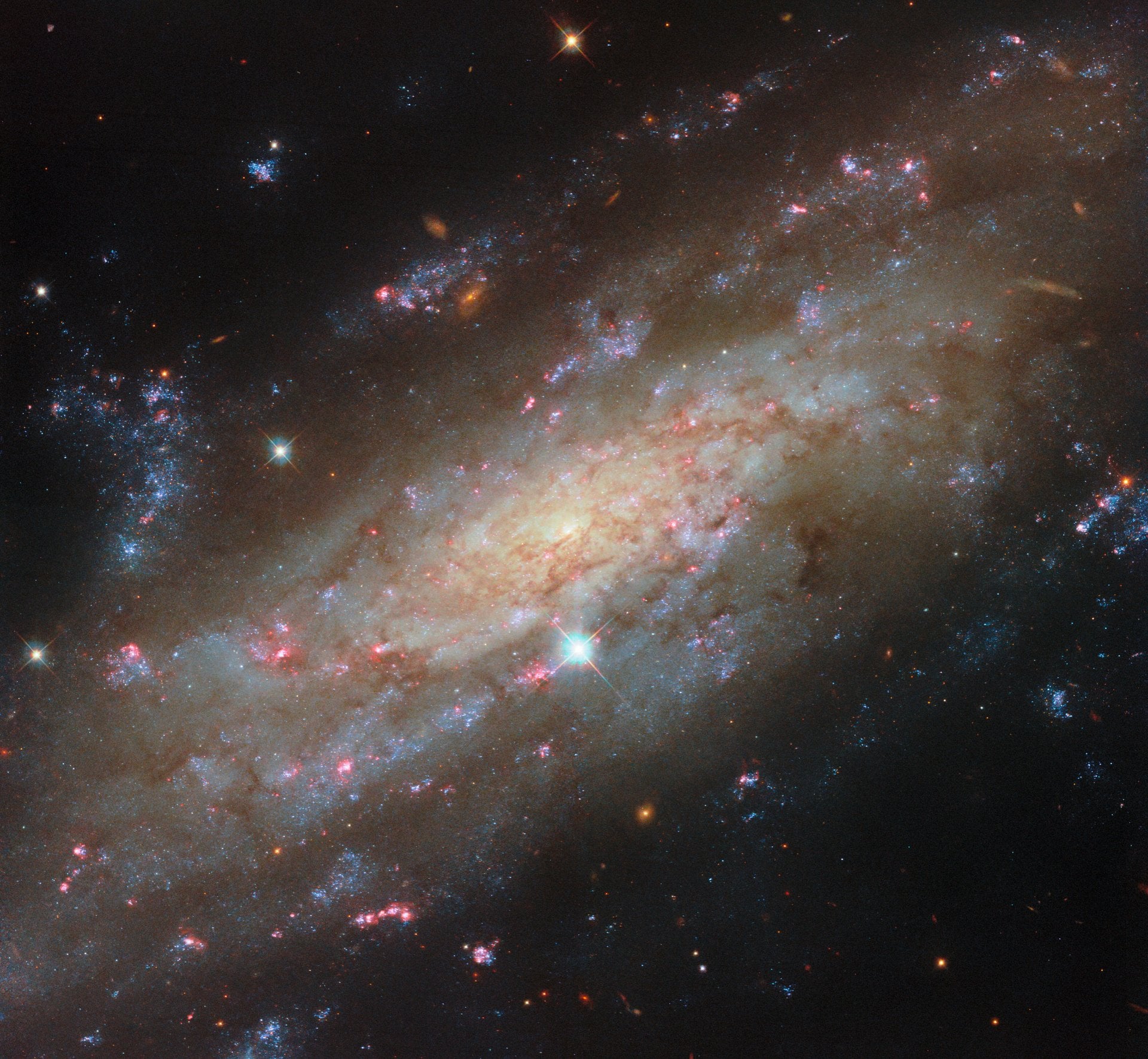
Hubble Captures Starry Spiral Galaxy NGC 3137
The Gist
Hubble captures a detailed image of spiral galaxy NGC 3137, located 53 million light-years away.
Explain Like I'm Five
"Hubble took a picture of a faraway galaxy, like our Milky Way, to help scientists learn how stars are born and grow."
Deep Intelligence Analysis
The image highlights stellar clusters where stars are born from collapsing clouds of dust and gas. The galaxy's center hosts a black hole estimated at 60 million solar masses. NGC 3137's high inclination provides a clear view of its spiral structure, with foreground Milky Way stars and distant background galaxies also visible. The PHANGS program integrates data from Hubble, the James Webb Space Telescope (JWST), and the Atacama Large Millimeter-submillimeter Array (ALMA) to conduct multi-scale, multi-phase studies of star formation in 55 nearby galaxies. This comprehensive approach enables an in-depth understanding of stellar lifecycles across spiral galaxies in the local universe. Newly formed stars appear as glowing red clouds, young stars are visible in bright blue clusters, and ancient stellar populations are large, red, and dusty.
*Transparency Disclosure: This analysis was conducted by an AI model and reviewed by human experts. While every effort has been made to ensure accuracy, the analysis should be considered as informational and not definitive. DailyOrbitalWire.news is committed to transparency in its AI-driven content creation.*
_Context: This intelligence report was compiled by the DailyOrbitalWire Strategy Engine. Verified for Art. 50 Compliance._
Impact Assessment
The image provides astronomers with an opportunity to study the life cycle of stars in a galaxy similar to the Milky Way. The PHANGS program combines data from Hubble, JWST, and ALMA to study star formation across spiral galaxies.
Read Full Story on Universe TodayKey Details
- ● NGC 3137 is located 53 million light-years away in the constellation Antlia.
- ● NGC 3137 is part of a group of galaxies similar to the Local Group.
- ● The galaxy's center hosts a black hole estimated at 60 million solar masses.
- ● The image combines observations in six different color bands.
Optimistic Outlook
Detailed observations of NGC 3137 and other galaxies will refine our understanding of stellar evolution and galaxy formation. Multi-telescope collaborations like PHANGS promise comprehensive insights into the cosmos.
Pessimistic Outlook
The vast distances involved limit the resolution and detail obtainable, even with advanced telescopes. Data interpretation can be complex, potentially leading to inaccurate conclusions about galactic processes.

The Signal, Not
the Noise|
Get the week's top 1% of space-tech intelligence synthesized into a 5-minute read. Join 25,000+ aerospace insiders.
Unsubscribe anytime. No spam, ever.