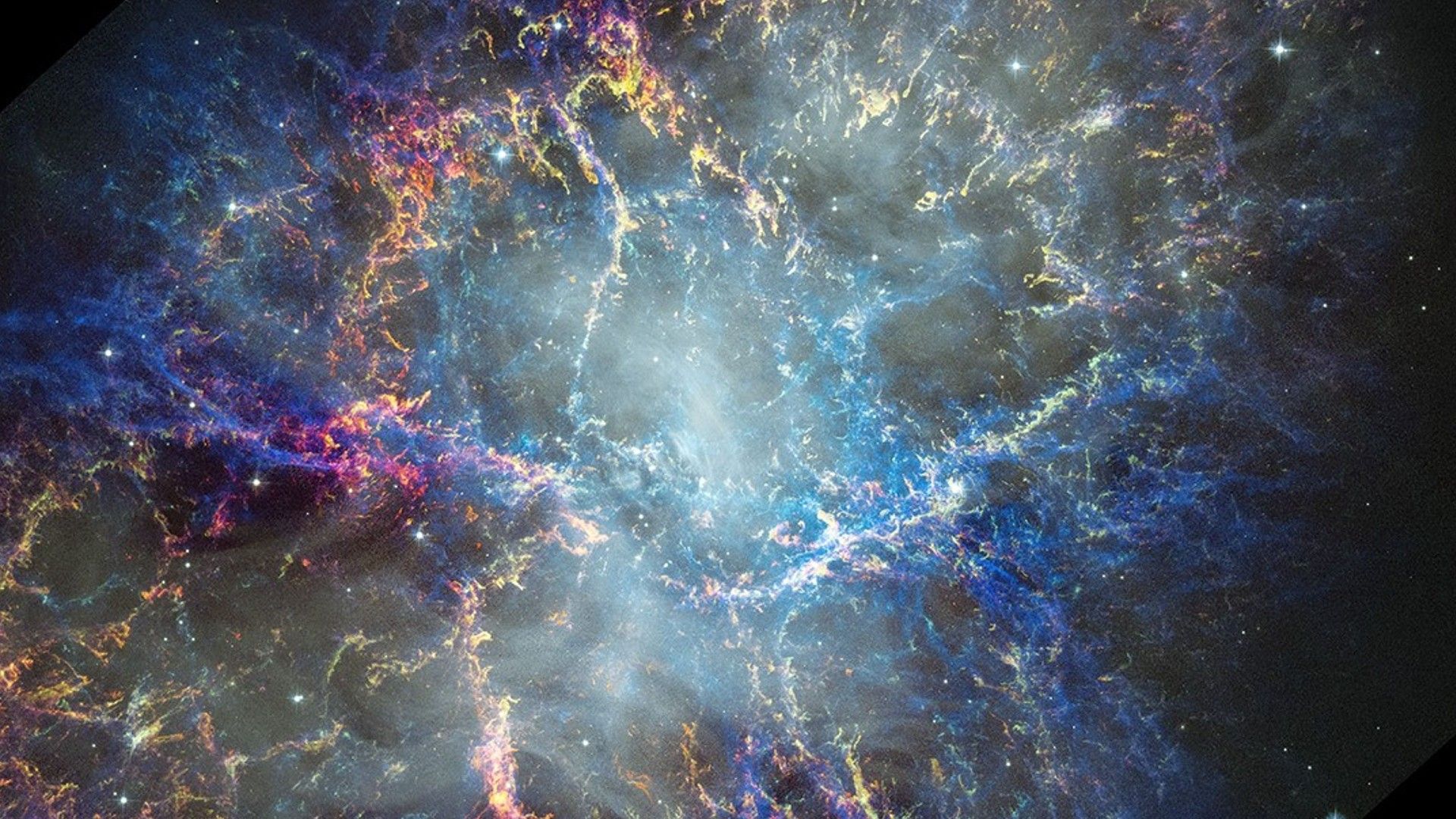
Hubble Revisits Crab Nebula, Reveals Expansion
The Gist
Hubble's 2024 images of the Crab Nebula reveal changes in gas temperature, density, and composition compared to 1999 images.
Explain Like I'm Five
"Imagine a firework that exploded a long time ago. Hubble is like a camera that took pictures of it then and now, and we can see how the smoke is still moving and changing!"
Deep Intelligence Analysis
The Crab Nebula, located 6,500 light-years away in the constellation Taurus, is the result of a supernova observed in 1054. Hubble's Wide Field Camera 3, installed in 2009, has enabled higher-resolution imaging, allowing for detailed analysis of the nebula's evolution. Comparing the 2024 images with those from 1999 allows scientists to track the expansion and transformation of the nebula's constituent gases. This research underscores the importance of sustained investment in space telescopes for advancing our understanding of astrophysical phenomena. The ability to observe changes over decades provides critical insights into the long-term processes shaping the universe.
Continued monitoring of the Crab Nebula and other dynamic celestial objects will rely on the next generation of space telescopes. These future observatories will need to build upon Hubble's legacy, offering even greater resolution and sensitivity to further unravel the mysteries of the cosmos. The study of supernova remnants like the Crab Nebula is crucial for understanding stellar evolution, the creation of heavy elements, and the overall dynamics of galaxies.
*Transparency: This analysis was generated by an AI model to provide a concise summary of the provided article. The AI model is trained to avoid hallucinations and adheres to the EU AI Act Article 50 compliance standards.*
_Context: This intelligence report was compiled by the DailyOrbitalWire Strategy Engine. Verified for Art. 50 Compliance._
Impact Assessment
The Hubble Space Telescope's longevity allows astronomers to study the evolution of supernova remnants over time. These observations provide insights into the changing conditions and chemical composition of nebulae.
Read Full Story on Space.comKey Details
- ● The Crab Nebula is 6,500 light-years from Earth in Taurus.
- ● Hubble first imaged the nebula in 1999 and again in 2024.
- ● Gases are moving outward at 3.4 million miles per hour (5.5 million kilometers per hour).
- ● The supernova that created the nebula was visible in 1054.
Optimistic Outlook
Continued observations with Hubble and other telescopes will further refine our understanding of supernova remnants. This will lead to better models of stellar evolution and the distribution of elements in the universe.
Pessimistic Outlook
The lifespan of Hubble is finite, and its eventual decommissioning will limit long-term observations. Future telescopes will need to match or exceed Hubble's capabilities to continue this research.

The Signal, Not
the Noise|
Get the week's top 1% of space-tech intelligence synthesized into a 5-minute read. Join 25,000+ aerospace insiders.
Unsubscribe anytime. No spam, ever.