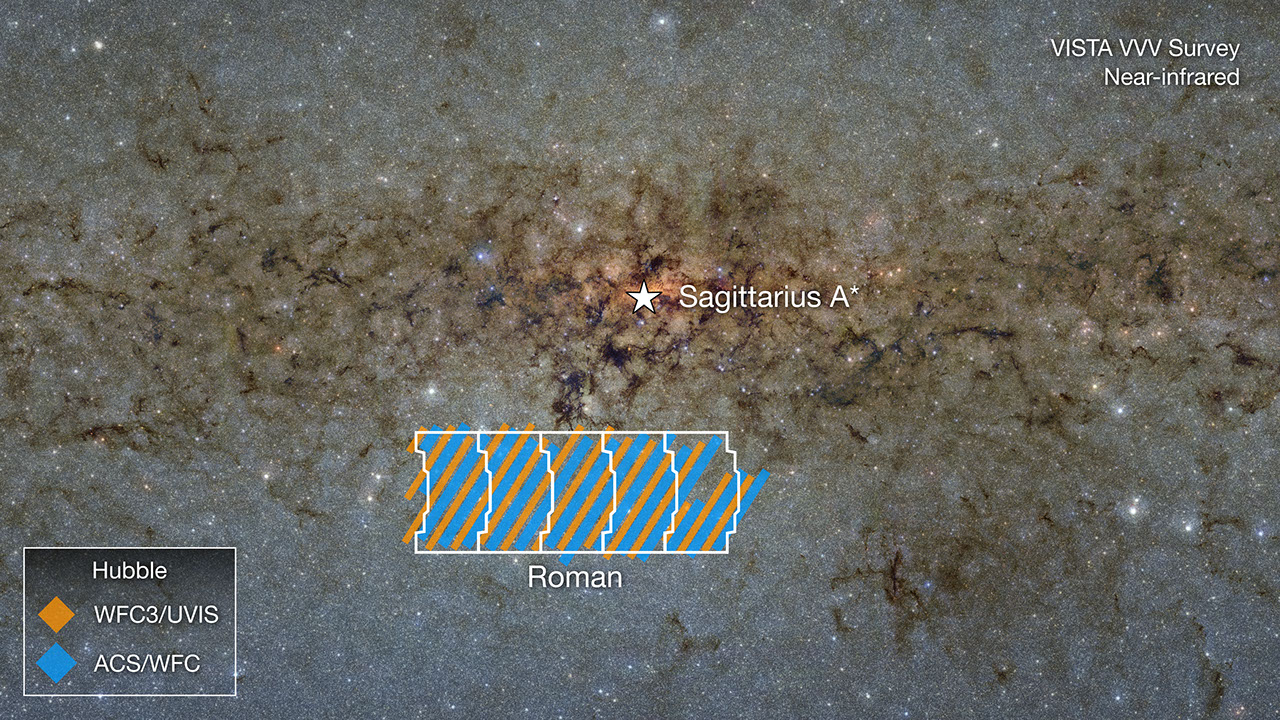
Hubble Prepares Groundwork for Roman Telescope's Galactic Bulge Survey
The Gist
Hubble is gathering data to support the Nancy Grace Roman Space Telescope's 2026 survey of the Milky Way's galactic bulge.
Explain Like I'm Five
"Hubble is helping Roman, a new telescope, get ready to study a crowded part of our galaxy. Roman will look for planets by watching how their gravity bends light, and Hubble is giving it a head start."
Deep Intelligence Analysis
Hubble's preparatory observations are crucial for disentangling light sources during microlensing events. By providing baseline data before these events occur, Hubble enables astronomers to differentiate between the lensing object and the background star, improving the accuracy of Roman's measurements. The collaboration between Hubble and Roman highlights the importance of multi-observatory approaches in modern astronomy.
The Roman Space Telescope's capabilities, including its wide field of view and rapid cadence, will enable it to survey millions of stars and discover thousands of new exoplanets. This will contribute to a more complete understanding of exoplanet populations and the distribution of matter within the galactic bulge. The mission's success hinges on the timely launch of the Roman Space Telescope and the effective integration of data from multiple observatories.
Transparency Footnote: This analysis was generated by an AI model to provide a concise and informative summary of the provided source content. The AI model was trained on a diverse range of scientific and technical texts to ensure accuracy and objectivity. The analysis is intended for informational purposes only and should not be considered as professional advice.
_Context: This intelligence report was compiled by the DailyOrbitalWire Strategy Engine. Verified for Art. 50 Compliance._
Impact Assessment
The Roman telescope's survey will detect thousands of new exoplanets and other objects. Hubble's data will help astronomers interpret Roman's observations by providing a baseline for comparison before microlensing events occur.
Read Full Story on NASA Breaking NewsKey Details
- ● Roman Space Telescope launch is targeted for early September 2026.
- ● Roman will survey 1.7 square degrees of the galactic bulge.
- ● Roman's Galactic Bulge Time-Domain Survey will consist of six 72-day observing seasons.
- ● Roman will take a snapshot every 12 minutes during the survey.
Optimistic Outlook
The combined data from Hubble and Roman could revolutionize our understanding of exoplanet populations and the distribution of rogue planets. Roman's microlensing capabilities will allow for a complete census of objects as small as Mars.
Pessimistic Outlook
Delays in the Roman Space Telescope launch could impact the timeline for the Galactic Bulge Time-Domain Survey. Accurately disentangling light sources during microlensing events remains a complex challenge.

The Signal, Not
the Noise|
Get the week's top 1% of space-tech intelligence synthesized into a 5-minute read. Join 25,000+ aerospace insiders.
Unsubscribe anytime. No spam, ever.