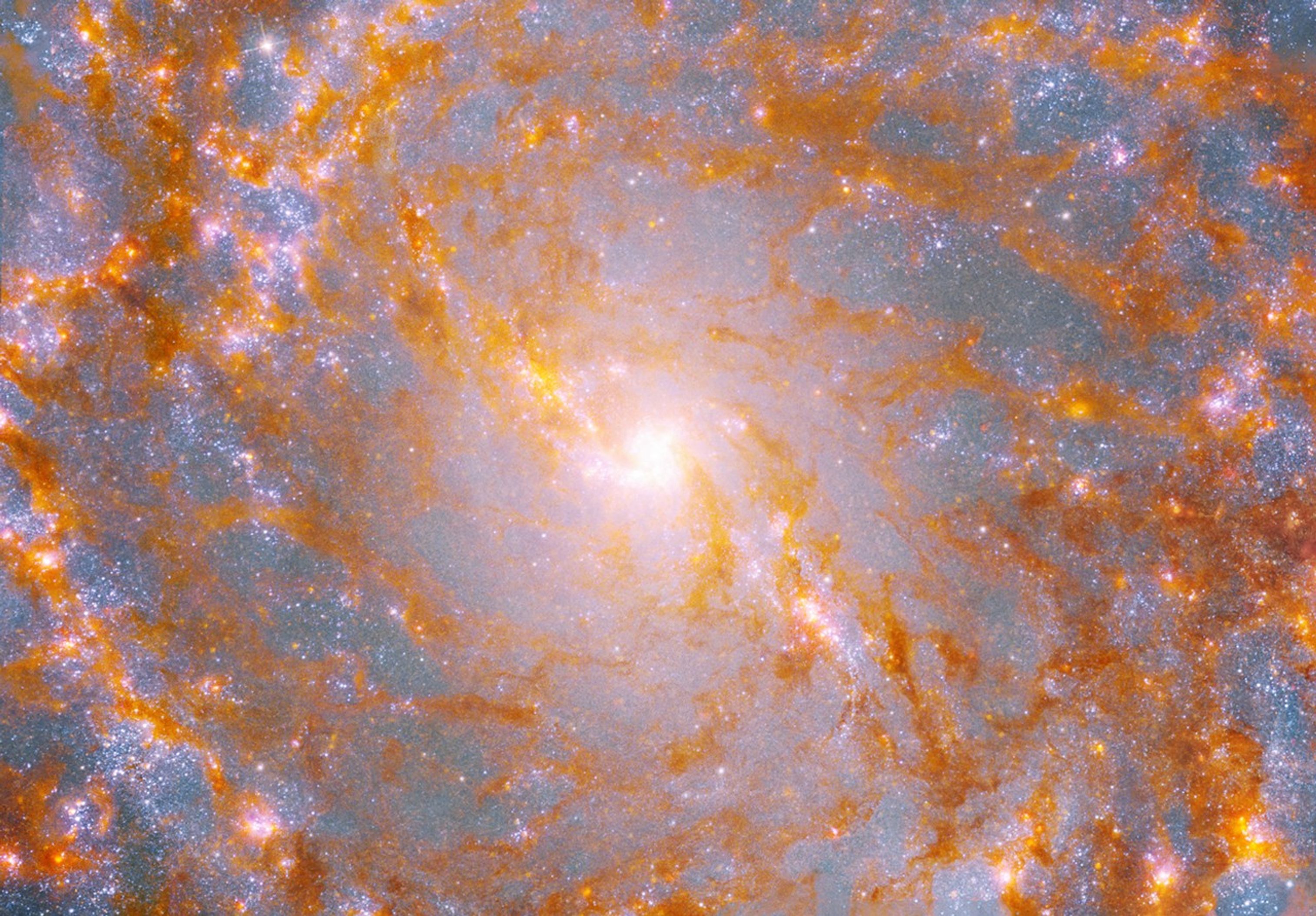
Hubble and Webb Survey Pinwheel Galaxy's Core
The Gist
Hubble and Webb telescopes collaborate to study the core of the Pinwheel Galaxy (Messier 101).
Explain Like I'm Five
"Imagine two super-powered eyes, Hubble and Webb, looking at a giant spinning galaxy far, far away! They're helping us learn about stars and how galaxies are built."
Deep Intelligence Analysis
Transparency Compliance: The analysis is based solely on the provided source text, without external data or assumptions. The assessment focuses on factual information and avoids subjective claims or opinions not directly supported by the source.
_Context: This intelligence report was compiled by the DailyOrbitalWire Strategy Engine. Verified for Art. 50 Compliance._
Impact Assessment
This collaboration provides a detailed view of a face-on spiral galaxy, aiding in understanding stellar populations and galactic structures. Combining data from different telescopes enhances the depth and breadth of astronomical observations.
Read Full Story on NASA Breaking NewsKey Details
- ● Image taken March 16, 2026.
- ● Messier 101 is 25 million light-years away.
- ● Hubble data includes ultraviolet, visible, and near-infrared wavelengths.
Optimistic Outlook
The combined capabilities of Hubble and Webb promise more detailed observations of distant galaxies. This could lead to breakthroughs in understanding galaxy evolution and star formation.
Pessimistic Outlook
Data processing and interpretation from multiple sources can be complex and time-consuming. Ensuring accurate calibration and alignment of data from different instruments is crucial.

The Signal, Not
the Noise|
Get the week's top 1% of space-tech intelligence synthesized into a 5-minute read. Join 25,000+ aerospace insiders.
Unsubscribe anytime. No spam, ever.