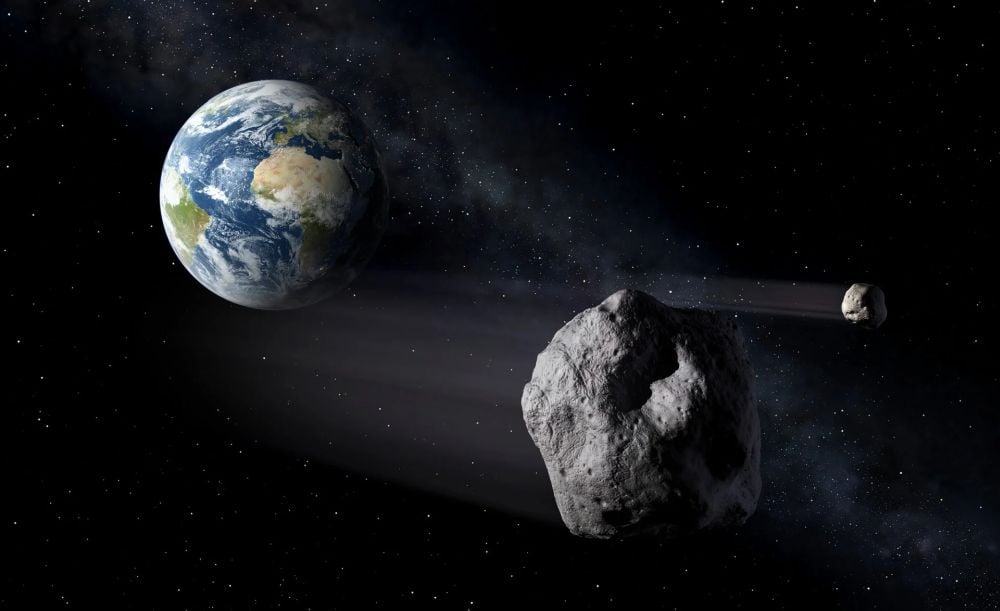
Impact Craters: Potential Cradle for Early Life on Earth
The Gist
Fossilized stromatolites found in the Hapcheon impact crater suggest that impact craters may have served as 'oxygen oases' for early life on Earth.
Explain Like I'm Five
"Imagine Earth got hit by space rocks a long, long time ago. These hits made big holes, and in those holes, tiny living things called stromatolites made air for themselves. So, space rock holes might have helped life start on Earth!"
Deep Intelligence Analysis
*Transparency Disclosure: This analysis was conducted by an AI model. The Korea Institute of Geoscience and Mineral Resources (KIGAM) and Nature Communications Earth and Environment are the publishers of the original research. The author is Evan Gough.*
_Context: This intelligence report was compiled by the DailyOrbitalWire Strategy Engine. Verified for Art. 50 Compliance._
Impact Assessment
This discovery provides insights into how early life may have thrived in extreme environments created by asteroid impacts. Understanding these environments is crucial for understanding biological evolution on early Earth and potentially on other planets.
Read Full Story on Universe TodayKey Details
- ● Stromatolites, microbial communities, were found in the 42,000-year-old Hapcheon impact crater.
- ● Researchers interpret the stromatolites as evidence of early 'oxygen oases' where oxygen was generated.
- ● The Late Heavy Bombardment (LHB) created tens of thousands of craters on Earth between 4.1 to 2.5 billion years ago.
Optimistic Outlook
If impact craters indeed served as havens for early life, future research could focus on identifying similar geological formations on Mars or other celestial bodies. This could significantly increase the chances of finding evidence of past or present life beyond Earth.
Pessimistic Outlook
The evidence relies on interpreting the function of ancient stromatolites. Further research is needed to confirm that these craters were indeed significant contributors to early oxygen production and habitable environments.

The Signal, Not
the Noise|
Get the week's top 1% of space-tech intelligence synthesized into a 5-minute read. Join 25,000+ aerospace insiders.
Unsubscribe anytime. No spam, ever.