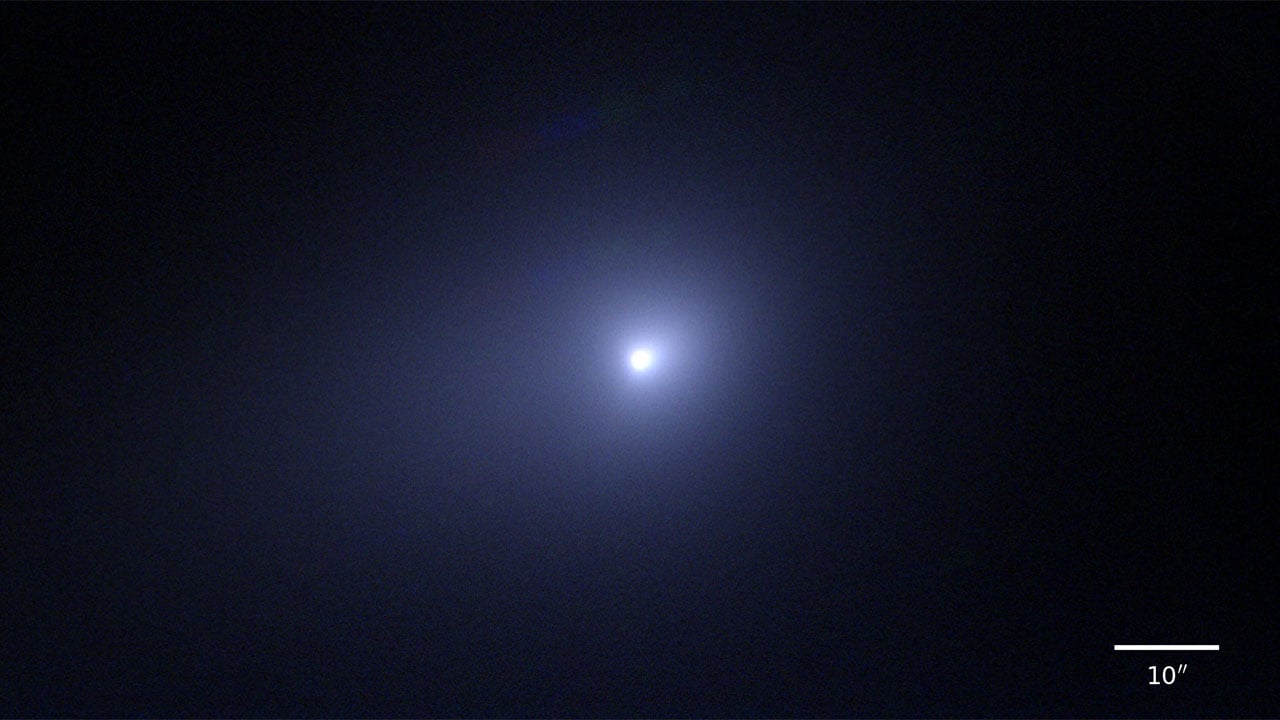
JUICE and Europa Clipper Simultaneously Observe Interstellar Comet 3I/ATLAS.
The Gist
ESA's JUICE and NASA's Europa Clipper simultaneously observed interstellar comet 3I/ATLAS, revealing its chemical composition after its pass by the Sun.
Explain Like I'm Five
"Two space robots, JUICE and Europa Clipper, worked together to look at a space snowball from another star system! They found out what it's made of by looking at the light it gives off."
Deep Intelligence Analysis
The detection of higher-than-expected carbon emissions, compared to comets within our Solar System, suggests that 3I/ATLAS may have originated from a different type of star system with distinct chemical conditions. The coordinated effort between the JUICE and Europa Clipper teams, facilitated by the involvement of SwRI researchers in both missions, demonstrates the potential for maximizing scientific return through collaborative observation strategies.
From a market perspective, the success of this mission highlights the value of investing in advanced scientific instruments and international collaborations. The data obtained from 3I/ATLAS will contribute to a better understanding of the formation and evolution of planetary systems, potentially informing future space exploration missions and resource utilization strategies. The coordinated observation also serves as a model for future missions targeting transient events, such as supernovae or gamma-ray bursts, where simultaneous observations from multiple platforms are essential for capturing critical data.
_Context: This intelligence report was compiled by the DailyOrbitalWire Strategy Engine. Verified for Art. 50 Compliance._
Impact Assessment
Simultaneous observations provide unique insights into the composition of interstellar objects, helping scientists understand conditions in other star systems. The coordinated effort demonstrates the potential for collaborative science between different space missions.
Read Full Story on Universe TodayKey Details
- ● The observations occurred in December 2025.
- ● The instruments used were the Ultraviolet Spectrographs (UVS) on both JUICE and Europa Clipper.
- ● The observations revealed hydrogen, oxygen, and carbon emissions from the comet.
- ● Higher-than-expected carbon emissions were detected compared to comets in our Solar System.
Optimistic Outlook
The success of this coordinated observation paves the way for future collaborations between space missions, maximizing scientific return. Further analysis of the comet's composition could reveal valuable information about the formation of planetary systems.
Pessimistic Outlook
The limited observation window and the challenges of coordinating observations between distant spacecraft pose limitations. The data obtained may not be fully representative of the comet's overall composition.

The Signal, Not
the Noise|
Get the week's top 1% of space-tech intelligence synthesized into a 5-minute read. Join 25,000+ aerospace insiders.
Unsubscribe anytime. No spam, ever.