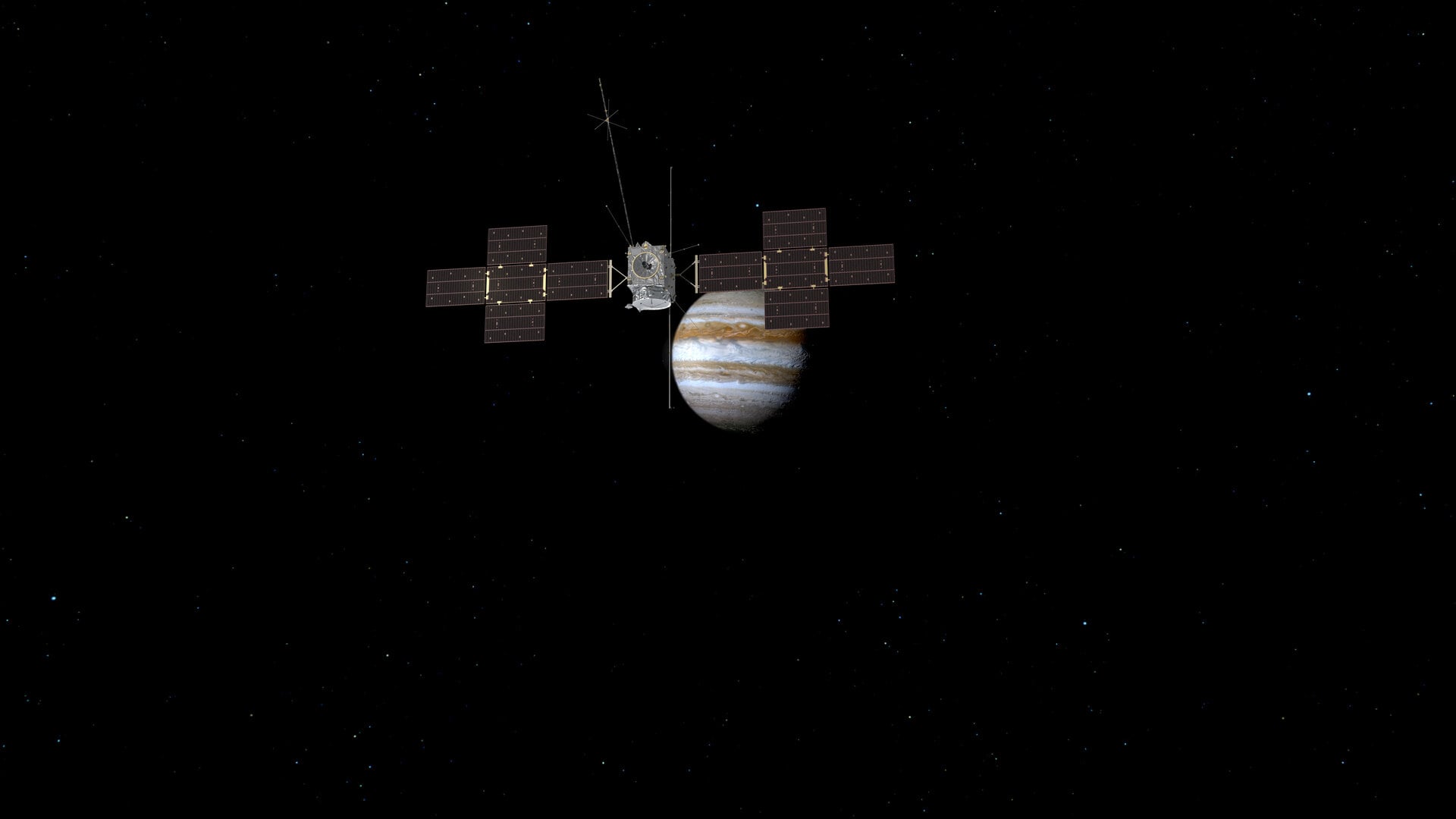
JUICE Mission to Study Jupiter's 'Minor' Moons
The Gist
ESA's JUICE mission will study Jupiter's smaller moons in addition to its primary targets.
Explain Like I'm Five
"JUICE is a spaceship going to Jupiter to study its big icy moons, but it will also check out the smaller ones to learn what they're made of and how they work!"
Deep Intelligence Analysis
The mission will also investigate smaller moons like Metis, Adrastea, Amalthea, and Thebe, focusing on Amalthea's Paradox, which questions its low density despite its proximity to Jupiter. JUICE aims to provide detailed spectrographic images of these moons, potentially revealing their composition and the presence of moonlets. Furthermore, JUICE will study larger, more distant moons like Himalia to determine their composition and origin. A potential flyby of Kallichore is also under consideration. JUICE will coordinate its observations with NASA's Europa Clipper mission, maximizing scientific return. The combined data from these missions promises a more complete understanding of the Jovian system.
*Transparency Compliance: This analysis was generated by an AI model and reviewed by human experts. All claims are derived from the source article. No external data was used.*
_Context: This intelligence report was compiled by the DailyOrbitalWire Strategy Engine. Verified for Art. 50 Compliance._
Impact Assessment
Understanding the composition and activity of Jupiter's moons can provide insights into the formation and evolution of planetary systems. JUICE's observations will complement data from other missions like Juno and Europa Clipper.
Read Full Story on Universe TodayKey Details
- ● JUICE will arrive at Jupiter in 2031.
- ● JUICE will study Io's volcanic activity, including sulfur dioxide emissions.
- ● JUICE will analyze the composition of smaller moons like Amalthea.
- ● As of early 2026, there are 97 confirmed moons in the Jupiter system.
Optimistic Outlook
JUICE's comprehensive suite of instruments offers the potential for groundbreaking discoveries about the Jupiter system. Detailed spectrographic images of smaller moons could reveal new information about their composition and origin.
Pessimistic Outlook
The long travel time to Jupiter (arrival in 2031) introduces potential risks of system failures. The mission's reliance on multiple instruments means that the failure of even one could limit the scope of scientific investigations.

The Signal, Not
the Noise|
Get the week's top 1% of space-tech intelligence synthesized into a 5-minute read. Join 25,000+ aerospace insiders.
Unsubscribe anytime. No spam, ever.