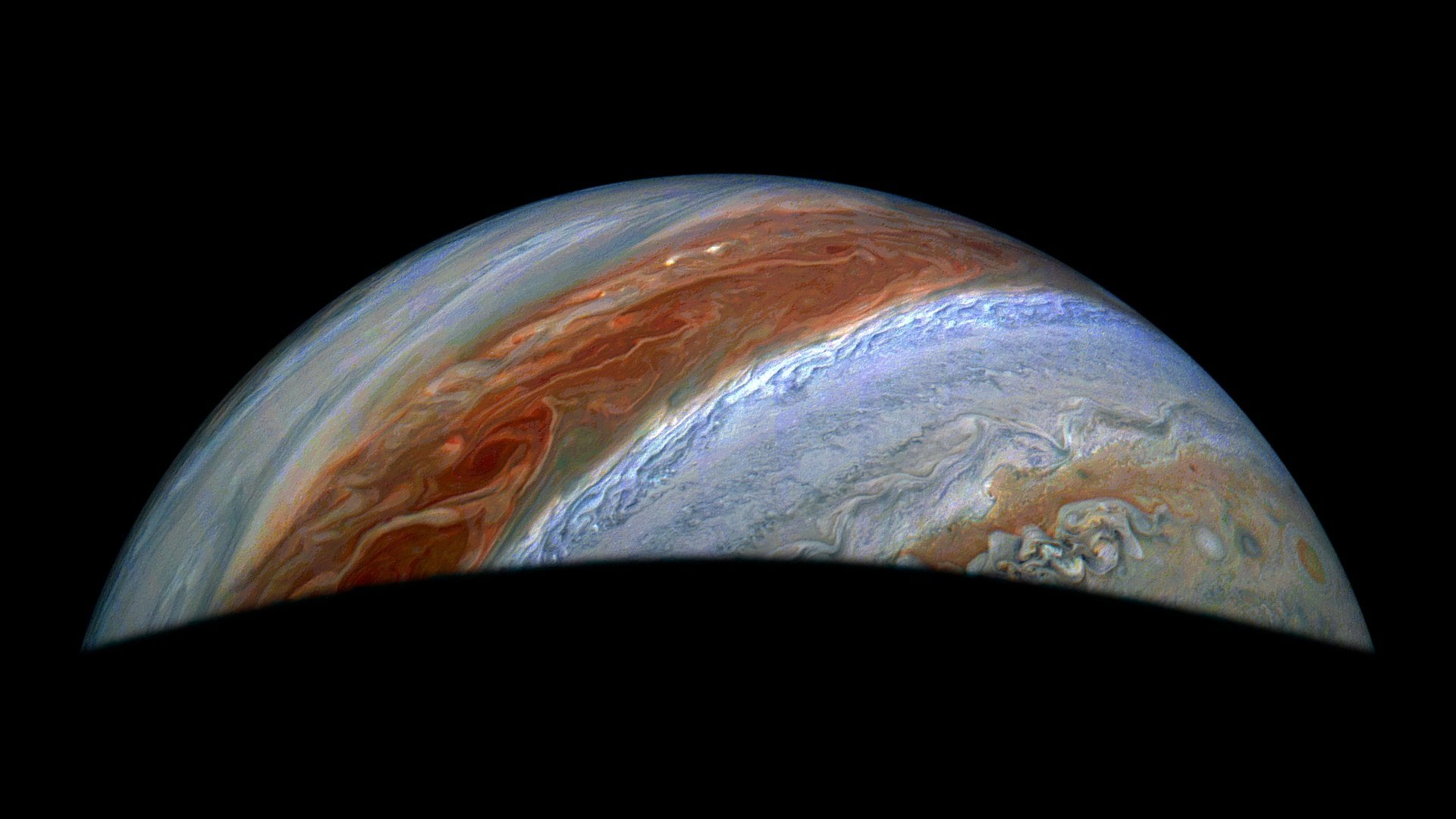
Juno Mission Reveals Complex Interior of Jupiter
The Gist
NASA's Juno mission reveals Jupiter's interior structure is more complex than previously understood, challenging existing planet formation theories.
Explain Like I'm Five
"Imagine Jupiter is like an onion, but instead of simple layers, it has lots of complicated ones inside! A spacecraft called Juno is helping us learn about these layers, and it turns out Jupiter is more confusing than we thought!"
Deep Intelligence Analysis
The mission's data necessitates modeling Jupiter as a multi-layered structure, akin to an onion with numerous layers, to accurately perform calculations. This complexity extends to the planet's magnetic field and atmospheric dynamics. The findings have implications for understanding the formation of gas giants and the evolution of planetary systems. The mission continues to gather data as it progresses towards Jupiter's North Pole, promising further insights into the planet's composition and internal processes. The Juno mission is actively rewriting the textbooks on gas giant formation, forcing scientists to reconsider long-held assumptions about planetary interiors.
*Transparency Disclosure: This analysis was composed by an AI model and reviewed by human experts.*
_Context: This intelligence report was compiled by the DailyOrbitalWire Strategy Engine. Verified for Art. 50 Compliance._
Impact Assessment
The Juno mission's findings are reshaping our understanding of gas giant formation and planetary interiors. This challenges existing models and necessitates a re-evaluation of planet formation theories.
Read Full Story on Universe TodayKey Details
- ● Juno is currently in its 83rd orbit around Jupiter.
- ● Juno arrived at Jupiter in 2016 to study the planet's formation and evolution.
- ● Juno's data suggests Jupiter may not have a compact core, or a core smaller than six Earth masses.
Optimistic Outlook
Juno's ongoing mission promises further insights into Jupiter's composition and dynamics, potentially unlocking new understandings of gas giant evolution. Future data could refine models of planetary formation and internal structure.
Pessimistic Outlook
The complexity revealed by Juno may indicate that current models are fundamentally flawed, requiring significant revisions. This could delay progress in understanding gas giant formation and evolution.

The Signal, Not
the Noise|
Get the week's top 1% of space-tech intelligence synthesized into a 5-minute read. Join 25,000+ aerospace insiders.
Unsubscribe anytime. No spam, ever.