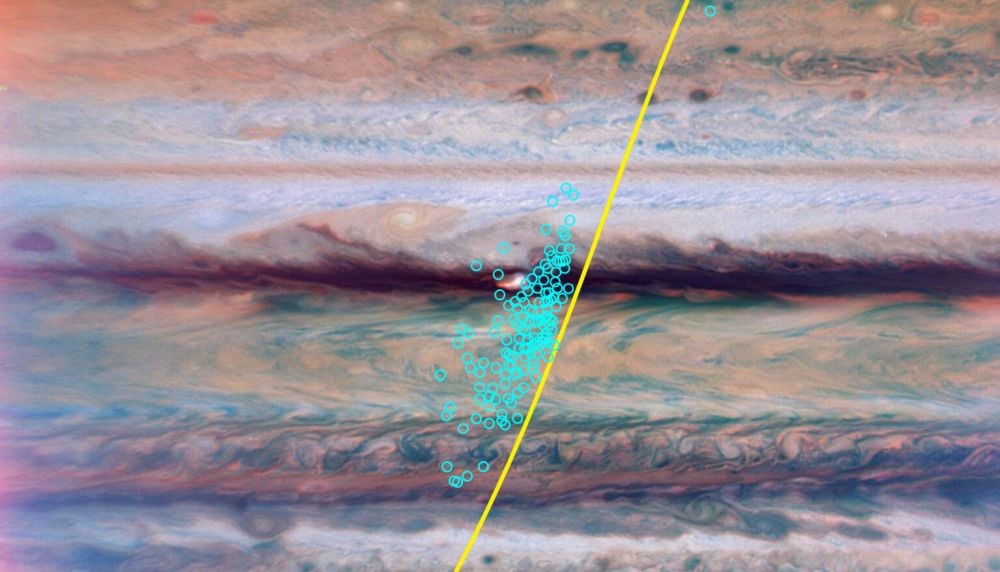
Juno Data Reveals Jupiter Lightning Millions of Times More Powerful Than Earth's
The Gist
New research based on Juno's Microwave Radiometer (MWR) found that lightning on Jupiter could be up to one million times more powerful than terrestrial lightning.
Explain Like I'm Five
"Imagine Jupiter's lightning is like a giant cosmic spark, way bigger and stronger than any lightning we see on Earth! Scientists use a special radio to 'hear' these sparks and learn about Jupiter's weather."
Deep Intelligence Analysis
The MWR instrument's design, featuring six antennas dedicated to specific frequency ranges, enables the detection of high-frequency radio pulses that can propagate directly from the lightning source to the instrument, bypassing the interference of Jupiter's ionosphere. This capability allows researchers to probe Jupiter's lightning more deeply, providing valuable data on the planet's atmospheric dynamics.
These findings contribute to a better understanding of gas giant planets and could potentially aid in the characterization of exoplanets. The advanced sensor technology used in the MWR could also be adapted for Earth-based atmospheric studies, improving weather forecasting and climate models. However, the extreme conditions on Jupiter also highlight the challenges of operating spacecraft in such environments, potentially impacting future mission design and the accuracy of planetary models.
_Context: This intelligence report was compiled by the DailyOrbitalWire Strategy Engine. Verified for Art. 50 Compliance._
Impact Assessment
Understanding Jupiter's lightning helps reveal details about the planet's convection processes, which are responsible for atmospheric churning and heat transport. The MWR's ability to measure radio pulses, not optical pulses, provides a more reliable indicator of lightning strength due to Jupiter's thick atmosphere.
Read Full Story on Universe TodayKey Details
- ● Jupiter's lightning can be up to one million times more powerful than Earth's.
- ● The Microwave Radiometer Instrument (MWR) on Juno detects radio pulses from lightning.
- ● MWR has six antennas, each dedicated to a specific range of frequencies.
- ● MWR detects pulses that have higher frequencies than Jupiter's plasma frequency.
Optimistic Outlook
Improved understanding of Jovian atmospheric dynamics could refine models for gas giant planets, potentially aiding in the characterization of exoplanets. Advanced sensor tech like MWR could be adapted for Earth-based atmospheric studies, improving weather forecasting and climate models.
Pessimistic Outlook
The extreme power of Jupiter's lightning highlights the challenges of operating spacecraft in such environments, potentially impacting future mission design. The complexity of Jovian atmospheric processes may limit the accuracy of current planetary models, hindering our understanding of gas giant evolution.

The Signal, Not
the Noise|
Get the week's top 1% of space-tech intelligence synthesized into a 5-minute read. Join 25,000+ aerospace insiders.
Unsubscribe anytime. No spam, ever.