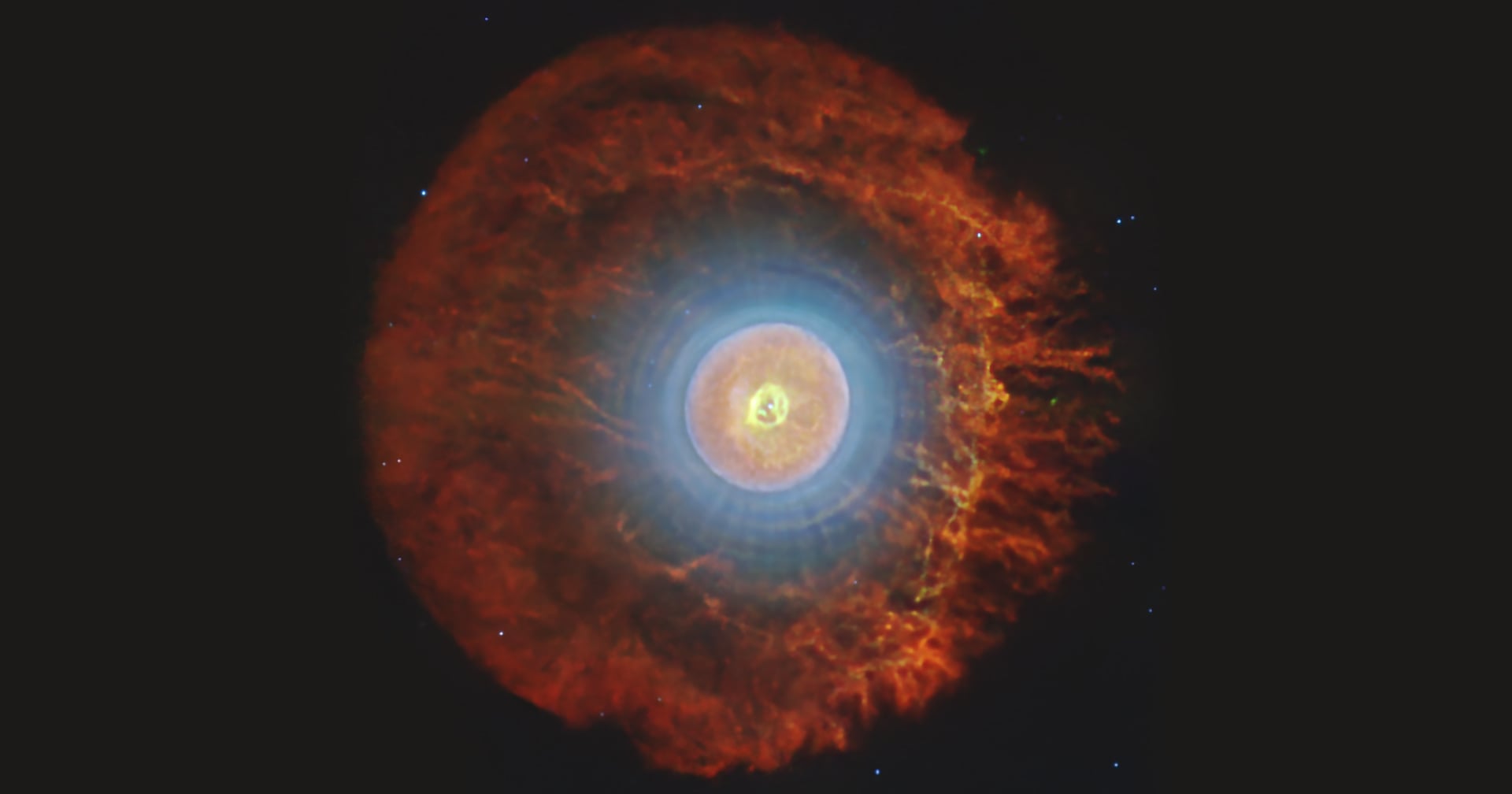
JWST Pinpoints Origin of Cosmic Buckyballs
The Gist
James Webb Space Telescope identifies the birthplace of buckyballs, complex carbon molecules, in a planetary nebula.
Explain Like I'm Five
"Imagine tiny soccer balls made of carbon floating in space! Scientists using a super powerful telescope called JWST found out where these balls are born, inside a cloud of gas left over from a dying star."
Deep Intelligence Analysis
The discovery is crucial for understanding carbon chemistry in extreme environments and its potential role in the origins of life. Buckyballs' unique structure and stability make them interesting candidates for various applications, including drug delivery and materials science. The JWST's ability to observe these molecules in detail opens new avenues for research into the formation and evolution of complex organic molecules in space.
Further studies are needed to determine the exact mechanisms by which buckyballs form in space and to explore their potential interactions with other molecules and materials. The insights gained from this research could have far-reaching implications for our understanding of the universe and the development of new technologies. The Canadian Space Agency (CSA) and the Natural Sciences and Engineering Research Council of Canada (NSERC) provided support for this research.
_Context: This intelligence report was compiled by the DailyOrbitalWire Strategy Engine. Verified for Art. 50 Compliance._
Impact Assessment
Understanding the formation of buckyballs in space helps track carbon chemistry and understand how organic materials change in extreme environments. This discovery challenges traditional views about space chemistry and offers clues about the origins of life.
Read Full Story on Universe TodayKey Details
- ● Buckyballs (C60) were first observed in space in 2010 by Professor Jan Cami using the Spitzer Space Telescope.
- ● The JWST's Mid-Infrared Instrument (MIRI) captured detailed views of the planetary nebula Tc 1, located 12,400 light-years away.
- ● Tc 1 is a stellar remnant (white dwarf) that expelled its outer layers, forming glowing gas clouds.
Optimistic Outlook
The JWST's advanced capabilities will likely lead to further discoveries of complex molecules in space, enhancing our understanding of astrochemistry. This could accelerate the development of new materials and technologies inspired by these molecules.
Pessimistic Outlook
Further research is needed to determine if buckyballs form in space through the same processes as on Earth. The extreme conditions in space may present challenges to replicating their formation in terrestrial labs.

The Signal, Not
the Noise|
Get the week's top 1% of space-tech intelligence synthesized into a 5-minute read. Join 25,000+ aerospace insiders.
Unsubscribe anytime. No spam, ever.