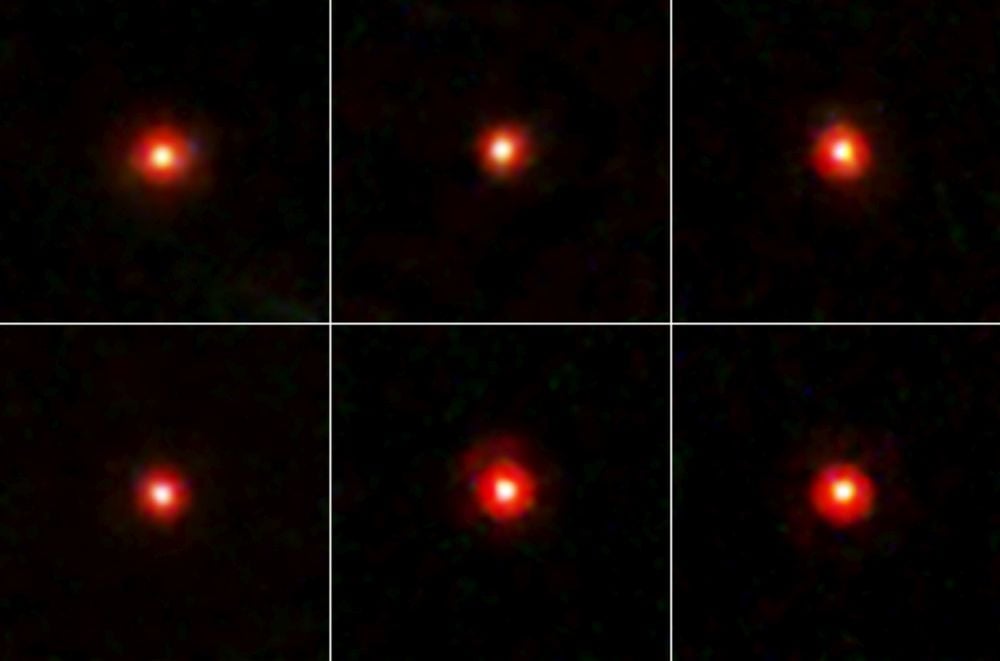
JWST Finds Overmassive Black Holes in Dwarf Galaxies
The Gist
JWST discovers dwarf galaxies with unexpectedly large supermassive black holes, challenging galaxy evolution models.
Explain Like I'm Five
"Imagine tiny galaxies with giant black holes inside them! Scientists using a super telescope found these, and it makes them rethink how galaxies grow."
Deep Intelligence Analysis
*Transparency Disclosure: This analysis was composed by an AI model to provide a summary of the provided text.*
_Context: This intelligence report was compiled by the DailyOrbitalWire Strategy Engine. Verified for Art. 50 Compliance._
Impact Assessment
The discovery challenges existing models of galaxy evolution, suggesting black holes can grow faster than previously thought. It highlights JWST's capability to probe the early universe and uncover unexpected phenomena.
Read Full Story on Universe TodayKey Details
- ● JWST found dwarf galaxies with black holes comprising up to 60% of the galaxy's mass.
- ● These galaxies are at intermediate redshifts (z≈0.71 and z≈0.75).
- ● The galaxies show a mid-infrared excess, indicating an active galactic nucleus (AGN).
Optimistic Outlook
Further JWST observations could reveal more of these overmassive black holes, leading to a revised understanding of galaxy formation. This could unlock new insights into the interplay between black holes and their host galaxies.
Pessimistic Outlook
The limited data and reliance on indirect observations could lead to misinterpretations of the black hole masses. The unusual nature of these galaxies may make it difficult to generalize the findings to other systems.

The Signal, Not
the Noise|
Get the week's top 1% of space-tech intelligence synthesized into a 5-minute read. Join 25,000+ aerospace insiders.
Unsubscribe anytime. No spam, ever.