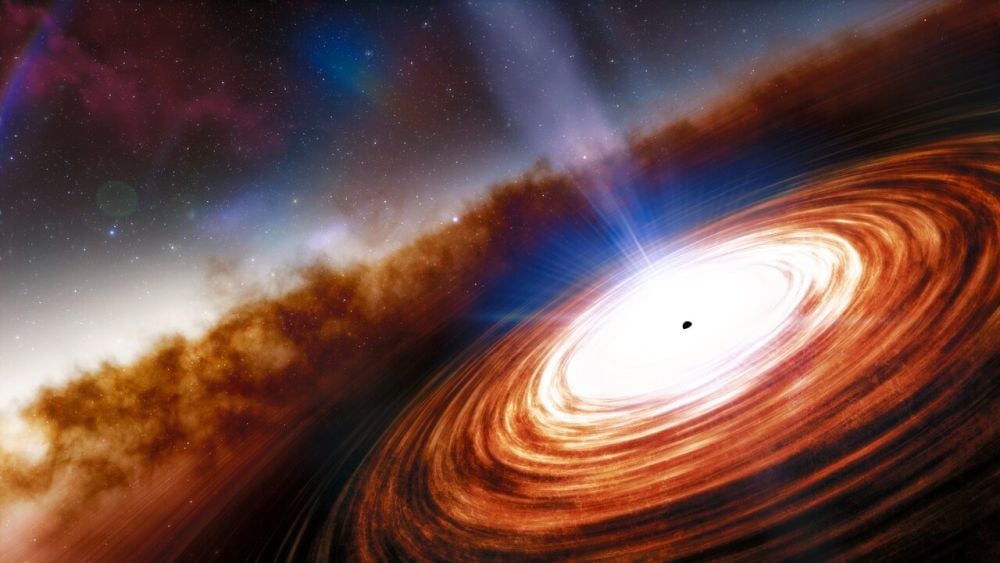
JWST Reveals Overmassive Black Holes in Early Universe
The Gist
JWST observations reveal early black holes are significantly more massive relative to their host galaxies than previously understood.
Explain Like I'm Five
"Imagine baby galaxies with giant black holes inside! These black holes are much bigger than we thought they could be, and scientists are trying to figure out how they got so big so early."
Deep Intelligence Analysis
New research proposes that these OBGs are the result of direct-collapse black holes (DCBHs) forming in primordial dark matter halos. DCBHs are black holes that collapse directly from matter without a stellar precursor, a process thought to be possible only in the unique conditions of the early universe. Cosmological simulations support this theory, suggesting that OBGs are a natural consequence of DCBH formation in the early universe.
The implications of this discovery are profound. It necessitates a revision of our understanding of black hole formation and galaxy evolution. Understanding the mechanisms behind DCBH formation could provide crucial insights into the origins of supermassive black holes and the evolution of galaxies in the early universe. Further research and observations are needed to refine these models and explore the full implications of these findings.
*Transparency Disclosure: This analysis was composed by an AI model. While efforts have been made to ensure accuracy and objectivity, the interpretation and conclusions presented are subject to limitations inherent in AI-driven analysis. The user is encouraged to consult original sources and expert opinions for comprehensive understanding.*
_Context: This intelligence report was compiled by the DailyOrbitalWire Strategy Engine. Verified for Art. 50 Compliance._
Impact Assessment
These findings challenge existing models of black hole and galaxy co-evolution, requiring updates to our understanding of the early universe. Understanding DCBH formation could unlock insights into the origins of supermassive black holes.
Read Full Story on Universe TodayKey Details
- ● Early black holes can comprise 10-30% of their host galaxies' mass.
- ● In extreme cases, black hole mass exceeds the entire stellar mass of the host galaxy.
- ● These galaxies are called overmassive black hole galaxies (OBG).
- ● A new theory suggests these OBGs result from direct-collapse black hole (DCBH) birth in primordial halos.
Optimistic Outlook
New models incorporating DCBH formation could provide a more complete picture of the early universe and black hole evolution. This could lead to breakthroughs in our understanding of fundamental physics.
Pessimistic Outlook
The discovery of OBGs highlights gaps in our current understanding of black hole formation and galaxy evolution. Reconciling these observations with existing models may prove challenging.

The Signal, Not
the Noise|
Get the week's top 1% of space-tech intelligence synthesized into a 5-minute read. Join 25,000+ aerospace insiders.
Unsubscribe anytime. No spam, ever.