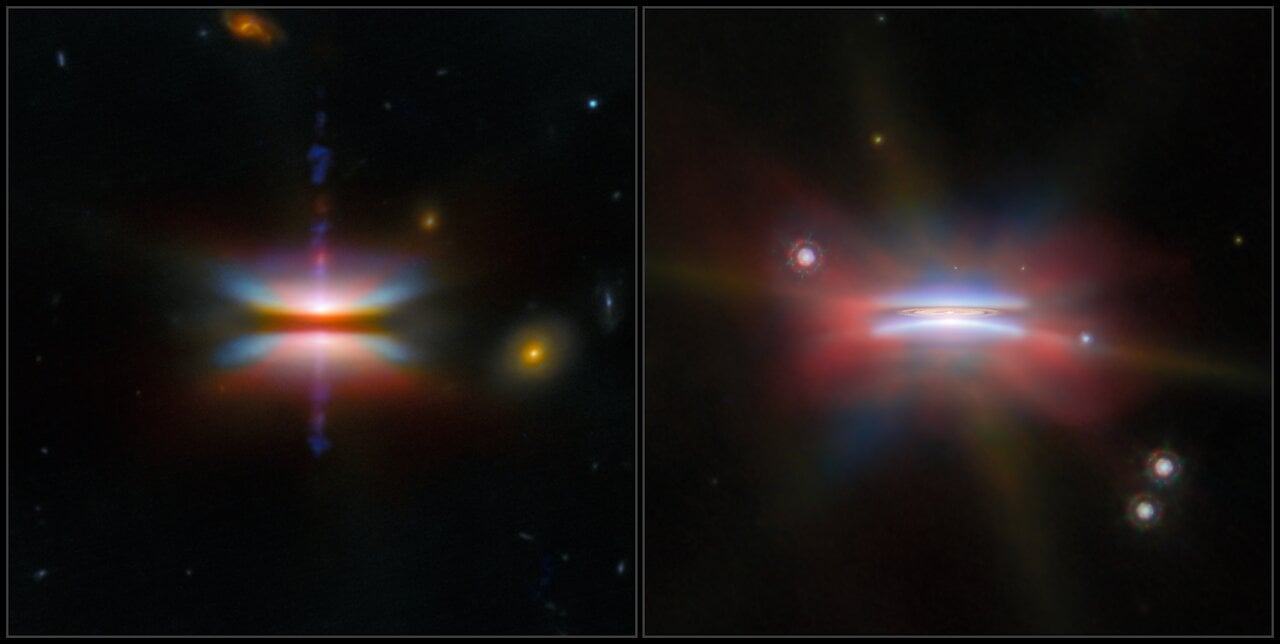
JWST Images Reveal Planet-Forming Disks and Potential Planet
The Gist
JWST captures detailed images of protoplanetary disks, revealing insights into planet formation.
Explain Like I'm Five
"Imagine a spinning pizza of dust and gas around a baby star. JWST took pictures of two of these pizzas, and one might have a baby planet being made inside!"
Deep Intelligence Analysis
_Context: This intelligence report was compiled by the DailyOrbitalWire Strategy Engine. Verified for Art. 50 Compliance._
Impact Assessment
These images provide crucial data on the distribution of gas and dust in protoplanetary disks, aiding in understanding planet formation. The discovery of a potential planet forming within Oph 163131's disk could refine planet formation models.
Read Full Story on Universe TodayKey Details
- ● JWST imaged protoplanetary disks Tau 042021 and Oph 163131, located 450 and 480 light-years from Earth.
- ● Images utilize NIRCam and MIRI to track dust grain distribution and composition.
- ● ALMA data for Oph 163131 shows a gap in the inner disk, potentially indicating planet formation.
- ● The images were obtained as part of Webb's Cycle 1 General Observation (GO) program #2562.
Optimistic Outlook
JWST's capabilities will likely lead to more detailed observations of protoplanetary disks, potentially revealing new exoplanets and refining our understanding of planetary system evolution. Continued analysis of these disks could unlock new insights into the conditions necessary for habitable planet formation.
Pessimistic Outlook
The interpretation of gaps in protoplanetary disks as definitive evidence of planet formation remains challenging. Further observations and modeling are needed to confirm the presence of planets and rule out alternative explanations for the observed structures.

The Signal, Not
the Noise|
Get the week's top 1% of space-tech intelligence synthesized into a 5-minute read. Join 25,000+ aerospace insiders.
Unsubscribe anytime. No spam, ever.