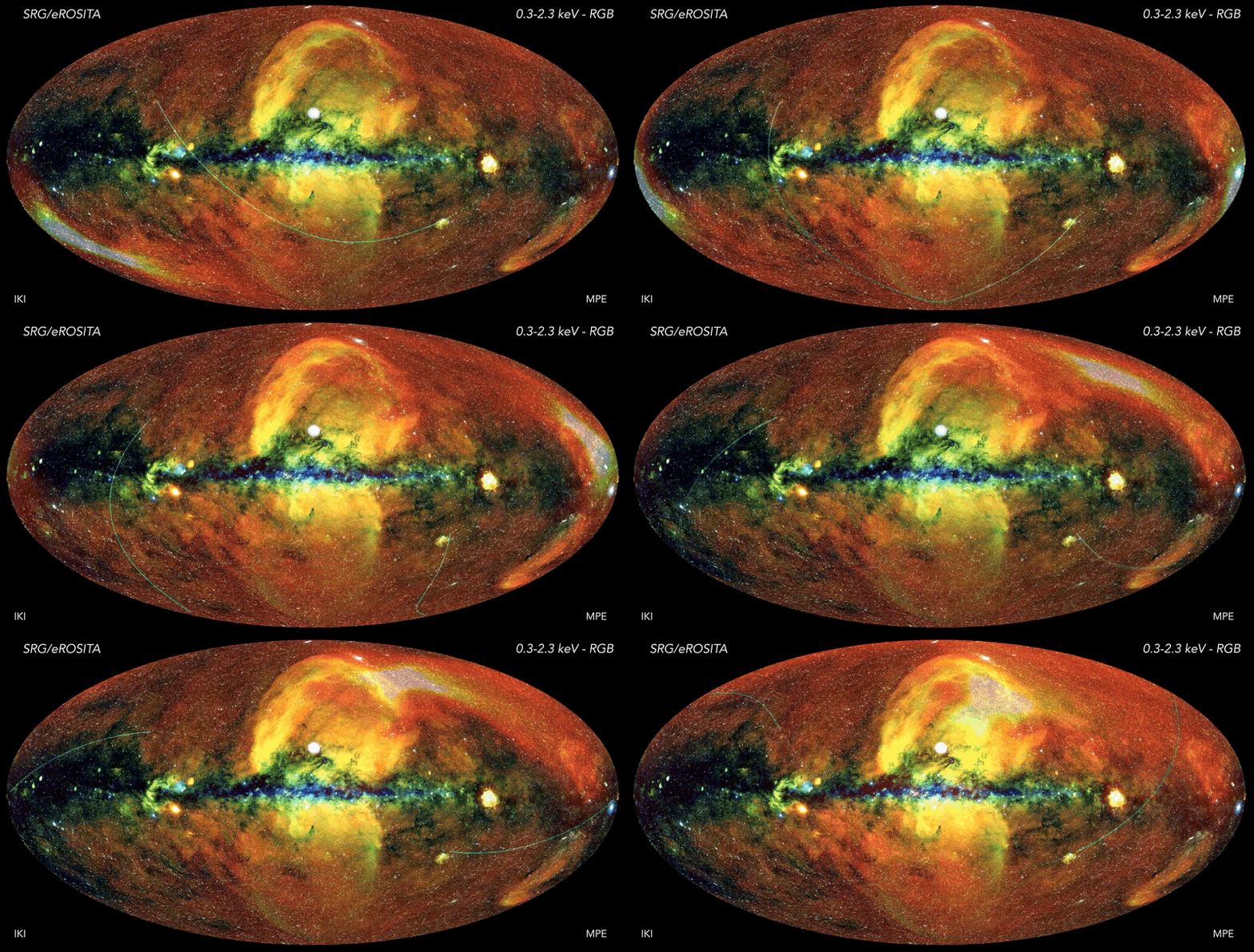
eROSITA maps Solar System's X-ray emissions, revealing new insights.
The Gist
eROSITA disentangles the Solar System's X-ray glow from deep space, providing unprecedented data.
Explain Like I'm Five
"Imagine taking a special picture of our Solar System with X-ray vision! Scientists used a telescope far away from Earth to see things we couldn't see before, like how the Sun's wind interacts with stuff floating in space."
Deep Intelligence Analysis
The implications for multi-planetary logistics are indirect but potentially significant. A better understanding of the solar wind and its interaction with the ISM could improve space weather forecasting, which is essential for protecting spacecraft and astronauts during long-duration missions. More accurate models of the space environment could also lead to more efficient spacecraft designs and mission planning. The study's findings also contribute to our understanding of the fundamental processes that shape the heliosphere, which is relevant to the search for habitable environments beyond Earth.
From a hardware engineering perspective, the eROSITA mission demonstrates the importance of strategic telescope placement and long-term observation capabilities. The ability to conduct observations from solar minimum onwards allowed researchers to track changes in X-ray levels driven by solar activity, providing valuable insights into the dynamics of the heliosphere. This highlights the need for robust and adaptable space-based instruments that can withstand the harsh conditions of space and provide continuous data over extended periods.
*Transparency Statement: This analysis was conducted by an AI language model to provide an objective summary of the provided source content.*
_Context: This intelligence report was compiled by the DailyOrbitalWire Strategy Engine. Verified for Art. 50 Compliance._
Impact Assessment
The new data refines cosmological models by isolating solar wind charge exchange (SWCX) emissions, previously considered signal interference. Understanding SWCX improves the accuracy of temperature and density measurements vital for understanding the universe's evolution. The ability to study the heavy-ion content of the solar wind and its interaction with the interstellar medium is now possible.
Read Full Story on Universe TodayKey Details
- ● eROSITA, aboard the SRG observatory, collected data from 2019-2021.
- ● The telescope is located around the L2 Lagrange Point.
- ● The study confirmed the existence of a 'helium focusing cone'.
- ● Observed changes in X-ray emissions due to increased solar activity.
Optimistic Outlook
The ability to track changes in X-ray levels driven by solar activity, thanks to eROSITA's location and long-term observations, opens new avenues for understanding solar dynamics. Improved models of SWCX emissions, combined with solar wind measurements, could lead to more accurate space weather forecasting and better protection of satellites.
Pessimistic Outlook
The complexity of disentangling X-ray emissions requires sophisticated data processing and modeling, potentially introducing uncertainties. Changes in solar activity could affect the accuracy of the models over time, requiring continuous recalibration and validation.

The Signal, Not
the Noise|
Get the week's top 1% of space-tech intelligence synthesized into a 5-minute read. Join 25,000+ aerospace insiders.
Unsubscribe anytime. No spam, ever.