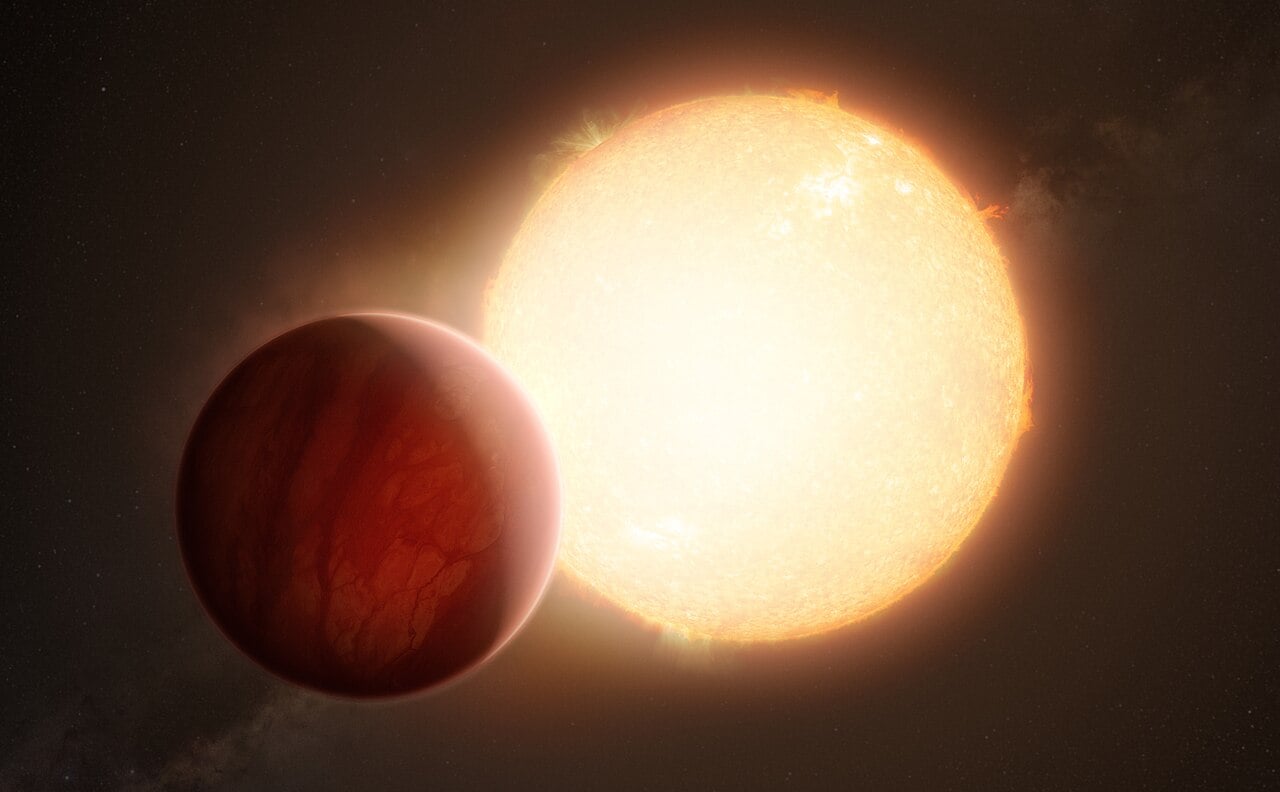
JWST Reveals Formation Secrets of Hot Jupiter System TOI-1130
The Gist
JWST data reveals that a hot Jupiter and its inner companion, TOI-1130b, likely migrated inward together from beyond the frost line.
Explain Like I'm Five
"Imagine a big bully planet (hot Jupiter) and a smaller planet (mini Neptune) that used to live far away from their star. Instead of the bully pushing the smaller planet away, they held hands and moved closer together!"
Deep Intelligence Analysis
*Transparency Disclosure: This analysis was conducted by an AI model to provide a concise summary of the provided article. The AI model has been trained to avoid generating misleading or harmful content. The analysis is intended for informational purposes only and should not be considered professional advice.*
_Context: This intelligence report was compiled by the DailyOrbitalWire Strategy Engine. Verified for Art. 50 Compliance._
Impact Assessment
This discovery challenges previous assumptions about hot Jupiter systems, suggesting that planets can migrate inward together without the smaller planet being destroyed. The chemical composition of TOI-1130b provides insights into planetary formation beyond the frost line.
Read Full Story on Universe TodayKey Details
- ● The TOI-1130 system is located 190 light years from Earth.
- ● TOI-1130c (hot Jupiter) orbits its star every eight days.
- ● TOI-1130b (mini Neptune) orbits even closer, every four days.
- ● JWST detected water vapor, carbon dioxide, sulphur dioxide, and a hint of methane in TOI-1130b's atmosphere.
Optimistic Outlook
Future JWST observations of similar systems could reveal more about the conditions that allow smaller planets to survive in close proximity to hot Jupiters. This could refine our understanding of planetary system formation and the potential for habitable worlds in unexpected locations.
Pessimistic Outlook
The specific conditions that allowed TOI-1130b to survive may be rare, limiting the generalizability of these findings. Further research is needed to determine how common such co-migration scenarios are and what factors influence their stability.

The Signal, Not
the Noise|
Get the week's top 1% of space-tech intelligence synthesized into a 5-minute read. Join 25,000+ aerospace insiders.
Unsubscribe anytime. No spam, ever.