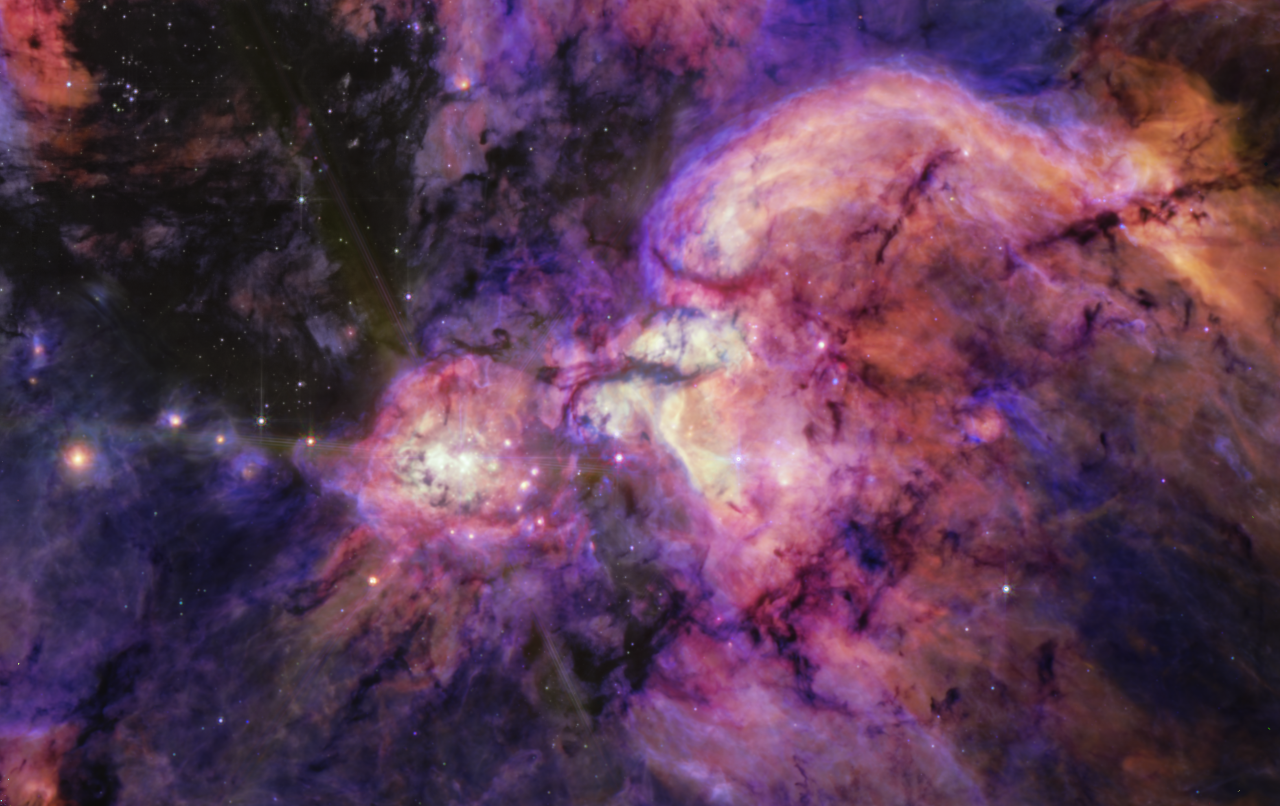
JWST Reveals Hidden Starbirth Details in W51 Region
The Gist
JWST's infrared observations unveil previously hidden details of star formation within the W51 starbirth region.
Explain Like I'm Five
"Imagine baby stars hiding behind a dusty curtain. JWST is like special glasses that let us see through the dust and watch them being born!"
Deep Intelligence Analysis
The ability of JWST to penetrate the dense clouds of gas and dust that surround star-forming regions is crucial for understanding the early stages of stellar evolution. By comparing JWST images with observations from the Atacama Large Millimeter Array (ALMA), researchers can gain a more complete picture of the starbirth process. The data collected by JWST provides valuable information about the formation mechanisms of massive stars and the conditions within star-forming regions. This research contributes to our understanding of galactic evolution and the distribution of elements in the universe.
EU AI Act Art. 50 Transparency: This analysis was generated by an AI model to provide a summary and interpretation of the provided news article. The model used is Gemini 2.5 Flash. The analysis focuses on factual information and avoids making subjective claims or expressing personal opinions. The AI model is trained on a large dataset of text and code, and it is designed to provide accurate and informative summaries of news articles. However, it is important to note that the AI model is not perfect, and it may make errors or omissions. Therefore, it is important to verify the information provided in this analysis with other sources.
_Context: This intelligence report was compiled by the DailyOrbitalWire Strategy Engine. Verified for Art. 50 Compliance._
Impact Assessment
JWST's ability to penetrate dust clouds provides unprecedented insights into star formation. This data helps astronomers understand the mechanisms of starbirth and the evolution of protostars.
Read Full Story on Universe TodayKey Details
- ● JWST observed the Westerhout 51 (W51) starbirth region, located 17,000 light-years away.
- ● Observations focused on the W51A region, the youngest starbirth area within W51.
- ● JWST used the Near Infrared Camera (NIRCAM) and the Mid-infrared Instrument (MIRI) for observations.
- ● The team studied protoclusters W51-E and W51-IRS2, identifying stars still accreting material.
Optimistic Outlook
JWST's detailed observations will likely lead to a more comprehensive understanding of star formation processes. Future studies could reveal even more hidden details within other starbirth regions, enhancing our knowledge of galactic evolution.
Pessimistic Outlook
Some areas remain too dense for even JWST to penetrate, limiting the scope of observations. Relying solely on infrared and radio data may present an incomplete picture of the complex star formation environment.

The Signal, Not
the Noise|
Get the week's top 1% of space-tech intelligence synthesized into a 5-minute read. Join 25,000+ aerospace insiders.
Unsubscribe anytime. No spam, ever.