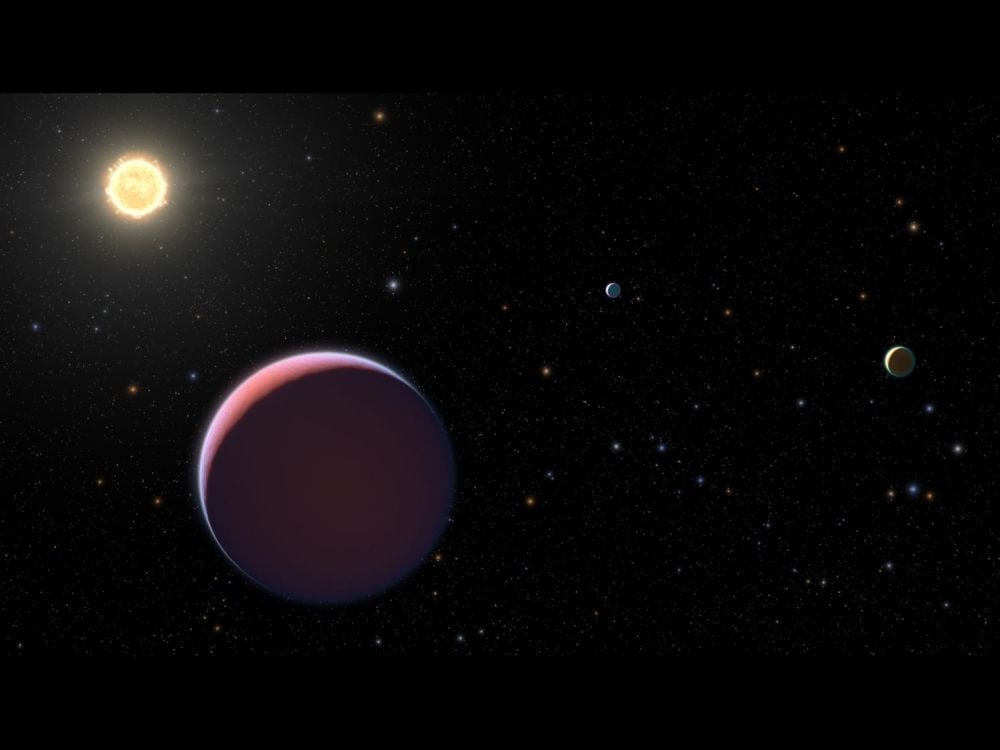
JWST Reveals Super-Puff Planet Kepler-51d Hidden Behind Thick Haze
The Gist
JWST observations of exoplanet Kepler-51d reveal a featureless transmission spectrum, indicating a thick haze obscuring its atmosphere.
Explain Like I'm Five
"A giant, fluffy planet far away is covered in so much fog that we can't see what it's made of!"
Deep Intelligence Analysis
Kepler-51d's unusual properties, including its large radius, low mass, and proximity to a young, active star, make it a valuable case study for understanding the diversity of exoplanets. The planet's location, relatively close to its star, raises questions about its atmospheric stability and the potential for mass loss due to stellar winds. The presence of a thick haze layer further complicates the picture, suggesting that the planet's atmosphere may be undergoing significant changes.
Future research efforts will likely focus on developing new techniques to penetrate the haze and characterize the underlying atmosphere. This could involve using different wavelengths of light or employing advanced data analysis methods. Ultimately, understanding the nature of Kepler-51d's atmosphere will provide crucial insights into the formation and evolution of super-puff planets and the broader context of planetary diversity.
_Context: This intelligence report was compiled by the DailyOrbitalWire Strategy Engine. Verified for Art. 50 Compliance._
Impact Assessment
The discovery of a thick haze layer on Kepler-51d provides insights into the formation and evolution of super-puff planets. It highlights the limitations of current planet formation models and the need for further research.
Read Full Story on Universe TodayKey Details
- ● Kepler-51d is a super-puff exoplanet with a radius of 9.3 Earth radii and a mass of 5.6 Earth masses.
- ● It orbits a young, active star at a distance similar to Venus's orbit around the Sun.
- ● JWST's NIRSpec instrument captured a transmission spectrum showing no strong molecular absorption signatures.
- ● The planet's low density and proximity to its star challenge current planet formation theories.
Optimistic Outlook
Future observations with JWST and other telescopes could penetrate the haze and reveal the composition of Kepler-51d's atmosphere. This could lead to a better understanding of the processes that create super-puff planets.
Pessimistic Outlook
The thick haze may permanently obscure the planet's atmosphere, making it difficult to determine its composition and origin. The planet's proximity to its active star poses a risk of atmospheric stripping.

The Signal, Not
the Noise|
Get the week's top 1% of space-tech intelligence synthesized into a 5-minute read. Join 25,000+ aerospace insiders.
Unsubscribe anytime. No spam, ever.