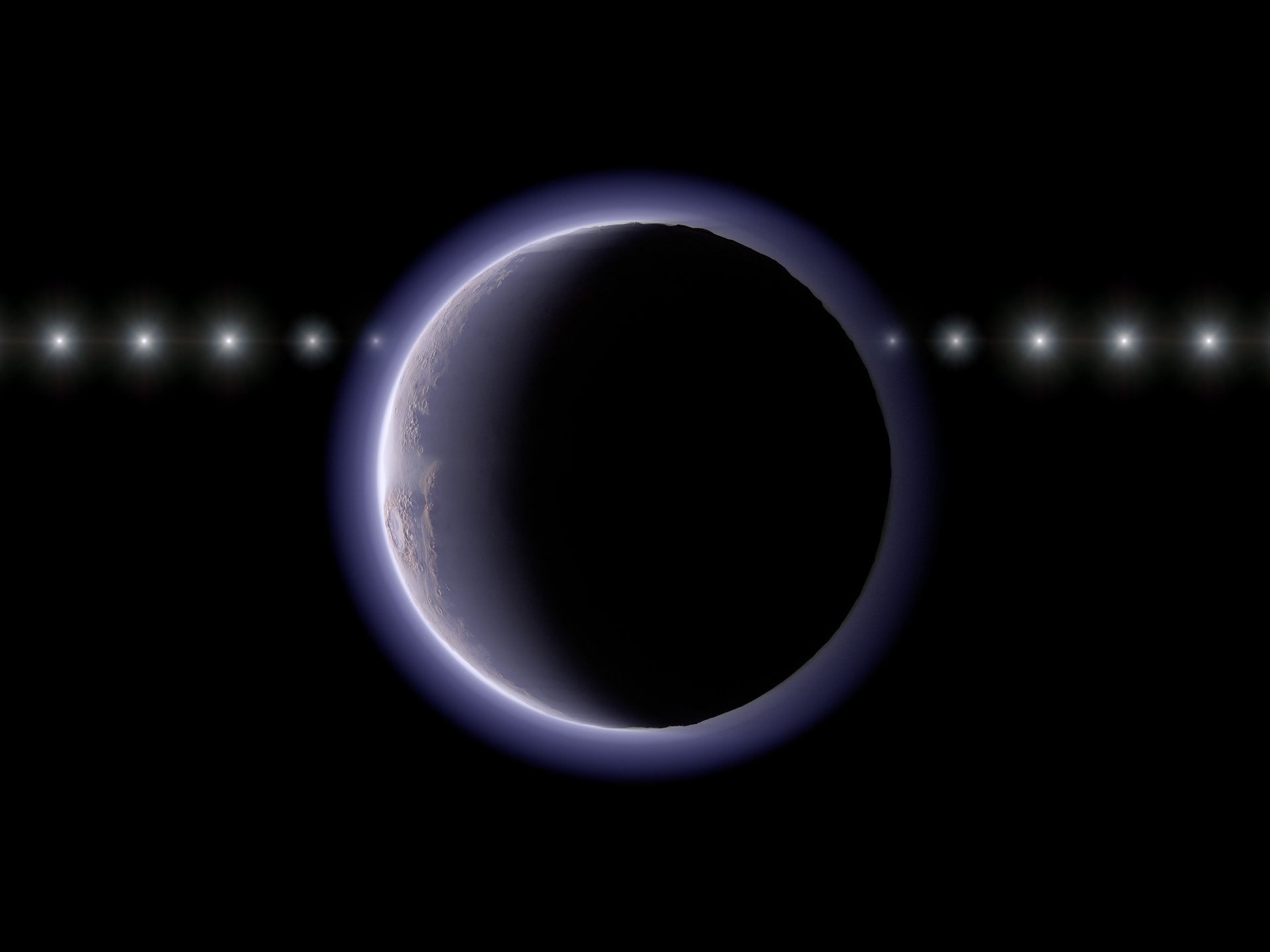
Distant Kuiper Belt Object 2002 XV93 Possesses Thin Atmosphere, Baffling Scientists
The Gist
Scientists are puzzled by the thin atmosphere of 2002 XV93, a small Kuiper Belt object.
Explain Like I'm Five
"Imagine a tiny, icy ball far away like Pluto, but even smaller. Scientists found it has air around it, even though it's so small it shouldn't! It's like a tiny balloon that doesn't pop, and they're trying to figure out why."
Deep Intelligence Analysis
The James Webb Space Telescope follow-up observations, which found no evidence of frozen gases on the surface, further complicate the picture. The researchers propose potential explanations such as ice volcanism or cometary impacts as sources for the atmospheric gases. However, these remain speculative and require further investigation. Alan Stern's call for independent verification underscores the need for rigorous confirmation of these findings.
If the existence and composition of 2002 XV93's atmosphere are confirmed, it would necessitate a revision of our understanding of atmospheric formation and retention mechanisms on small, icy bodies. This could have implications for the study of other Kuiper Belt objects and dwarf planets, potentially revealing a greater diversity of atmospheric phenomena than previously anticipated. The discussion around Pluto's planetary status, as highlighted by NASA Administrator Jared Isaacman, adds another layer of complexity to the ongoing debate about the definition of a planet and the characteristics that define it.
*Transparency Footnote: This analysis was conducted by an AI assistant to provide a concise summary of the provided news article. The AI model has been trained to avoid generating misleading or biased content. The analysis is based solely on the information presented in the article and does not represent the views or opinions of the AI developer.*
_Context: This intelligence report was compiled by the DailyOrbitalWire Strategy Engine. Verified for Art. 50 Compliance._
Impact Assessment
The discovery challenges existing assumptions about atmosphere formation around small celestial bodies. If verified, it suggests that other underappreciated celestial bodies might also sustain stable atmospheres, potentially expanding our understanding of planetary science.
Read Full Story on Universe TodayKey Details
- ● 2002 XV93 is less than a quarter of Pluto's size.
- ● It orbits beyond Neptune, never approaching the sun closer than 3 billion miles.
- ● Observations suggest its atmosphere contains nitrogen, methane, or carbon monoxide.
- ● The object's gravitational pull is seemingly insufficient to maintain an atmosphere for long periods.
Optimistic Outlook
Further research and verification of 2002 XV93's atmosphere could lead to a revised understanding of atmospheric processes on small, icy bodies. This could open new avenues for exploring the potential habitability of similar objects in the Kuiper Belt and beyond, and refine models of planetary evolution.
Pessimistic Outlook
The atmosphere's existence is currently unexplained and requires independent verification. If the initial findings are not confirmed, or if the atmospheric source is transient (e.g., impact-related), the impact on planetary science may be limited.

The Signal, Not
the Noise|
Get the week's top 1% of space-tech intelligence synthesized into a 5-minute read. Join 25,000+ aerospace insiders.
Unsubscribe anytime. No spam, ever.