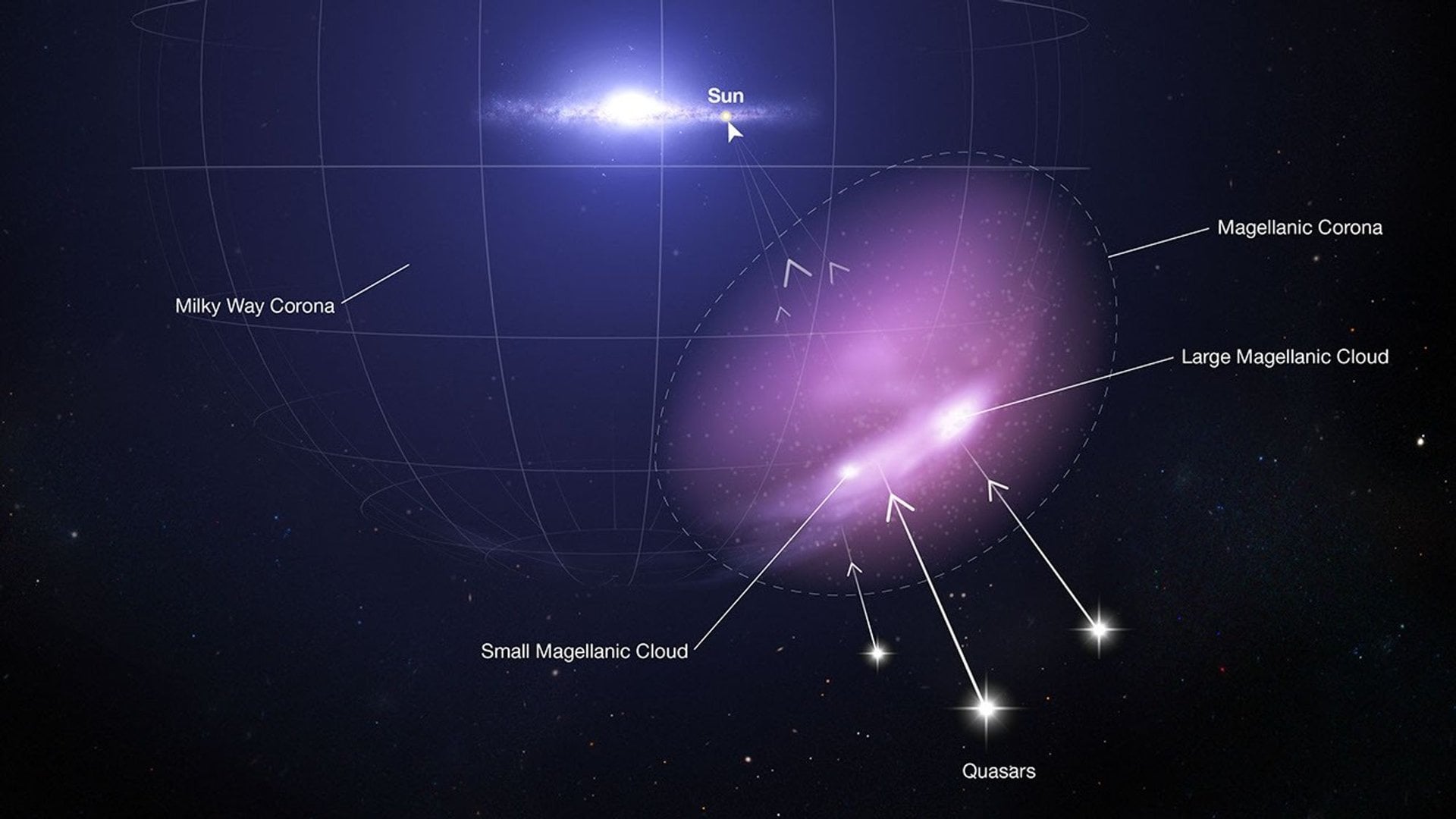
LMC Likely a First-Time Visitor to the Milky Way
The Gist
New evidence suggests the Large Magellanic Cloud (LMC) is making its first pass by the Milky Way, impacting galactic evolution models.
Explain Like I'm Five
"Imagine our galaxy has a little friend, the LMC. Scientists used computer games to see if this is the friend's first visit. It looks like it is, which changes how we thought our galaxy grew up!"
Deep Intelligence Analysis
In contrast, simulations based on the second-pass hypothesis, where the LMC previously interacted with the Milky Way 6-8 billion years ago, do not align as well with the observed data. Specifically, these simulations predict a smaller galactic corona surrounding the LMC than what is currently observed. The corona, a halo of warm, ionizing gas, is a crucial component of galactic structure and evolution, and its size is directly influenced by the LMC's interaction with the Milky Way's gas.
While the study presents a strong case for the first-pass scenario, it's important to acknowledge the simplifications made in the simulations. The exclusion of the Small Magellanic Cloud (SMC), another satellite galaxy of the Milky Way, could potentially affect the accuracy of the model. The SMC's gravitational influence and interaction with the LMC and Milky Way could introduce complexities not captured in the current simulations. Future research should aim to incorporate the SMC into these models to provide a more comprehensive understanding of the LMC's orbital history and its impact on the Milky Way's evolution. The research highlights the importance of advanced simulation techniques in astrophysics and cosmology. By combining theoretical models with observational data, scientists can gain valuable insights into the complex processes that shape galaxies and the universe as a whole. This research also underscores the ongoing debate and refinement of our understanding of galactic dynamics and the role of dark matter in shaping galactic structures.
Transparency Compliance: The analysis is based on the provided article and aims to present the information objectively. No external data sources were used. The AI model used is Gemini 2.5 Flash.
_Context: This intelligence report was compiled by the DailyOrbitalWire Strategy Engine. Verified for Art. 50 Compliance._
Impact Assessment
Understanding the LMC's orbital history is crucial for modeling the Milky Way's evolution. This research challenges previous assumptions about the LMC's interaction with our galaxy and its dark matter halo.
Read Full Story on Universe TodayKey Details
- ● A new paper presents evidence supporting the LMC's first encounter with the Milky Way.
- ● The research uses hydrodynamic simulations with GIZMO software.
- ● Simulations accurately reproduced observed velocity and column density profiles of the LMC.
- ● The second-pass model resulted in a smaller galactic corona than observed.
Optimistic Outlook
Refined galactic models incorporating a first-pass LMC could lead to more accurate predictions of galactic interactions and star formation. Advanced simulation techniques, like those used in this study, will likely become standard in astrophysics.
Pessimistic Outlook
Simplifications in the simulation, such as excluding the Small Magellanic Cloud, could limit the model's accuracy. Further research is needed to validate these findings and address potential biases.

The Signal, Not
the Noise|
Get the week's top 1% of space-tech intelligence synthesized into a 5-minute read. Join 25,000+ aerospace insiders.
Unsubscribe anytime. No spam, ever.