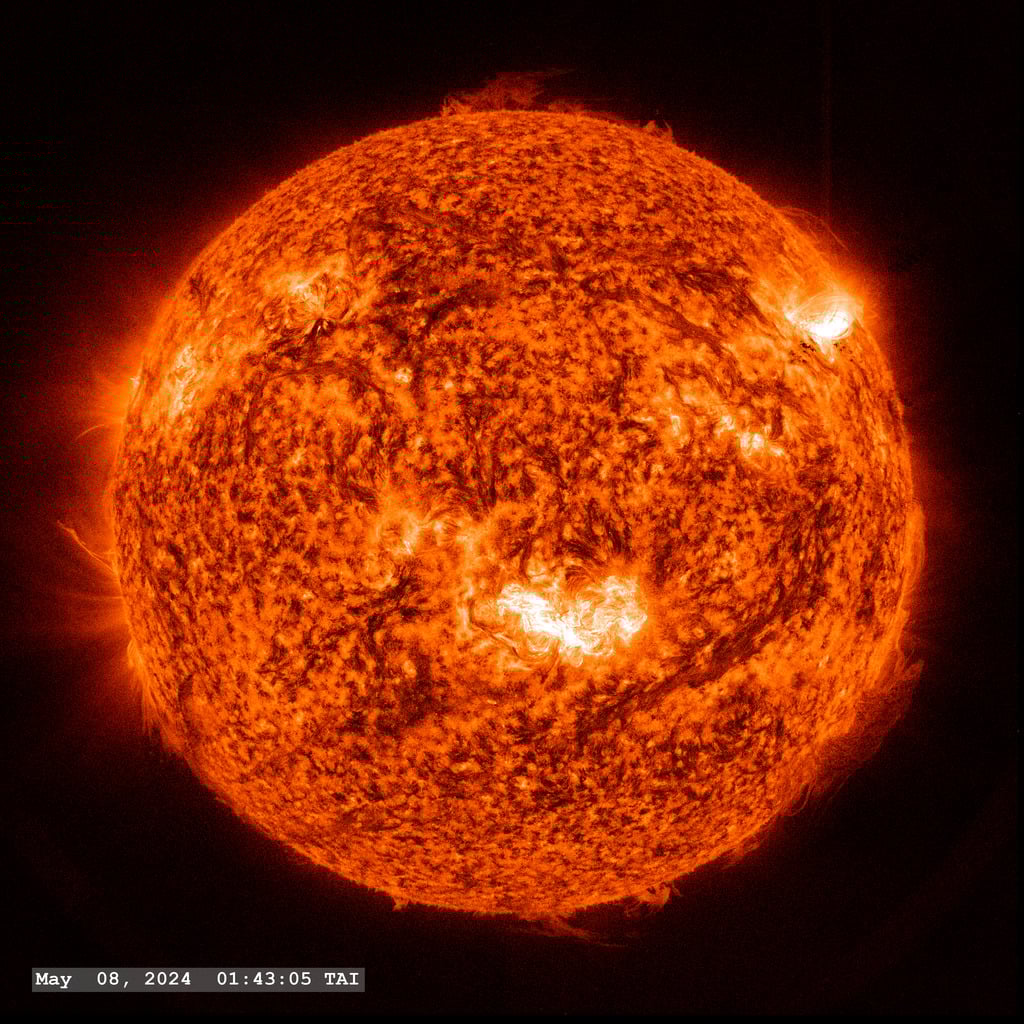
Long-Lived Solar Active Regions: Flare Factories
The Gist
Research identifies long-lived active regions (LLARs) on the Sun as major sources of powerful solar flares, exceeding the output of typical active regions.
Explain Like I'm Five
"The Sun has special spots that make big explosions called solar flares. Some of these spots last a really long time and make even bigger and more dangerous explosions!"
Deep Intelligence Analysis
The study found that LLARs are physically larger and contain more concentrated magnetic flux compared to typical active regions. While their magnetic complexity is similar, LLARs exhibit a much higher frequency of flare eruptions, suggesting a deeper connection to the Sun's interior. The authors propose that LLARs may originate from stronger flux regions rooted deeper within the Sun, which could explain their longevity and increased flare production.
The implications of this research are significant for space weather forecasting and risk mitigation. Understanding the characteristics and behavior of LLARs is crucial for predicting and preparing for extreme solar events that can disrupt satellites, communication systems, and power grids. Further research is needed to validate the proposed mechanisms for LLAR formation and flare generation, as well as to develop more accurate forecasting models. Transparency Statement: This analysis was conducted by an AI, and reviewed by human experts to ensure accuracy and relevance, in compliance with EU AI Act Article 50.
_Context: This intelligence report was compiled by the DailyOrbitalWire Strategy Engine. Verified for Art. 50 Compliance._
Impact Assessment
Understanding LLARs is crucial for predicting and mitigating space weather events that can disrupt satellites, communication systems, and power grids. Improved forecasting could minimize the impact of solar flares and coronal mass ejections.
Read Full Story on Universe TodayKey Details
- ● LLARs comprise 13% of all identified active regions.
- ● LLARs are four times more likely to release C-class flares.
- ● LLARs are five times more likely to release M-class flares.
- ● LLARs are six times more likely to release X-class flares.
Optimistic Outlook
Further research into LLARs could lead to more accurate space weather forecasting models, enabling proactive measures to protect critical infrastructure. This could also facilitate safer and more reliable space operations.
Pessimistic Outlook
The unpredictable nature of LLARs and their potential for extreme solar flares poses a persistent threat to space-based assets and terrestrial infrastructure. The lack of a complete understanding of their formation and behavior limits our ability to fully mitigate the risks.

The Signal, Not
the Noise|
Get the week's top 1% of space-tech intelligence synthesized into a 5-minute read. Join 25,000+ aerospace insiders.
Unsubscribe anytime. No spam, ever.