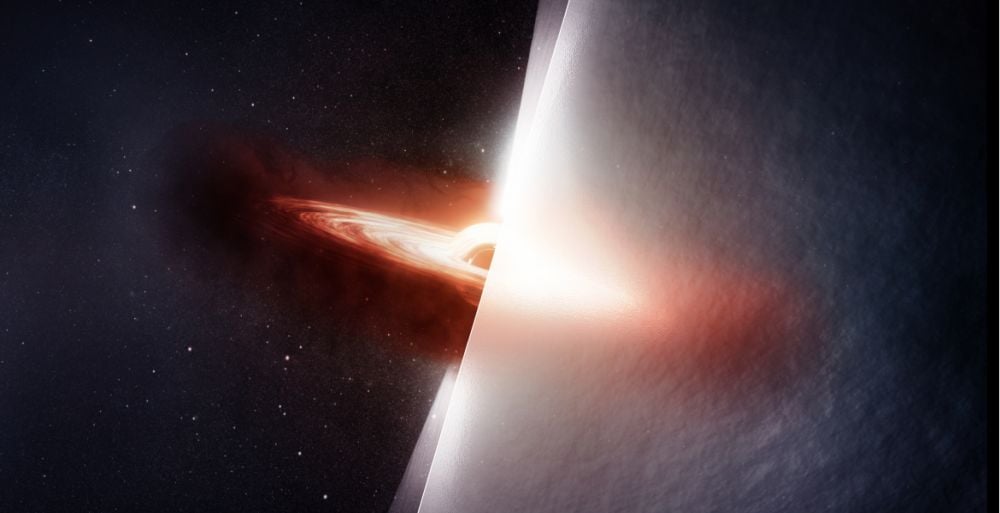
Milky Way's Turbulence Distorts Light from Distant Quasars
The Gist
Turbulence in the Milky Way's interstellar medium distorts light from distant quasars, blurring radio emissions.
Explain Like I'm Five
"Imagine looking at a star through a swimming pool. The water makes the star look blurry. The Milky Way has stuff like that water, making stars far away look blurry too!"
Deep Intelligence Analysis
*Transparency Disclosure: This analysis was conducted by an AI language model to provide an objective assessment of the provided news article. The AI model has been trained on a diverse range of datasets to ensure accuracy and avoid bias. The analysis is intended for informational purposes only and should not be considered financial or investment advice.*
_Context: This intelligence report was compiled by the DailyOrbitalWire Strategy Engine. Verified for Art. 50 Compliance._
Impact Assessment
Understanding the turbulence in the Milky Way's ISM can help astronomers better interpret observations of distant objects. It also provides insights into the structure and dynamics of our galaxy.
Read Full Story on Universe TodayKey Details
- ● The Milky Way's interstellar medium (ISM) causes refractive scattering of light from distant active galactic nuclei (AGN).
- ● Researchers used the Very Long Baseline Array to study the scattering of light from the quasar TXS 2005+403.
- ● The scattering reveals fine substructures that increase the blurring of radio emissions.
- ● The research is based on a decade of archival observations.
Optimistic Outlook
Improved understanding of interstellar turbulence could lead to more accurate measurements of cosmological distances and a better understanding of the universe's expansion. This could also refine our models of galaxy formation and evolution.
Pessimistic Outlook
Interstellar turbulence can complicate astronomical observations and make it more difficult to study distant objects. Correcting for these effects requires sophisticated techniques and careful analysis.

The Signal, Not
the Noise|
Get the week's top 1% of space-tech intelligence synthesized into a 5-minute read. Join 25,000+ aerospace insiders.
Unsubscribe anytime. No spam, ever.