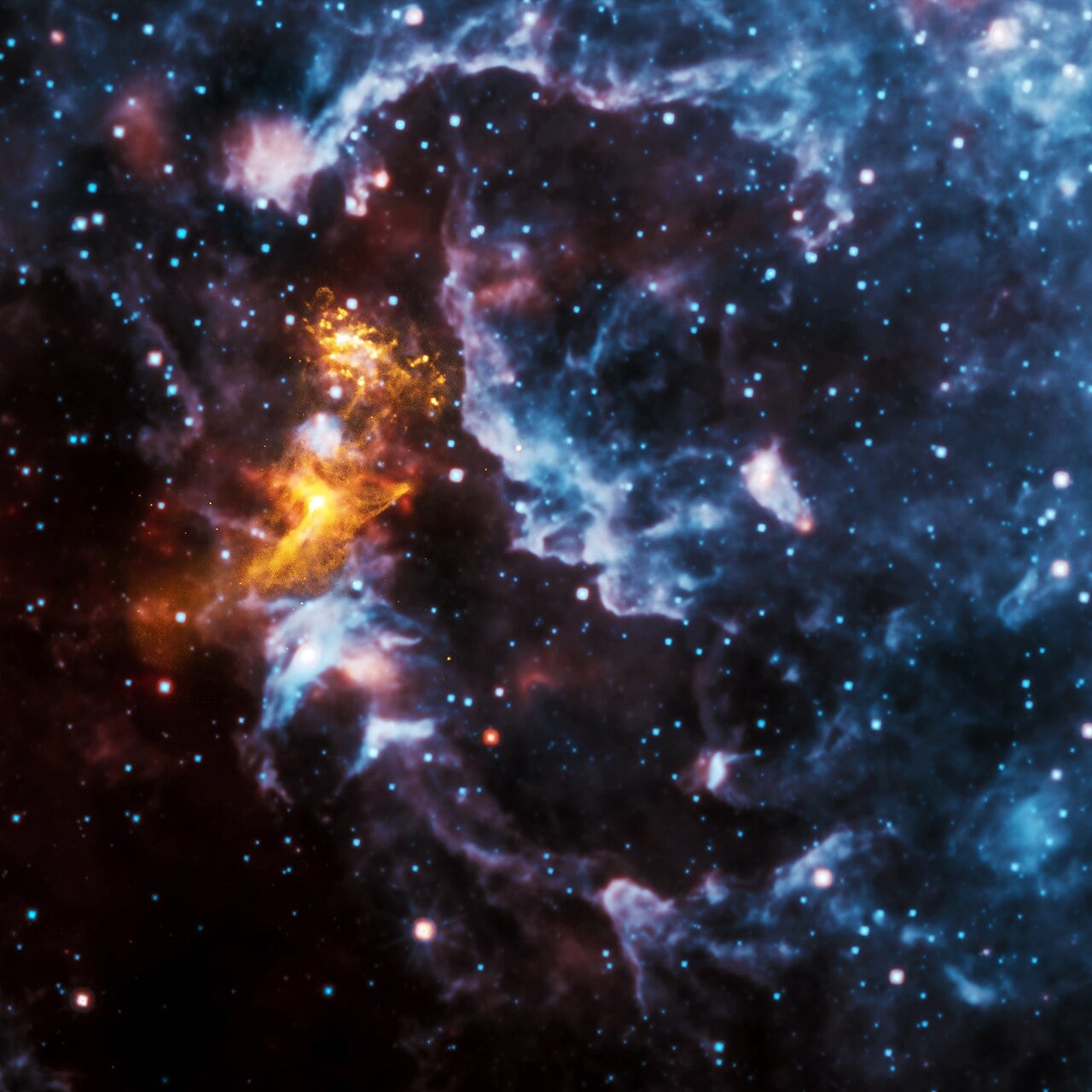
Millisecond Pulsars Emit Radio Waves from Unexpected Outer Regions
The Gist
Millisecond pulsars emit radio signals from their outer magnetic reaches, challenging previous assumptions about their origin near the surface.
Explain Like I'm Five
"Imagine a super-fast spinning star that sends out radio waves like a lighthouse. We used to think the waves came from close to the star, but now we know they also come from way, way out far away from the star!"
Deep Intelligence Analysis
This finding has profound implications for various fields, including gravitational wave detection, the study of dense matter, and deep-space navigation. Accurate interpretation of pulsar signals is crucial for these applications, and the revised understanding of their origin necessitates a reevaluation of existing models. The discovery also raises questions about the formation of stable radio signals in the energetic and chaotic outer region of pulsars, warranting further investigation.
Moreover, the finding hints that nearly all millisecond pulsars that produce gamma-rays may also emit radio waves, even faintly, suggesting that more of them could be detectable than previously assumed. This could lead to a significant increase in the number of known pulsars, providing valuable data for various scientific endeavors. The use of orbiting observatories like NASA's Fermi telescope and ESA's Solar Orbiter are crucial in unraveling these complex processes and gaining a deeper understanding of the universe.
*Transparency Disclosure: This analysis was conducted by an AI model and reviewed by human experts to ensure accuracy and relevance, in compliance with EU AI Act Article 50 requirements.*
_Context: This intelligence report was compiled by the DailyOrbitalWire Strategy Engine. Verified for Art. 50 Compliance._
Impact Assessment
Understanding the true origin of pulsar signals is crucial for accurately interpreting measurements used in studying gravity, dense matter, and gravitational waves. This discovery may lead to the detection of more pulsars than previously assumed.
Read Full Story on Universe TodayKey Details
- ● Radio signals from millisecond pulsars originate from two separate regions.
- ● These outer pulses align with gamma-ray flashes detected by NASA's Fermi telescope.
- ● The outer radio emissions originate from the current sheet, a region beyond the pulsar's magnetic field boundary.
- ● The study analyzed radio observations of nearly 200 millisecond pulsars.
Optimistic Outlook
The revised understanding of pulsar emissions could refine the precision of pulsar-based technologies, such as using them as gravitational wave detectors. More accurate pulsar models could also improve deep-space navigation systems relying on pulsar timing.
Pessimistic Outlook
The complexity of radio signal formation in the chaotic outer region of pulsars poses challenges for accurate data interpretation. Existing models may need significant revisions, potentially delaying advancements in related fields.

The Signal, Not
the Noise|
Get the week's top 1% of space-tech intelligence synthesized into a 5-minute read. Join 25,000+ aerospace insiders.
Unsubscribe anytime. No spam, ever.