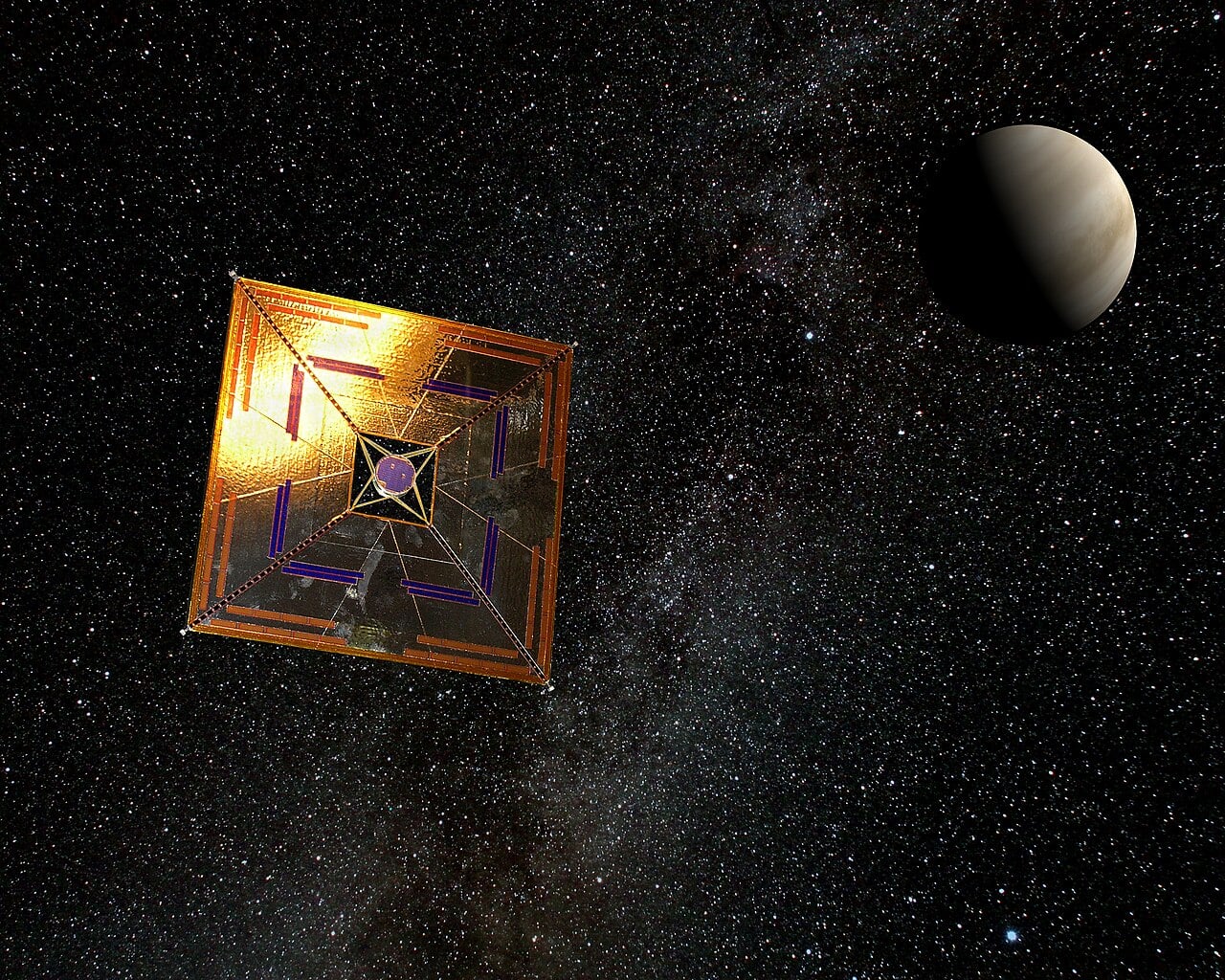
Nanoengineered Light Sail Achieves High Reflectivity, Low Weight
The Gist
Researchers create a multi-dielectric Photonic Crystal Light Sail (PCLS) with 90% reflectivity at 1.177 μm and a weight of 7.2 grams per square meter.
Explain Like I'm Five
"Imagine a super light mirror that uses sunlight or a laser to push it through space. This new mirror is made of tiny building blocks and is so light that it can travel really fast!"
Deep Intelligence Analysis
_Context: This intelligence report was compiled by the DailyOrbitalWire Strategy Engine. Verified for Art. 50 Compliance._
Impact Assessment
This new light sail design addresses the heat and weight limitations of traditional solar sails, potentially enabling faster and more efficient interplanetary travel. The use of nanoscale structures opens new possibilities for advanced propulsion systems.
Read Full Story on Universe TodayKey Details
- ● The PCLS achieves 90% reflectivity at a 1.177 micrometer wavelength.
- ● One square meter of the PCLS material weighs approximately 7.2 grams.
- ● Simulations show a 1 square meter sail pushed by a 100 kW laser could accelerate up to 300 m/s in one hour.
Optimistic Outlook
The high reflectivity and low weight of the PCLS could significantly improve the performance of solar sails, making them a viable option for interplanetary missions. Further development could lead to even more efficient designs and the realization of interstellar travel.
Pessimistic Outlook
The technology is still in its early stages, and scaling up production of the PCLS material may present significant challenges. The reliance on high-powered lasers for propulsion could also limit its practical applications.

The Signal, Not
the Noise|
Get the week's top 1% of space-tech intelligence synthesized into a 5-minute read. Join 25,000+ aerospace insiders.
Unsubscribe anytime. No spam, ever.