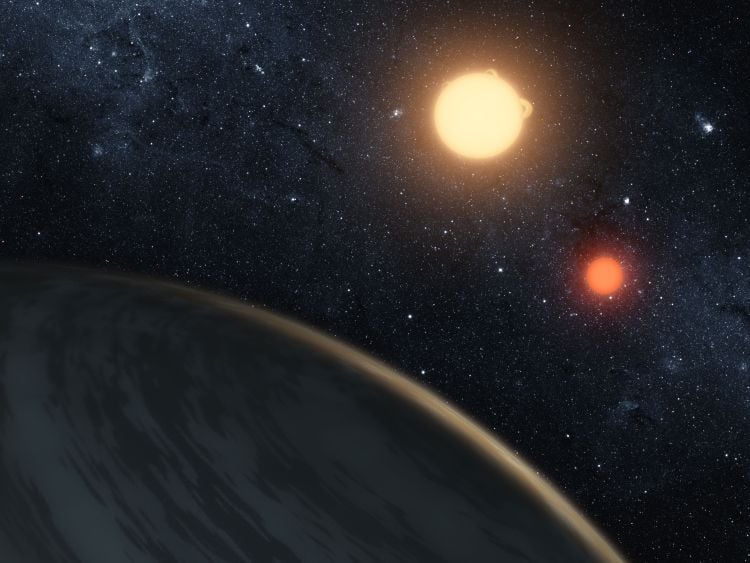
Saturn-Mass Exoplanet Discovered Orbiting Binary Star System
The Gist
Researchers discovered a Saturn-sized exoplanet orbiting two M-dwarf stars using gravitational microlensing.
Explain Like I'm Five
"Imagine two small stars like our sun, and a planet the size of Saturn going around both of them very far away. Scientists used a special trick with gravity to see it, even though it's super far!"
Deep Intelligence Analysis
The study highlights the capability of microlensing to reveal planets in dynamically complex stellar environments, including systems inaccessible to conventional detection techniques. The discovery expands the census of planets in multiple-star systems and contributes to a more comprehensive understanding of planet formation in such environments. Although models varied on the exoplanet's exact mass and orbital distance, they consistently estimated the masses of the two M-dwarf stars.
Despite its effectiveness in certain scenarios, microlensing has only confirmed a small fraction of known exoplanets. This discovery adds to the growing body of knowledge about exoplanets in binary systems, providing valuable insights into the diversity of planetary systems and the conditions under which planets can form and persist. The discovery of KMT-2016BLG-1337L is a significant step in the ongoing exploration of exoplanets and the search for habitable worlds beyond our solar system.
Transparency: This analysis was conducted by an AI, model Gemini 2.5 Flash, based solely on the provided source content. The AI's objective was to provide a factual summary and analysis without external influence.
_Context: This intelligence report was compiled by the DailyOrbitalWire Strategy Engine. Verified for Art. 50 Compliance._
Impact Assessment
This discovery highlights the capability of microlensing to detect planets in complex stellar environments inaccessible to conventional methods. It expands our understanding of planet formation in multiple-star systems and the diversity of planetary systems.
Read Full Story on Universe TodayKey Details
- ● The exoplanet, designated KMT-2016BLG-1337L, is located approximately 22,800 light-years from Earth.
- ● The binary star system consists of two M-dwarf stars with masses estimated at 0.54 and 0.40 solar masses, separated by 3.5 AU.
- ● Microlensing, the discovery method, has confirmed just over 250 exoplanets out of 6,100+ confirmed exoplanets.
Optimistic Outlook
Microlensing offers a unique tool for discovering exoplanets in dynamically complex systems. Further refinement of microlensing techniques could reveal more exoplanets, including those in binary systems, enhancing our understanding of planetary formation under diverse conditions.
Pessimistic Outlook
The disagreement in mass and orbital distance estimations from different models highlights the challenges in characterizing exoplanets using microlensing. The limited number of exoplanets discovered via microlensing compared to other methods suggests it may remain a niche technique.

The Signal, Not
the Noise|
Get the week's top 1% of space-tech intelligence synthesized into a 5-minute read. Join 25,000+ aerospace insiders.
Unsubscribe anytime. No spam, ever.