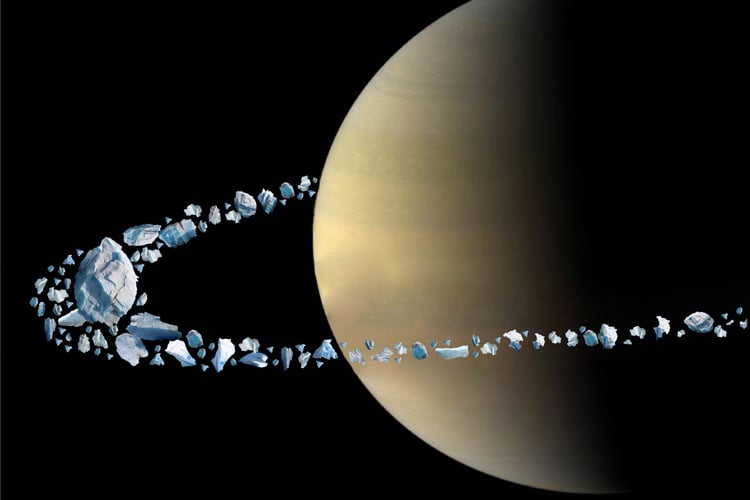
Saturn's Rings Likely Formed From Dismantled Moon 'Chrysalis'
The Gist
Saturn's rings may have originated from the destruction of an ancient moon, 'Chrysalis', approximately 100 million years ago.
Explain Like I'm Five
"Imagine Saturn had a moon that got too close and broke apart, like a cookie crumbling. Those cookie crumbs became Saturn's beautiful rings!"
Deep Intelligence Analysis
The simulations suggest that Chrysalis ventured too close to Saturn, resulting in its gravitational disruption. While some fragments escaped Saturn's gravity, the remaining material formed the planet's extensive ring system. The researchers suggest that the rings may have initially been larger, with gravitational interactions with moons like Titan reducing their size over time.
Despite these findings, several questions remain, including the fate of the largest fragment of Chrysalis and its impact on ring development. Future research aims to explore the influence of these fragments on impact craters on Saturn's moons. This study builds upon previous research, including a 2022 study in Science, which also suggested an ancient moon as the origin of Saturn's rings. Further investigation into Saturn's rings could provide insights into the planet's history and the dynamics of celestial bodies within the Roche limit.
Transparency Compliance: The analysis is based on the provided source content and aims to provide an objective summary of the findings. No external data sources were used. The AI model used is Gemini 2.5 Flash.
_Context: This intelligence report was compiled by the DailyOrbitalWire Strategy Engine. Verified for Art. 50 Compliance._
Impact Assessment
Understanding the formation of Saturn's rings provides insights into the planet's history and the dynamics of celestial bodies within its Roche limit. The study suggests that gravitational interactions with Saturn and its moons shaped the rings into their current form.
Read Full Story on Universe TodayKey Details
- ● Researchers estimate Saturn's rings formed approximately 100 million years ago.
- ● The 'Chrysalis' moon was estimated to be about the size of Saturn's moon Iapetus (1,469 km diameter).
- ● Chrysalis's composition was modeled as a mixture of water ice and rock.
- ● Chrysalis orbited as close as 1 to 1.5 Saturn radii, near the Roche limit.
Optimistic Outlook
Further research into the remnants of Chrysalis could reveal more about the early solar system and the processes that shape planetary rings. Future studies could clarify the composition and distribution of material within Saturn's rings.
Pessimistic Outlook
Unanswered questions remain regarding the largest piece of Chrysalis and its influence on the rings' growth, indicating the complexity of modeling such events. The exact mechanisms of ring formation and evolution are still not fully understood.

The Signal, Not
the Noise|
Get the week's top 1% of space-tech intelligence synthesized into a 5-minute read. Join 25,000+ aerospace insiders.
Unsubscribe anytime. No spam, ever.