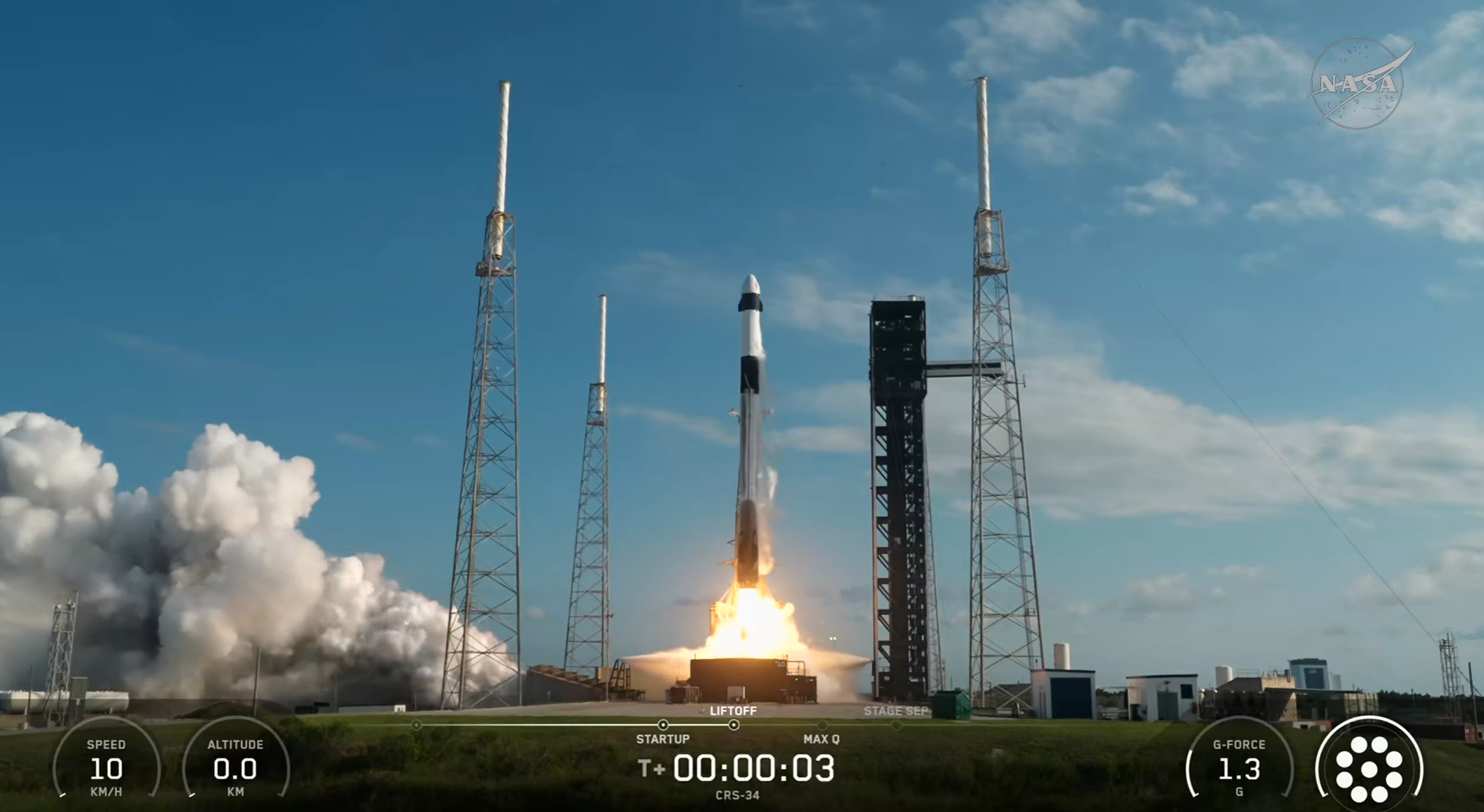
SpaceX CRS-34 Delivers Science and Cargo to ISS
The Gist
SpaceX's 34th resupply mission successfully launched, delivering critical experiments and cargo to the International Space Station.
Explain Like I'm Five
"Imagine sending a big box of toys and science experiments to astronauts living in a house in space! SpaceX uses a rocket and a special spaceship called Dragon to deliver these important things to the International Space Station."
Deep Intelligence Analysis
Of particular interest are the experiments focused on mitigating the challenges of long-duration spaceflight. The investigation into Earth-based microgravity simulators aims to improve the fidelity of ground-based research, while the bone scaffold project seeks to develop novel treatments for bone fragility, a common issue for astronauts in space. Furthermore, the study of red blood cell changes in space could provide insights into the physiological effects of prolonged exposure to microgravity, informing countermeasures to protect astronaut health during future missions to the Moon and Mars.
Beyond its scientific contributions, the CRS-34 mission underscores the importance of commercial partnerships in space exploration. SpaceX's Falcon 9 launch vehicle and Dragon spacecraft have become reliable workhorses for NASA, providing a cost-effective and efficient means of resupplying the ISS. This partnership not only supports ongoing research but also frees up NASA resources to focus on more ambitious endeavors, such as the Artemis program and the development of next-generation space technologies. The Dragon spacecraft is scheduled to remain at the station until mid-June, when it will depart and return to Earth with time-sensitive research and cargo, ahead of splashing down off the coast of California.
*Transparency Disclosure: This analysis was composed by an AI model. While efforts have been made to ensure accuracy, the content should be critically evaluated and cross-referenced with verified sources. The AI is trained on a broad dataset and may produce outputs that are not always error-free. This content is intended for informational purposes only and does not constitute professional advice.*
_Context: This intelligence report was compiled by the DailyOrbitalWire Strategy Engine. Verified for Art. 50 Compliance._
Impact Assessment
This mission ensures the continued operation of the ISS and the advancement of scientific knowledge in space. The experiments conducted on the ISS contribute to understanding the challenges of long-duration spaceflight and developing new technologies for future missions.
Read Full Story on NASA Space StationKey Details
- ● SpaceX CRS-34 launched on a Falcon 9 from Cape Canaveral.
- ● The Dragon spacecraft carried nearly 6,500 pounds of cargo.
- ● Docking is scheduled for May 17 at approximately 7 a.m. EDT.
- ● Experiments include studies on microgravity simulation, bone scaffolds, and red blood cell changes.
Optimistic Outlook
Successful resupply missions like CRS-34 demonstrate the reliability of commercial partnerships in supporting space exploration. The new experiments could lead to breakthroughs in understanding human health in space and developing advanced materials for space structures, potentially accelerating progress towards lunar and Martian missions.
Pessimistic Outlook
Delays or failures in resupply missions could jeopardize the ongoing research and operations on the ISS. Dependence on a single launch provider also introduces risk, as any issues with the Falcon 9 could impact the station's supply chain and research timeline.

The Signal, Not
the Noise|
Get the week's top 1% of space-tech intelligence synthesized into a 5-minute read. Join 25,000+ aerospace insiders.
Unsubscribe anytime. No spam, ever.