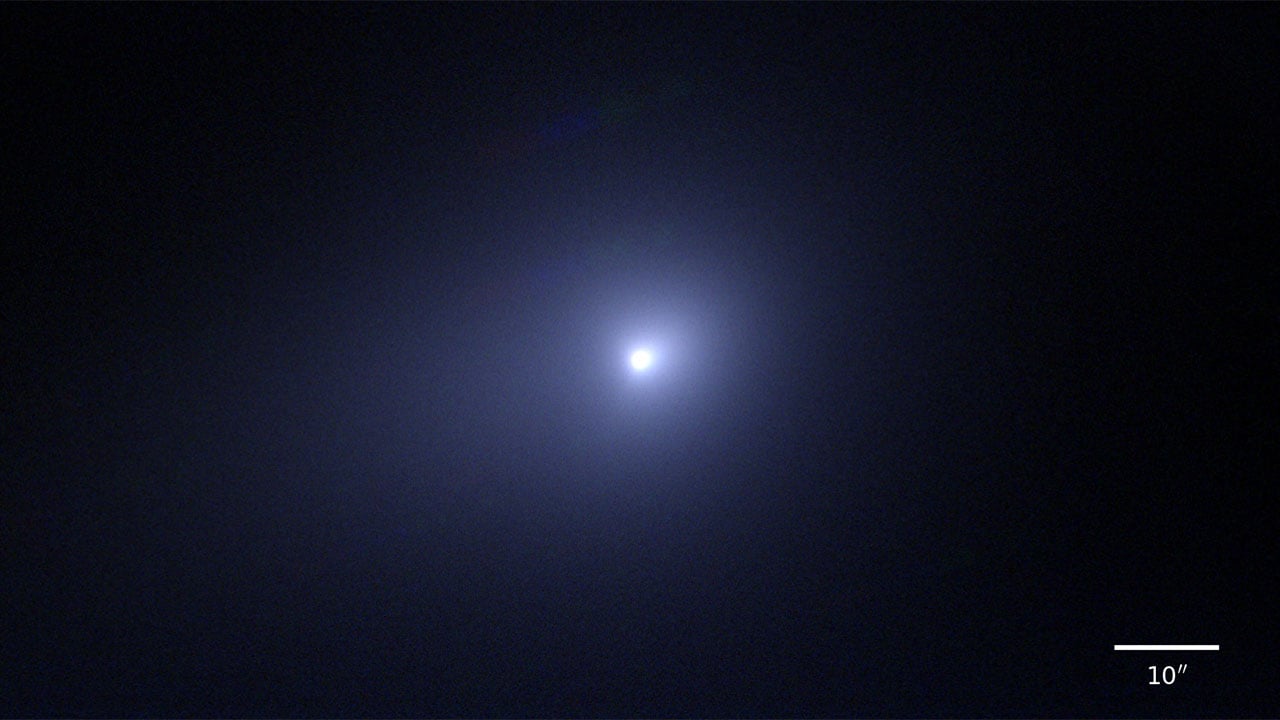
Subaru Telescope Unlocks Comet 3I/ATLAS Interior Secrets
The Gist
The Subaru Telescope's observations of interstellar comet 3I/ATLAS reveal a lower carbon dioxide to water ratio than previously estimated, offering insights into its internal composition.
Explain Like I'm Five
"Imagine space rocks from other star systems visiting our solar system! Scientists used a giant telescope to see what these rocks are made of. They found that one rock, called 3I/ATLAS, has less of a fizzy gas (carbon dioxide) compared to water than we thought. This helps us learn about how planets are made in other places!"
Deep Intelligence Analysis
Comet 3I/ATLAS, detected on June 1st, 2025, by the Asteroid Terrestrial-impact Last Alert System (ATLAS), has been closely monitored due to its larger size and brightness compared to previous interstellar objects like 1I/'Oumuamua and 2I/Borisov. The team applied analytical methods developed from decades of observing comets within our solar system to estimate the CO2-to-water ratio in the coma of 3I/ATLAS. This approach allowed them to gain insights into the nucleus's structure and composition.
The study emphasizes the role of asteroids and comets as remnants from planetary system formation. By examining their interior compositions, scientists can infer the conditions present during the formation of these systems. The expected increase in interstellar object discoveries with the advent of new survey telescopes will further enhance our ability to compare comets from different stellar systems. This comparative analysis will contribute to a deeper understanding of planetesimal and planet formation in diverse environments.
*Transparency Disclosure: This analysis was conducted by an AI, providing an objective interpretation of the source material. No external data sources were consulted, ensuring that the information presented is solely derived from the provided text.*
_Context: This intelligence report was compiled by the DailyOrbitalWire Strategy Engine. Verified for Art. 50 Compliance._
Impact Assessment
Understanding the composition of interstellar objects like 3I/ATLAS provides valuable data about planetary system formation outside our solar system. The analytical methods developed in this study will enhance future observations of interstellar objects, allowing for comparative analysis of comets from different stellar systems.
Read Full Story on Universe TodayKey Details
- ● Observations occurred on January 7th, 2026.
- ● 3I/ATLAS is the third interstellar object detected in our Solar System.
- ● The CO2-to-water ratio was lower than previous space telescope observations.
- ● 3I/ATLAS was detected on June 1st, 2025.
Optimistic Outlook
Future survey telescopes are expected to discover more interstellar objects, enabling deeper comparative studies of cometary composition and evolution. This will lead to a more comprehensive understanding of planetesimal and planet formation across various stellar systems.
Pessimistic Outlook
The observed differences in CO2-to-water ratios raise questions about the accuracy of previous space telescope observations and the potential for misinterpretations of cometary composition. Further research is needed to validate these findings and refine our understanding of interstellar object analysis.

The Signal, Not
the Noise|
Get the week's top 1% of space-tech intelligence synthesized into a 5-minute read. Join 25,000+ aerospace insiders.
Unsubscribe anytime. No spam, ever.