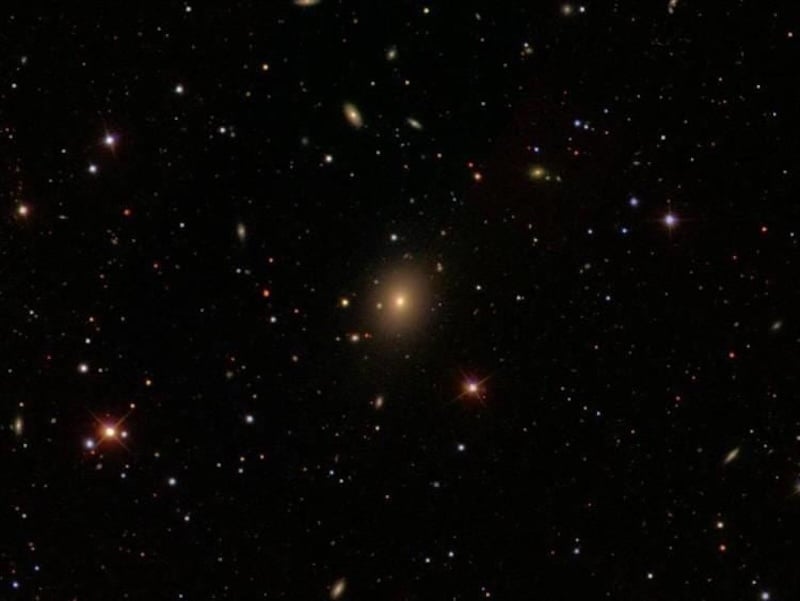
Supermassive Black Holes on Collision Course
The Gist
A close pair of supermassive black holes in Markarian 501 are predicted to merge within 100 years.
Explain Like I'm Five
"Imagine two giant marbles, each bigger than the sun, swirling around each other in space. They're going to crash soon, making a huge splash!"
Deep Intelligence Analysis
_Context: This intelligence report was compiled by the DailyOrbitalWire Strategy Engine. Verified for Art. 50 Compliance._
Impact Assessment
This is the first confirmed detection of a close pair of supermassive black holes in the final stages of merging. The merger will release enormous amounts of energy, potentially observable across the universe.
Read Full Story on Universe TodayKey Details
- ● The black holes are in the galaxy Markarian 501, 450 million light years away.
- ● They orbit each other every 121 days.
- ● The separation is 250-540 times the Earth-Sun distance.
- ● Each black hole contains hundreds of millions of solar masses.
Optimistic Outlook
Studying the merger could provide insights into black hole growth and galaxy evolution. Gravitational waves from the event could be detectable by future observatories.
Pessimistic Outlook
Predicting the precise timing and characteristics of the merger remains challenging. The event could disrupt the host galaxy and have unforeseen consequences.

The Signal, Not
the Noise|
Get the week's top 1% of space-tech intelligence synthesized into a 5-minute read. Join 25,000+ aerospace insiders.
Unsubscribe anytime. No spam, ever.